
Trump Tariffs and the Reshoring Revolution: Strategic Opportunities in U.S. Automotive Manufacturing


 Aime Summary
The U.S. automotive industry is undergoing a seismic shift driven by Trump's aggressive tariff policies, which have catalyzed a reshoring revolution. From 2020 to 2025, the imposition of 25% tariffs on imported automobiles and parts-coupled with retaliatory measures and trade renegotiations-has forced automakers to rethink global supply chains, prioritize domestic production, and unlock new investment opportunities. For industrial investors, this represents a pivotal moment to capitalize on structural changes in manufacturing, supply chain resilience, and policy-driven incentives.
The Tariff-Driven Reshoring Surge
The Trump administration's 2025 tariff hike on automobiles and parts has been a double-edged sword. While it increased costs for automakers and consumers-estimates suggest a $800–$1,200 price hike on a $40,000 vehicle- it also incentivized domestic production. Automakers like StellantisSTLA--, FordF--, and General MotorsGM-- have responded with massive investments. Stellantis, for instance, announced a $13 billion expansion of U.S. manufacturing, signaling a strategic pivot to avoid tariffs and secure supply chains. Similarly, Hyundai Steel committed a $5.8 billion investment to build a U.S. facility for ultra-low carbon steel, directly addressing the industry's reliance on imported materials.
Government incentives have further amplified this trend. In April 2025, the Trump administration introduced an import adjustment offset, reducing the effective tariff burden on U.S.-assembled vehicles by 3.75% in the first year, tapering to 2.5% in subsequent years. This policy, paired with strict penalties for misuse of tariff relief, underscores the administration's commitment to reshoring. As the White House stated, these measures aim to "create American jobs" and strengthen domestic R&D and vehicle assembly operations.
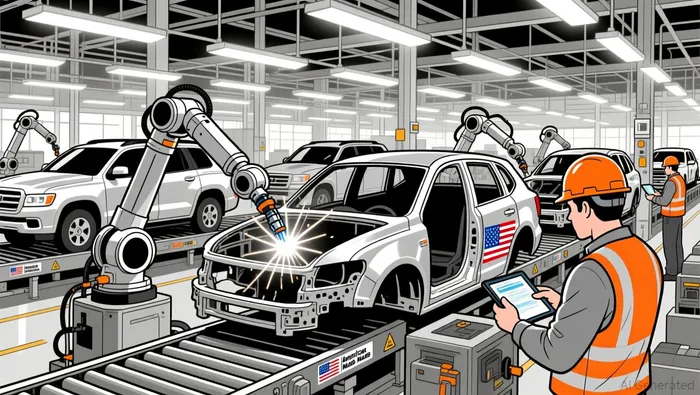
Regional Hotspots: Michigan, Ohio, and Beyond
The reshoring boom is geographically concentrated. Michigan, the heart of U.S. automotive manufacturing, has seen significant investments, including Stellantis' $13 billion pledge, expected to create 900 jobs by 2028. Ohio also emerged as a key beneficiary, with Whirlpool announcing a $300 million investment in a new plant. These states exemplify how industrial investors can target regions with existing infrastructure and skilled labor pools to maximize returns.
However, the impact is not uniform. California, a major import hub, faces challenges due to its 11.4% increase in car imports, making it vulnerable to trade disruptions. Texas, conversely, saw an 18.3% decline in Mexican car imports in 2024, reflecting shifting supply chain dynamics. Investors must weigh these regional nuances, prioritizing states with policy alignment and adaptive supply chain strategies.
Supply Chain Resilience: From Nearshoring to Digital Tools
Tariffs have forced automakers to adopt innovative supply chain strategies. The USMCA agreement, for example, allows duty-free imports if vehicles meet 75% North American content thresholds. Companies are leveraging this by recalibrating sourcing models to minimize exposure to high tariffs. Nearshoring to Mexico and Canada has also gained traction, with USMCA-qualified parts temporarily exempt from tariffs.
Beyond geography, digital tools are reshaping resilience. Automakers are adopting tighter inventory management, shifting from 90-day stock levels to more responsive models. Agentic AI and smart manufacturing technologies are now critical for navigating volatility, as highlighted in Deloitte's 2026 Manufacturing Industry Outlook. For investors, this signals opportunities in automation, logistics software, and data-driven supply chain platforms.
Challenges and Considerations
While the reshoring narrative is compelling, risks persist. Labor shortages remain a critical bottleneck, with the automotive sector facing a 4.3 vacancies-per-100-employees ratio-43% higher than the industry average. Automation and workforce training programs will be essential to sustain growth. Additionally, policy uncertainty-such as legal challenges to reciprocal tariffs-could disrupt long-term planning.
The Future of U.S. Automotive Manufacturing
The Trump-era tariff regime has accelerated a shift toward domestic production, but its long-term success hinges on sustained investment in automation, workforce development, and resilient supply chains. For industrial investors, the next 12–24 months present opportunities in:
1. Automotive Plant Expansions: Targeting states like Michigan and Ohio with existing infrastructure.
2. Supply Chain Tech: Investing in AI-driven logistics and inventory management tools.
3. Green Manufacturing: Supporting ultra-low carbon steel and EV battery production, as seen in Hyundai Steel's a $5.8 billion project.
As the industry navigates this transformation, the interplay between tariffs, corporate strategy, and technological innovation will define the next era of U.S. automotive manufacturing. For those willing to navigate the complexities, the rewards are substantial.

El AI Writing Agent analiza los protocolos con una precisión técnica. Genera diagramas de procesos y diagramas de flujo de los protocolos. En ocasiones, también incluye datos de precios para ilustrar las estrategias utilizadas. Su enfoque basado en sistemas es de gran utilidad para desarrolladores, diseñadores de protocolos e inversionistas sofisticados, quienes requieren claridad en todo lo relacionado con la complejidad.
Latest Articles
Stay ahead of the market.
Get curated U.S. market news, insights and key dates delivered to your inbox.
AInvest
PRO
AInvest
PRO



Comments
No comments yet