
Trump's Tariffs and Market Volatility: Navigating the New Global Supply Chain Landscape
 Aime Summary
The Trump administration's 2024–2025 tariff policies have rewritten the rules of global trade, creating a volatile environment where supply chains fracture, markets recalibrate, and investors must navigate unprecedented uncertainty. With tariffs as high as 100% on Chinese electric vehicles and 50% on copper and semiconductors, the U.S. has forced a seismic shift in how companies source, produce, and distribute goods. This article examines the economic fallout of these policies, identifies resilient sectors poised to benefit, and offers a roadmap for investors to capitalize on the reshaped global landscape.
Tariff Uncertainty and the Fracturing of Global Supply Chains
The Trump administration's approach to tariffs has been both aggressive and unorthodox. By leveraging the International Emergency Economic Powers Act (IEEPA) and Section 232, the U.S. has imposed or threatened tariffs on over 71% of its $2.3 trillion in annual imports. The average effective tariff rate has surged to 12.9%, the highest since 1941, while retaliatory measures from China, the EU, and Canada have further fragmented trade flows.
For example, the 125% tariff on Chinese goods—stacked atop existing Section 232 steel and aluminum tariffs—has forced companies like TeslaTSLA-- and AppleAAPL-- to accelerate reshoring efforts. Tesla's Texas Gigafactory now accounts for 25% of global EV production, while Apple has redirected 20% of its manufacturing to Vietnam. These moves reflect a broader trend: companies prioritizing supply chain resilience over cost efficiency.
The ripple effects are global. China's 84% retaliatory tariff on U.S. agricultural goods has hurt American farmers, while the EU's 30% tariff on U.S. whiskey and other exports has disrupted key industries. Meanwhile, the 50% copper tariff has triggered a surge in LME prices, paralyzing the Midwest premium (MWP) market and creating volatility for manufacturers reliant on raw materials.
Resilient Sectors: Where to Invest in the New Trade Reality
Amid the chaos, certain sectors are thriving. These industries are either insulated from tariffs or directly benefit from the administration's “Made in America” agenda.
1. Domestic Manufacturing and Semiconductor Production
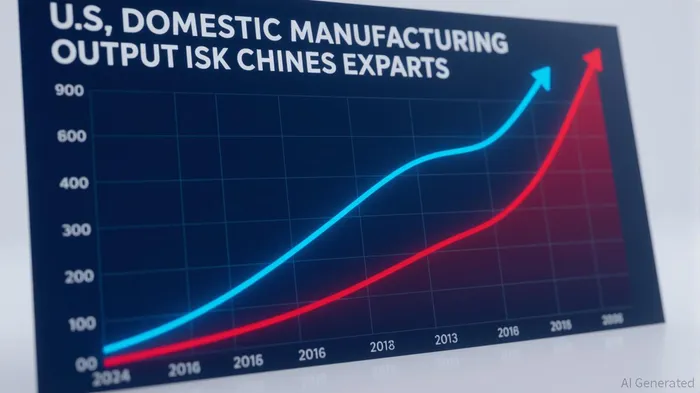
The CHIPS Act and Trump's tariffs have created a perfect storm for U.S. semiconductor manufacturers. Intel's $20 billion investment in domestic chip production, paired with 50% tariffs on Chinese semiconductors, has positioned the company as a key player in a post-China era. Similarly, companies like Applied MaterialsAMAT-- and Lam ResearchLRCX-- are seeing demand surge as firms prioritize domestic supply chains.
Steel and aluminum producers are also reaping rewards. NucorNUE-- (NUE), the largest U.S. steelmaker, has seen its stock rise 200% over five years, driven by 25% tariffs on Chinese imports. However, automakers like General MotorsGM-- face $1.1 billion in trade-related expenses, highlighting the duality of tariff impacts. Investors should favor firms with robust balance sheets and reshoring capabilities.
2. Energy and Commodities: Copper, Semiconductors, and Pharmaceuticals
The 50% copper tariff has reignited demand for domestic mining operations. Freeport-McMoRanFCX-- (FCX), a leading copper producer, is expanding to meet green energy needs, while a 200% pharmaceutical tariff creates opportunities for domestic drug manufacturers like PerrigoPRGO-- and Mylan.
However, these sectors are not without risks. A 50% copper tariff could exacerbate inflationary pressures, and the pharmaceutical tariff threatens global medicine supply chains. Investors should focus on companies with low-cost extraction methods and integration of green technologies.
3. Undervalued Markets: Vietnam, India, and Mexico
As U.S. companies seek alternatives to China, Vietnam, India, and Mexico have emerged as key players. Vietnam, now absorbing 40% of displaced Chinese manufacturing, is attracting Apple and NikeNKE--, which have redirected 20% of production to the country. India's 26% reciprocal tariff has not deterred investment: Apple has pledged $1 billion to Indian manufacturing, while WalmartWMT-- reduced Chinese imports by 10%.
Mexico, bolstered by USMCA's duty-free provisions, is a magnet for nearshoring. Ford's relocation of production to Mexican suppliers and a Deloitte study projecting 40% of U.S. companies to shift supply chains to North America by 2026 underscore this trend. However, logistical challenges—such as 15% cross-border trucking delays—remain a concern.
Strategies for Navigating Tariff-Driven Volatility
To thrive in this environment, investors must adopt a dual strategy: hedge global exposure and prioritize domestic innovation.
- Hedge Global Exposure: Companies like TSMCTSM-- and Apple, which face 25%+ semiconductor tariffs, are vulnerable. TSMC's 20% stock decline in 2025 highlights the risks of overreliance on global supply chains. Investors should diversify portfolios by including firms with localized production or diversified supplier networks (e.g., Texas Instruments).
- Prioritize Domestic Innovation: Firms aligned with the “Made in America” agenda—such as IntelINTC--, Nucor, and Freeport-McMoRan—are well-positioned to benefit from sustained protectionist policies.
- Embrace Technology and Infrastructure: AI-driven logistics and blockchain-enabled supply chains can mitigate tariff volatility. Companies optimizing these tools—such as those in the logistics or fintech sectors—offer long-term resilience.
Conclusion: Balancing Risk and Opportunity
The Trump tariff regime has created a fragmented global economy, but it has also unlocked new investment opportunities. While tariffs raise prices and disrupt markets, they also incentivize reshoring, innovation, and diversification. Investors who focus on resilient sectors—domestic manufacturing, energy, and undervalued markets—can navigate the volatility and capitalize on the administration's trade agenda.
As the global supply chain landscape continues to evolve, the winners will be those who adapt. The key to success lies in strategic foresight, agility, and a willingness to embrace the inevitable shifts in a world reshaped by tariffs.

Stay ahead of the market.
Get curated U.S. market news, insights and key dates delivered to your inbox.




Comments
No comments yet