
Trump Tariffs and U.S. Manufacturing Comeback: Whirlpool's Strategic Play


 Aime Summary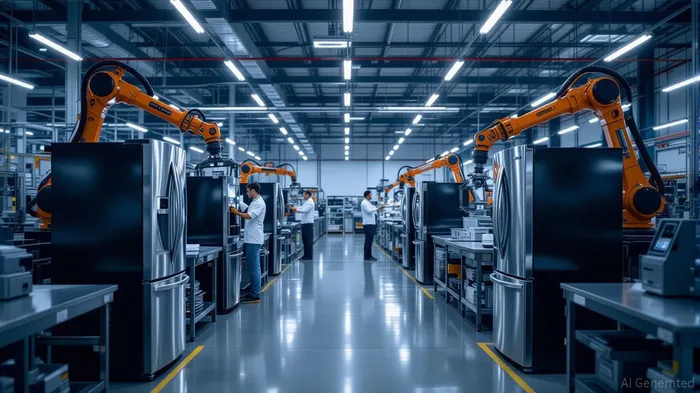
The U.S. manufacturing sector has long been a battleground for economic policy debates, and the Trump administration's aggressive tariff regime has reignited discussions about its potential to revive domestic industries. While critics argue that tariffs create economic uncertainty and reduce competitiveness, certain sectors—particularly those shielded by protectionist measures—have seen renewed investment. Whirlpool CorporationWHR-- (WHR), a global leader in home appliances, exemplifies how companies are navigating this complex landscape. This article assesses the long-term investment potential of tariff-benefit industries, with a focus on Whirlpool's strategic positioning in a post-PCE (Personal Consumption Expenditures) economic environment.
Tariffs as a Double-Edged Sword
The Trump administration's tariffs on steel and aluminum—initially 25% and later escalated to 50% for most countries—were designed to protect domestic producers from foreign competition. For WhirlpoolWHR--, which relies heavily on steel for appliances like refrigerators and washing machines, these tariffs have had a dual impact. On one hand, they have increased input costs, squeezing profit margins. On the other, they have indirectly supported U.S. steel producers, reducing reliance on cheaper but lower-quality imports. This dynamic has forced Whirlpool to recalibrate its supply chain, prioritizing domestic suppliers and investing in automation to offset rising material costs.
The broader economic data underscores the mixed legacy of these tariffs. According to the Joint Economic Committee, U.S. manufacturing investment could decline by over 13% annually due to policy uncertainty, with cumulative losses exceeding $490 billion by 2029. However, industries like steel and aluminum have seen a modest rebound in domestic production. For Whirlpool, this means a more stable supply chain but also higher operational expenses. The company's ability to pass these costs to consumers—via premium pricing on “Made in America” appliances—has been a key differentiator in maintaining profitability.
Whirlpool's Strategic Play: Localization and Innovation
Whirlpool's response to the tariff-driven environment has centered on two pillars: localization and innovation. The company has expanded its U.S. manufacturing footprint, including a $400 million investment in a new plant in Georgia in 2024. This move aligns with the administration's push for reshoring and leverages the higher cost of imported steel to justify domestic production. By reducing dependency on global supply chains, Whirlpool mitigates risks from trade wars and currency fluctuations.
Innovation has also been critical. Whirlpool has integrated smart technology into its appliances, creating a premium product line that commands higher margins. This strategy not only offsets tariff-related costs but also taps into the growing demand for energy-efficient and connected devices. The company's partnership with U.S. steel producers to develop high-strength, lightweight materials further illustrates its commitment to leveraging domestic resources.
Post-PCE Dynamics: Inflation, Interest Rates, and Investment
The post-PCE era is defined by elevated inflation and interest rates, which have dampened business investment. The Q2 2025 U.S. Economic Forecast projects core PCE inflation at 3.6% by late 2025, with real GDP growth at 1.4%. For manufacturing, this means tighter borrowing costs and reduced consumer spending on durable goods. However, Whirlpool's focus on premium products and domestic production positions it to weather these headwinds.
The baseline scenario assumes tariffs remain at 15%, with business investment growing modestly (0.7% in 2025). In this environment, Whirlpool's emphasis on automation and efficiency could drive cost savings. The upside scenario—lower tariffs and dovish monetary policy—would further boost demand for durable goods, benefiting companies like Whirlpool. Conversely, the downside scenario (25% tariffs and a potential recession) could strain margins, though the company's diversified global operations provide a buffer.
Investment Considerations: Balancing Risks and Rewards
Investors evaluating Whirlpool must weigh several factors:
1. Tariff Volatility: While current policies favor domestic steel, a shift in administration or trade agreements could alter the landscape. Whirlpool's reliance on U.S. steel makes it sensitive to policy changes.
2. Consumer Demand: The PCE forecast suggests durable goods spending will contract in 2025, but Whirlpool's premium positioning may insulate it from broader trends.
3. Operational Efficiency: The company's investments in automation and supply chain resilience are critical to maintaining margins amid rising costs.
4. Global Exposure: Whirlpool's international operations (40% of revenue) offer diversification but also expose it to foreign exchange risks and geopolitical tensions.
Conclusion: A Strategic Bet on Resilience
Whirlpool's strategic pivot to domestic manufacturing and innovation positions it as a compelling long-term investment in a post-PCE era. While tariffs have introduced volatility, the company's ability to adapt—through localization, premium pricing, and technological advancement—mitigates many risks. For investors, the key is to monitor macroeconomic indicators, particularly inflation and interest rates, which will shape the durability of Whirlpool's growth. In a world where protectionism and automation are reshaping industries, Whirlpool's playbook offers a blueprint for navigating the new normal.
Investment Advice: Consider a long-term position in Whirlpool, with a focus on its domestic production initiatives and R&D pipeline. Diversify across sectors to hedge against trade policy shifts, and use PCE inflation trends as a barometer for adjusting exposure.

Stay ahead of the market.
Get curated U.S. market news, insights and key dates delivered to your inbox.




Comments
No comments yet