
How Will Trump's Tariffs Impact Your Portfolio?
For over two years, the U.S. economy has displayed remarkable resilience, with robust consumption and government spending offsetting weaknesses in interest rate-sensitive sectors like housing. However, as we look ahead to 2025, the economic landscape appears poised for a shift.
A key catalyst for this change is the implementation of new tariffs, which could disrupt consumption, temper growth, and complicate monetary policy.
Tariffs Will Slow the Economy in 2025
The driving forces behind recent economic growth—household consumption and government spending—are showing signs of fatigue. Household spending, which has been supported by historically strong balance sheets, is likely to weaken under the weight of new tariffs and rising debt service levels.
The Federal Reserve's data indicates that household debt service as a percentage of disposable income has reached 11.5%, comparable to pre-pandemic levels. This erosion of financial strength leaves households more vulnerable to adverse shocks, with tariffs expected to be a significant trigger.
Government spending, another pillar of recent growth, may also falter. While potential new fiscal measures under President Trump could provide temporary support, the extension of existing tax cuts and possible spending reductions may neutralize much of the stimulus.
As a result, the pace of economic growth is expected to decelerate throughout 2025, though not to the point of recession. Current projections place the odds of a recession at 15% for 2025, rising to 40% by the end of 2026.
Tariffs will Have a Counterintuitive Impact on Inflation Over Time
Inflation fears have resurfaced, driven by higher prices reported in recent PMI data and concerns highlighted in Federal Reserve minutes. However, a closer examination reveals a more nuanced picture. Over a six-month horizon, inflation metrics, such as personal consumption expenditures (PCE), show steady declines, with core measures ranging between 1.9% and 2.4%.
This suggests that inflationary pressures remain contained, albeit temporarily disrupted by new tariffs.
The direct impact of tariffs on inflation is straightforward: a broad-based 10% tariff could elevate the consumer price index (CPI) by approximately 1%. However, their broader effects are disinflationary, as higher import costs reduce consumption and dampen demand.
The Federal Reserve faces the challenge of distinguishing between temporary price spikes from trade policies and persistent inflationary trends. If mismanaged, the central bank risks either overstimulating or prematurely tightening the economy, potentially tipping the U.S. into a recession by 2026.
Tariffs Will Impact the Path of Monetary Policy
The Federal Reserve's path forward is fraught with uncertainty. Despite the anticipated inflationary impact of tariffs, the Fed is likely to proceed cautiously, pausing rate cuts temporarily but not halting them altogether. Markets currently expect 75 basis points of cuts in 2025, with the Fed holding rates steady until the second quarter.
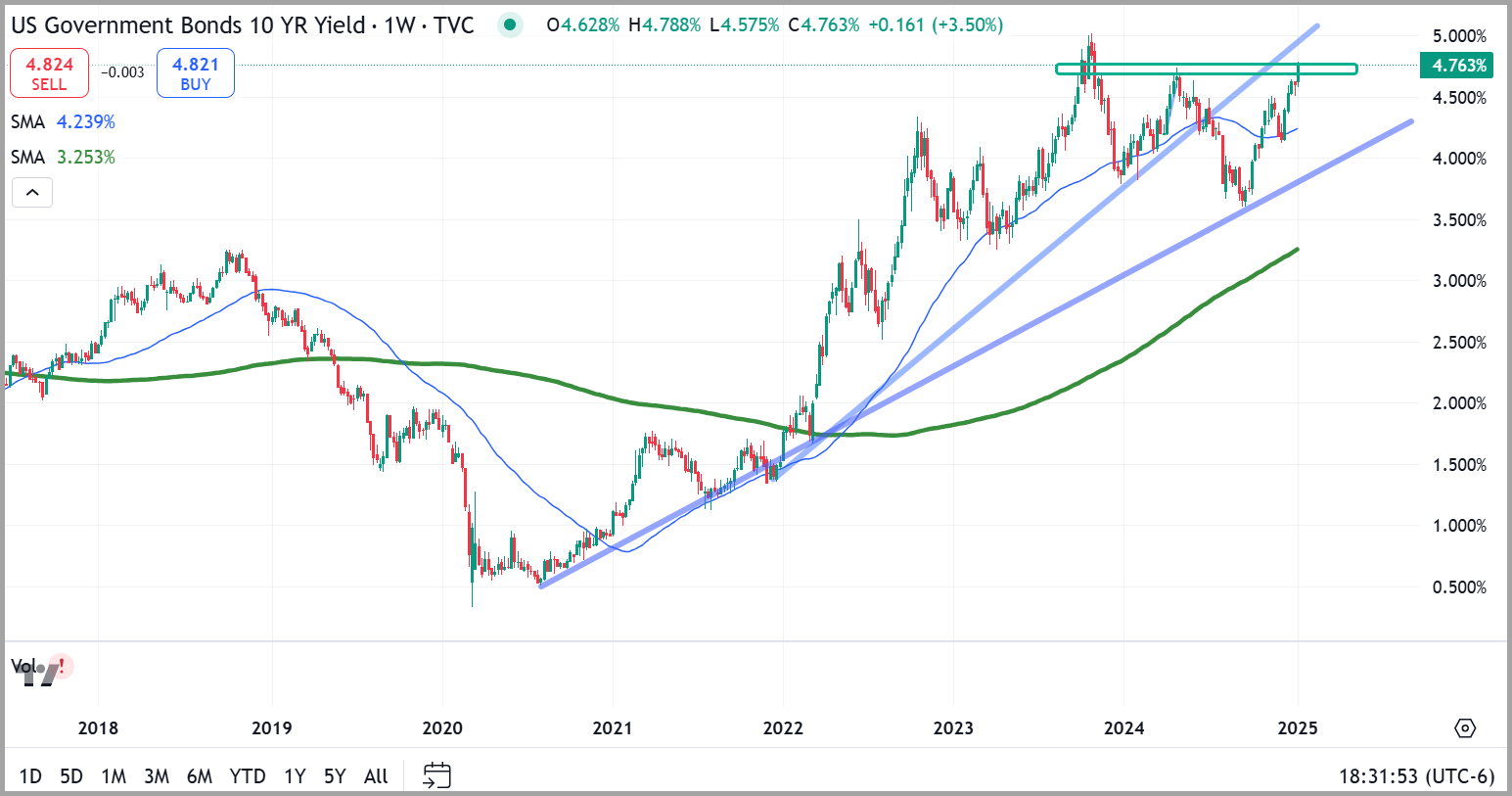
The recent surge in Treasury yields further complicates monetary policy. While some of the increase reflects a higher implied neutral rate, much of it is driven by an elevated term premium. This premium, influenced by sentiment and exaggerated growth expectations, has pushed yields above levels supported by economic fundamentals.
As growth moderates, yields are expected to retreat, with the 10-year yield projected to fall to 3.90% by the end of 2025 and 3.35% by the close of 2026.
Tariffs will be a Headwind for the Consumer
The most immediate and tangible impact of tariffs will be on consumer spending. Tariffs reduce household purchasing power, forcing consumers to allocate more income toward higher-priced goods. This shift is particularly concerning for low- and moderate-income households, which are already experiencing financial strain.
Rising delinquency rates and stagnant wage growth further exacerbate these vulnerabilities, creating a potential drag on overall economic growth.
Investment Implications
As tariffs and their ripple effects unfold, investors must adjust their strategies to navigate the evolving economic environment.
Fixed Income: Elevated term premiums present opportunities in longer-dated Treasuries, particularly as yields retreat in response to slowing growth. Investors should consider laddering maturities to manage duration risk.
Equities: Companies with pricing power and exposure to domestic demand are better positioned to weather tariff-related challenges. Consumer staples and technology firms focused on innovation may provide relative stability.
Commodities: Trade disruptions could affect commodity prices. While tariffs may initially support inflation-sensitive assets like gold, broader disinflationary effects could limit upside potential.
Currencies: The U.S. dollar's strength may persist in the near term, driven by higher Treasury yields, but softening growth expectations could eventually cap gains.
Looking Ahead
Tariffs represent a complex challenge for the U.S. economy, simultaneously exerting inflationary and disinflationary forces. Their implementation is likely to slow growth, reduce consumer spending, and complicate monetary policy decisions.
As 2025 approaches, the economic narrative will pivot from one of resilience to moderation, requiring policymakers, businesses, and investors to adapt to a more constrained environment.
While recession risks remain relatively low in the near term, the long-term trajectory hinges on the Federal Reserve's ability to balance its inflation mandate with the broader economic impacts of trade policy.
For investors, this period of transition underscores the importance of diversification, vigilance, and strategic allocation to navigate an increasingly uncertain economic landscape.

Independent investment research powered by a team of market strategists with 20+ years of Wall Street and global macro experience. We uncover high-conviction opportunities across equities, metals, and options through disciplined, data-driven analysis.
Latest Articles
Unlock Market-Moving Insights.
Subscribe to PRO Articles.
Already have an account? Sign in
Unlock Market-Moving Insights.
Subscribe to PRO Articles.
Already have an account? Sign in
Stay ahead of the market.
Get curated U.S. market news, insights and key dates delivered to your inbox.




