
Trump's Tariffs Face Supreme Court's Showdown: Justices Signal Trouble for Trump's Trade Arsenal


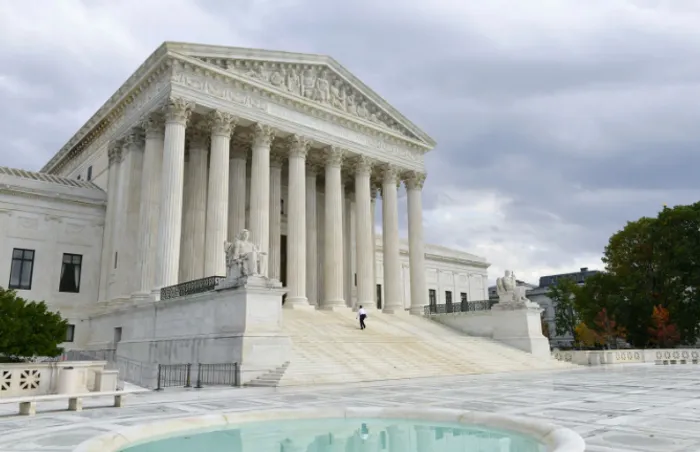
The marble halls of the Supreme Court echoed with pointed questions on Wednesday, as justices from across the ideological spectrum grilled the Trump administration's defense of sweeping tariffs that have reshaped global trade.
In a hearing that blended constitutional scrutiny with economic reality, Solicitor General D. John Sauer faced a barrage of skepticism over the president's use of the International Emergency Economic Powers Act (IEEPA) to impose duties on imports from allies and adversaries alike.
The stakes? A policy projected to generate $3 trillion in revenue by 2035, now teetering on the edge of judicial rebuke.
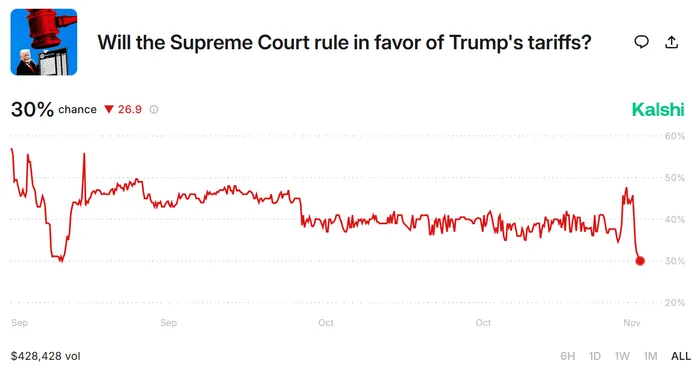
Markets didn't wait for a verdict. The S&P 500 climbed 0.37%, while the Nasdaq surged 0.65%, reflecting investor relief at the prospect of lighter trade barriers. Yet prediction markets painted a darker picture for the tariffs' survival, with odds plummeting on platforms like Kalshi and Polymarket. This courtroom drama isn't just legal theater—it's a pivotal moment for U.S. fiscal policy, corporate bottom lines, and the delicate balance of power in Washington.
Justices Probe the Limits of Presidential Power
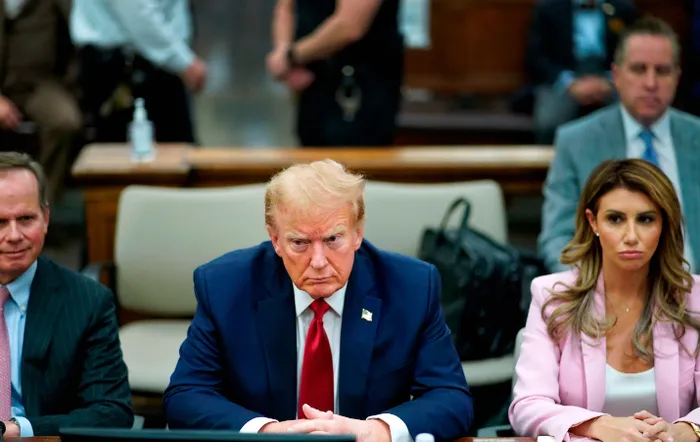
From the outset, the oral arguments exposed fissures in the administration's legal foundation. Sauer argued that these "regulatory tariffs" were essential tools for addressing trade imbalances and the fentanyl crisis, not primarily revenue raisers. "The fact that they raise revenue was only incidental," he insisted, positioning them under the president's authority to regulate foreign commerce.
But the justices weren't buying it. Liberal Justice Sonia Sotomayor cut to the core: "You say tariffs are not taxes, but that's exactly what they are. They're generating money from American citizens, revenue." She highlighted a historical anomaly—no president since IEEPA's enactment in 1977 had wielded it for tariffs until Trump. Conservative voices amplified the concern. Justice Neil Gorsuch warned of a "one-way ratchet" toward executive overreach, questioning what happens if a president vetoes congressional efforts to reclaim authority. "Congress as a practical matter can't get this power back once it's handed it over," he said, evoking fears of eroding legislative checks.
Chief Justice John Roberts, along with Justices Amy Coney Barrett, Brett Kavanaugh, and Samuel Alito, joined the fray, pressing Sauer on the unilateral declaration of "international emergencies" like trade deficits and drug flows. The tariffs in question start at 10% on many nations, escalating to 50% on goods from India and Brazil. Lower courts had already struck them down, ruling Trump overstepped by citing IEEPA for reciprocal tariffs on U.S. trading partners and fentanyl-specific duties on Canada, China, and Mexico.
On the plaintiffs' side, attorney Neal Katyal drove home the constitutional point: "Tariffs are taxes. Our founders gave that taxing power to Congress alone." He dismissed the administration's foreign policy rationale, noting that while tariffs carry diplomatic weight, the Constitution delegates taxation squarely to lawmakers. Katyal spotlighted inconsistencies, like the 39% tariff on Switzerland—a U.S. ally with which America runs a trade surplus—underscoring the policy's arbitrary bite.
Economic Ripples: Billions at Stake
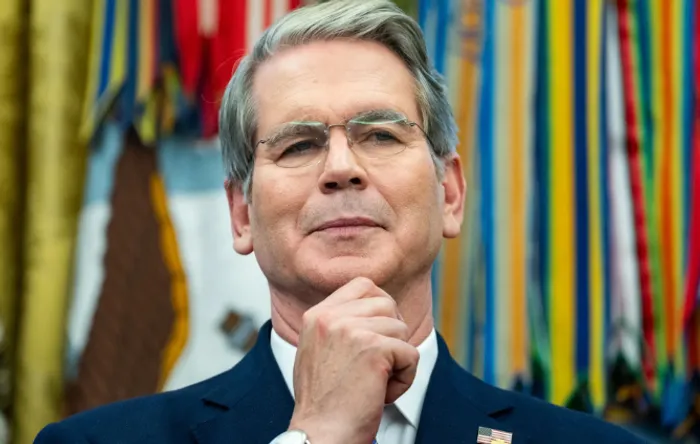
The financial implications loomed large over the proceedings. The Committee for a Responsible Federal Budget estimates these tariffs could yield $3 trillion in extra revenue by 2035, with customs duties already soaring nearly 300% in the second half of fiscal 2025, collecting $151 billion. Treasury Secretary Scott Bessent, who attended the hearing, warned in a September filing that an adverse ruling could force refunds exceeding $750 billion if delayed until next summer. The administration has pushed for an expedited decision, but the court gave no timeline after the 2½-hour session.
Critics argue the true cost falls on American shoulders. Plaintiffs like Victor Owen Schwartz, whose V.O.S. Selections imports wines and spirits, decried the tariffs as "arbitrary" and "unpredictable." "These tariffs aren't paid by foreign governments or companies," Schwartz said in a post-hearing statement. "It's American businesses like mine, and American consumers, that are footing the bill." Importers absorb the duties and pass them on, inflating prices and squeezing margins in sectors from manufacturing to retail.
Trump frames the tariffs as a bulwark for domestic industry, prodding companies to produce stateside. In a Truth Social post on Tuesday, he called the case "LIFE OR DEATH for our Country," crediting tariffs for stock market highs and renewed global respect. "With a Victory, we have tremendous, but fair, Financial and National Security," he wrote. Bessent echoed this on X, praising Sauer's arguments while lambasting Katyal and co-counsel Benjamin Gutman for "foundational misunderstandings." He mocked their distinction between tariffs and embargoes or quotas, noting all affect revenues: "What embarrassing statements to make in front of SCOTUS."
Prediction Markets Bet Against Survival
As the hearing unfolded, traders on prediction platforms recalibrated in real time. On Kalshi, contracts wagering on a pro-tariff ruling slid to around 30% from nearly 50% pre-hearing. Polymarket mirrored the drop, falling to about 30% from over 40% earlier in the week. These shifts capture the justices' tone—conservatives aligning with liberals in unease over IEEPA's broad interpretation—as a harbinger of defeat.
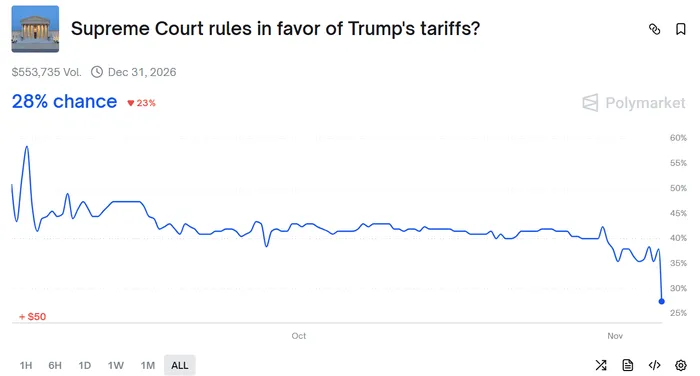
Prediction markets, where participants bet on outcomes with real money, often serve as early warning systems for policy shifts. Wednesday's reaction underscores investor wariness: if the tariffs fall, it could unwind a key pillar of Trump's economic strategy, potentially easing inflationary pressures but disrupting supply chains built around the duties. For Wall Street, the uncertainty injects volatility; a ruling against could boost multinational firms reliant on imports, while domestic producers might face stiffer competition.
Broader Implications for Trade and Power
This case tests more than tariffs—it's a litmus for Trump's second-term agenda, where the court has sometimes favored his policies. Trump considered attending, a historic first for a sitting president, but opted out to avoid distraction, deeming it "one of the most important and consequential Decisions ever made."
Should the court invalidate the tariffs, it would reaffirm congressional primacy in taxation, curbing future executive adventurism. Katyal warned against "junking the worldwide tariff architecture," arguing IEEPA was never meant for such overhauls. For businesses, predictability hangs in the balance; unlike congressionally set duties, these executive actions have bred chaos.
Yet Trump's defiance resonates in a polarized landscape. He insists tariffs shield against exploitation, fueling deals and security. Critics counter that consumers bear the brunt, with studies showing minimal foreign absorption of costs.
As the nation awaits a decision, the hearing's skepticism signals headwinds for the administration's trade fortress. Markets may cheer short-term relief, but the long game involves recalibrating U.S. competitiveness in a tariff-free world. In finance, where policy pivots can swing trillions, this Supreme Court skirmish reminds us: economic power isn't just wielded—it's constitutionally constrained.

Expert analysis on U.S. markets and macro trends, delivering clear perspectives behind major market moves.
Latest Articles
Stay ahead of the market.
Get curated U.S. market news, insights and key dates delivered to your inbox.


AInvest
PRO
AInvest
PRO



Comments
No comments yet