
Trump's Tariffs on Canada and Market Volatility: Opportunities in Defensive Sectors
The U.S.-Canada trade dispute, marked by escalating tariffs and retaliatory measures, has unleashed unprecedented market volatility. With tariffs now at 35% on key Canadian imports—effective August 1—and economic forecasts predicting a 0.8% GDP contraction for the U.S. in 2025, investors face a critical crossroads. In this environment, sector rotation strategies centered on defensive plays and tariff-resistant industries are essential to navigating the storm.
The Tariff Quagmire: Economic Fallout and Market Risks
The latest tariff hikes, implemented under the International Emergency Economic Powers Act (IEEPA), have pushed U.S. trade barriers to their highest levels since the 1930s. While the tariffs aim to curb Canadian exports (excluding energy and potash), they have backfired on key sectors:
- Consumer prices are up 1.9% in the short term, with households losing an average of $2,500 in purchasing power.
- Manufacturing is bifurcated: non-advanced durable goods (e.g., textiles) see growth, while advanced manufacturing (e.g., semiconductors) declines 2.8%.
- Construction and agriculture have been hardest hit, with output dropping 3.5% and 1.0%, respectively.
The ripple effects extend globally. Canada's economy is projected to shrink 1.9% in the long term, while retaliatory tariffs on $155 billion CAD of U.S. goods further strain bilateral trade. This creates a fertile ground for sector rotation, as investors seek shelter in industries insulated from geopolitical headwinds.
Defensive Sectors: A Harbor in Turbulent Waters
1. Utilities and Infrastructure: Powering Stability
Utilities are a prime defensive play. Companies like NextEra Energy (NEE), the world's largest producer of wind and solar power, are critical to powering AI infrastructure and renewable energy projects. Their stable cash flows and inelastic demand make them resilient to tariff-driven inflation.
2. Healthcare: A Lifeline for Investors
Healthcare remains a safe haven. With tariffs having little impact on healthcare supply chains—due to domestic production and diversified sourcing—companies like UnitedHealth Group (UNH) and Merck (MRK) offer steady returns. The sector's defensive nature is amplified by aging populations and rising healthcare spending.
3. Consumer Staples: Navigating Inflation
Consumer staples have outperformed discretionary sectors as households tighten budgets. Procter & Gamble (PG) and Coca-Cola (KO), with their inelastic demand and pricing power, are top picks.
Sector Rotation: Capitalizing on Tariff-Resistant Industries
While defensive sectors provide ballast, aggressive investors should rotate into industries that benefit from the trade war's distortions:
1. Energy: The Tariff Winner
U.S. energy companies thrive as Canadian and Mexican imports face tariffs. EOG Resources (EOG) and Chevron (CVX) are poised to gain market share. The Energy Select Sector SPDR Fund (XLE) offers broad exposure to this trend.
2. Financials: Rising Rates, Rising Rewards
Banks like JPMorgan Chase (JPM) and Wells Fargo (WFC) benefit from higher interest rates, provided the 10-year Treasury yield stays below 4.2%. Monitor bond yields closely: a breach of this threshold could signal overheating markets.
3. Telecom and Tech Infrastructure: Betting on the AI Boom
While broad tech faces risks from potential tariffs on semiconductors, sectors tied to AI infrastructure—cloud computing, fiber optics—are insulated. AT&T (T) and Verizon (VZ), with their 5G rollouts, offer defensive tech exposure.
Sectors to Avoid: Trade Sensitivity and Overhang Risks
- Advanced Manufacturing: Sectors reliant on global supply chains, like semiconductors and automotive, face headwinds.
- Construction: Labor shortages and tariff-driven material costs have slashed output.
- Technology: Avoid until the November 2025 Section 232 report clarifies risks around semiconductor tariffs.
Key Catalysts and Thresholds
- August 12, 2025: The deadline for U.S. tariffs on Chinese goods at 55%. A reduction could ease global trade tensions, but high tariffs risk further Canadian retaliation.
- July 16 Earnings Reports: Bank results will signal economic health. Weak loan growth or rising provisions could amplify recession fears.
- November Section 232 Report: Delays in semiconductor tariffs could spark a rebound in stocks like ASML (ASML) and Lam Research (LRCX).
Investment Strategy: A Balanced Approach
- Core Portfolio: Allocate 30% to utilities (e.g., NEENEE--, XLU ETF), 20% to healthcare (e.g., UNH, HMO ETF), and 15% to consumer staples (e.g., PGPG--, KO).
- Growth Plays: Deploy 25% to energy (XLE, EOG) and 10% to financials (JPM, XLF).
- Tech Caution: Short the Technology Select Sector SPDR Fund (XLK) until November's clarity.
Risks and Considerations
- Geopolitical Escalation: Canada's economy, already contracting, could retaliate further, amplifying trade friction.
- Bond Market Signals: A 10-year Treasury yield above 4.2% could trigger a sell-off in financials861076-- and broader markets.
- Earnings Misses: Weak results from Delta Air LinesDAL-- or NetflixNFLX-- could expose vulnerabilities in cyclical sectors.
Conclusion: Navigate Volatility with Discipline
The U.S.-Canada trade war has reshaped the investment landscape, demanding a focus on sector rotation, defensive stability, and policy timing. By prioritizing utilities, healthcare, and energy while avoiding trade-sensitive sectors, investors can weather the storm. Stay agile—monitor tariff deadlines, bond yields, and earnings catalysts—to capitalize on opportunities as this volatile chapter unfolds.
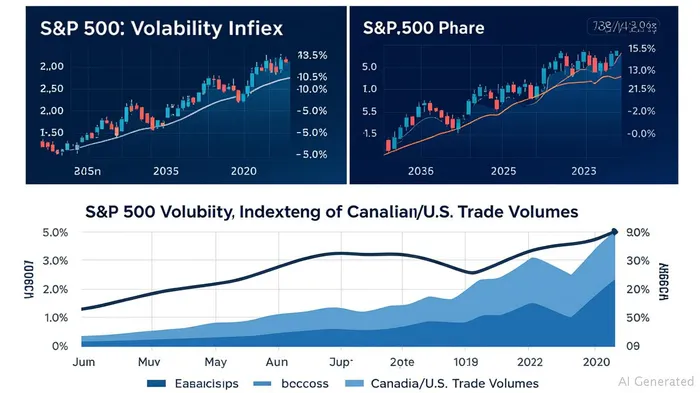
Data-driven decisions require vigilance. Let the tariffs guide you to safer shores.

Stay ahead of the market.
Get curated U.S. market news, insights and key dates delivered to your inbox.


AInvest
PRO
AInvest
PRO



Comments
No comments yet