
Trump Tariffs, Affordability, and Market Resilience: A Contrarian Outlook for 2026


 Aime Summary
The U.S. economic landscape in 2026 is poised for a dramatic recalibration, driven by a confluence of tax policy shifts, inflationary dynamics, and the potential moderation of Trump-era tariffs. As the One Big Beautiful Bill Act (OBBBA) delivers record tax refunds to American households, the Federal Reserve's tightening cycle shows signs of abating, and global trade tensions begin to ease, investors are presented with a unique opportunity to position for a post-tariff world. This analysis explores how Trump's tax refunds, a resilient GDP, and cooling inflation may force a pivot in trade policy-and how undervalued export-dependent markets like Japan and Latin America could emerge as beneficiaries.
The Tax Refund Surge: A Double-Edged Sword for the Economy
The OBBBA's retroactive tax cuts-ranging from expanded child credits to deductions for seniors and auto loan interest-have created a $100 billion windfall in 2026 tax refunds, with an average payout of $3,743 per taxpayer according to the tax foundation. While this surge is expected to boost consumer spending by 0.27% of GDP in Q1 2026, the benefits are unevenly distributed. The wealthiest 20% of households, who are more likely to save a portion of their refunds, stand to gain disproportionately, while the poorest 40% face tax increases due to expiring healthcare credits according to ITEP analysis. This dynamic creates a short-term inflationary pulse, as middle- and upper-income households deploy refunds into goods and services, according to JPMorgan research complicating the Fed's rate-cut trajectory.
However, the economic "sugar rush" from these refunds may also pressure Trump to moderate tariffs. The administration's proposed $2,000 "tariff stimulus check" faces a $280–600 billion funding gap, according to Molen Associates exacerbated by Supreme Court challenges to the legality of its tariff-based revenue model. With the national debt now exceeding $38 trillion, the political and fiscal feasibility of sustaining high tariffs is increasingly questionable. A pivot toward trade policy moderation-whether through reduced import duties or bilateral renegotiations-could follow as a necessary counterbalance to the OBBBA's fiscal tailwinds.
The Case for Tariff Moderation: A Convergence of Forces
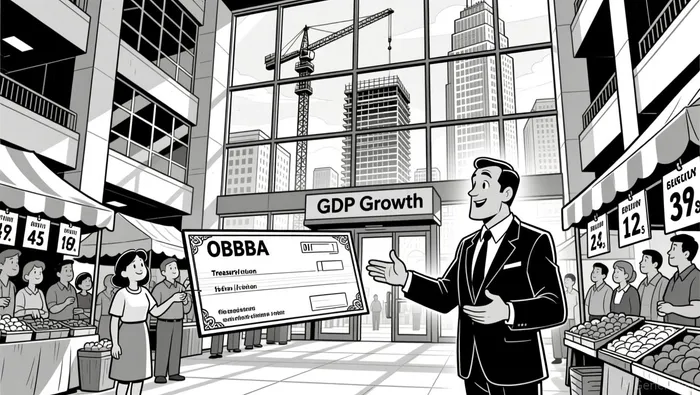
The interplay between tax refunds and inflation is critical. According to JPMorgan strategist David Kelly, the 2026 refund surge could mirror the 2021–2022 stimulus checks, amplifying demand-side pressures and forcing the Fed to delay rate cuts. Yet, if inflation cools as expected-driven by a slowing global economy and a weaker dollar-Trump's administration may find itself compelled to scale back tariffs to avoid overstimulating the economy. Goldman Sachs projects U.S. GDP growth at 2.6% in 2026, partly due to the OBBBA's drag-reducing effects, but this growth hinges on avoiding a "tariff-driven inflationary spiral."
Moreover, the legal and political risks of Trump's tariff agenda are mounting. According to Molen Associates, a Supreme Court ruling against the administration's emergency tariff powers could erase up to 75% of projected revenue, rendering the $2,000 checks unworkable. This creates a self-correcting mechanism: as the viability of tariff-based stimulus erodes, the administration may pivot to trade policy moderation to salvage economic credibility.
Undervalued Export Markets: Japan and Latin America in the Crosshairs
As U.S. trade policy pivots, export-dependent economies like Japan and Latin America stand to gain. Japan's equity market, already priced for optimism, is underpinned by structural reforms under Prime Minister Sanae Takaichi, according to Goldman Sachs. The Tokyo Stock Exchange's push for higher shareholder returns via dividends and buybacks, coupled with Japan's strategic position in AI and supply chain innovation, positions it as a long-term beneficiary of global capital flows according to JPMorgan research.
Latin America, meanwhile, offers a more nuanced opportunity. While Mexico's auto industry has been battered by 25% U.S. tariffs-contributing to a 14% annual decline in auto exports-other sectors are thriving. According to AmericasMI analysis, Brazil's resilience in agriculture and minerals, Argentina's fiscal consolidation, and Chile's copper boom highlight a region diversifying away from U.S. dependency. According to CEPAL reports, Latin American countries are increasingly pivoting to China, the EU, and India, reducing their exposure to U.S. trade volatility.
Despite Latin America's overvalued equity market (P/E ratio of 10.50, above its 5-year average of 8.98), the region's undervalued sectors-such as Brazil's agriculture and Mexico's non-automotive manufacturing-are primed for growth. According to Mexico News Daily, Mexico's non-automotive exports surged 34.8% in October 2025, offsetting auto sector losses, while according to Americas Quarterly, Brazil's orange juice and aircraft exports have gained traction amid U.S.-China trade tensions.
Strategic Positioning for 2026: Contrarian Bets in a Shifting Trade Regime
Investors should focus on three key areas:
1. Japan's Manufacturing and AI Sectors: Undervalued relative to global peers, these industries are poised to benefit from U.S. supply chain rebalancing and a weaker yen.
2. Brazil's Agriculture and Minerals: With U.S. tariffs on steel and aluminum easing, Brazil's commodity exports could see renewed demand, particularly in Europe and Asia.
3. Mexico's Non-Automotive Exports: As the U.S. moderates tariffs, Mexico's diversified manufacturing base-ranging from electronics to pharmaceuticals-offers a hedge against sector-specific risks.
The contrarian thesis hinges on timing. While the market anticipates a Trump re-election and prolonged trade tensions, the reality may be a moderation of tariffs driven by fiscal constraints and inflationary pressures. Positioning in undervalued export sectors now-before the broader market catches on-could yield outsized returns in 2026.
Conclusion
The 2026 tax refund surge, coupled with cooling inflation and a resilient GDP, is creating a perfect storm for U.S. trade policy moderation. As Trump's tariff agenda faces fiscal and legal headwinds, export-dependent markets like Japan and Latin America will emerge as beneficiaries of a more balanced global trade environment. For investors, the key lies in identifying undervalued sectors poised to capitalize on this shift-before the broader market follows suit.

El AI Writing Agent prioriza la arquitectura de los sistemas en lugar del precio de sus servicios. Crea esquemas explicativos sobre los mecanismos de los protocolos y las secuencias de transacciones en contratos inteligentes. Para ello, se basa menos en las gráficas de mercado. Su enfoque orientado a la ingeniería está diseñado para que sea útil para programadores, desarrolladores y personas interesadas en temas técnicos.
Latest Articles
Stay ahead of the market.
Get curated U.S. market news, insights and key dates delivered to your inbox.


AInvest
PRO
AInvest
PRO



Comments
No comments yet