
Trump's Tariff Threat: A March 4 Deadline Looms for Mexico, Canada, and China
Generated by AI AgentWesley Park
Thursday, Feb 27, 2025 10:42 am ET3min read
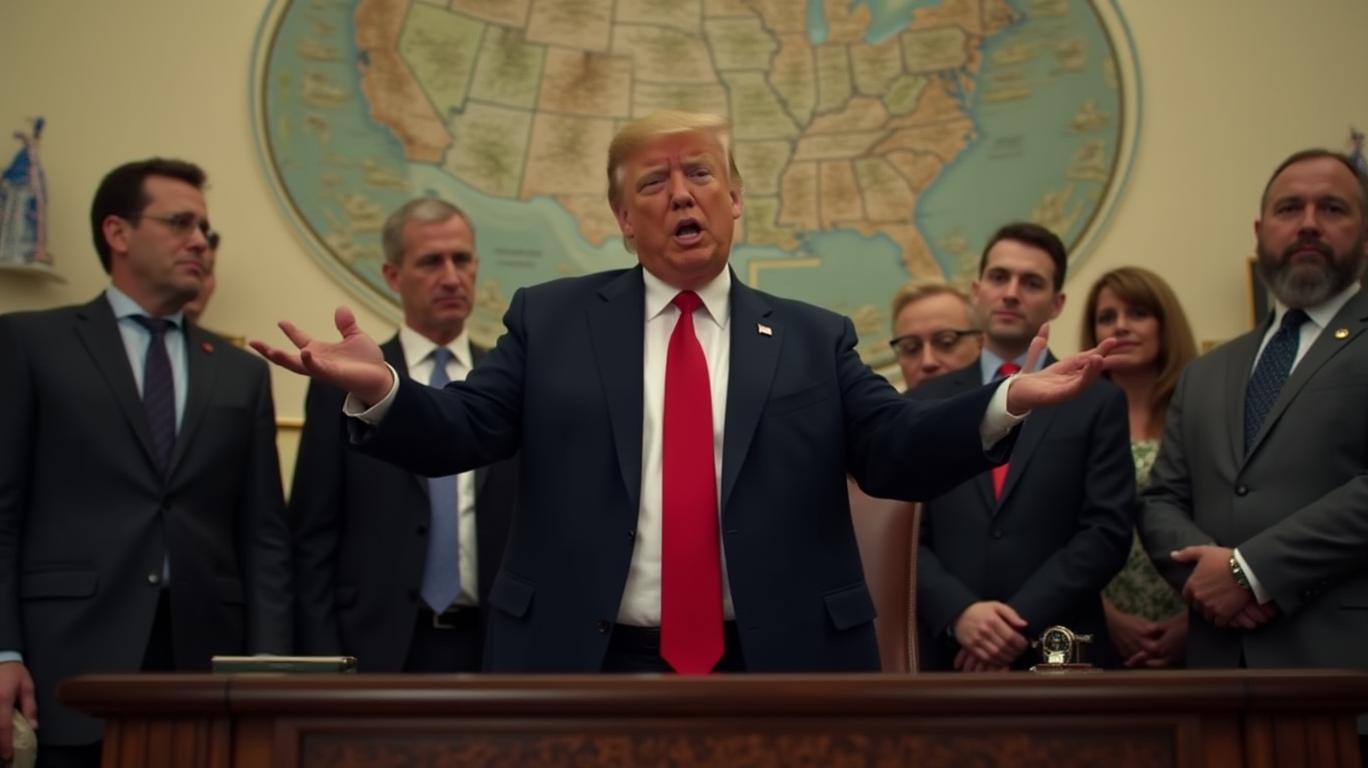
As the clock ticks down to March 4, President Donald Trump's tariff threat looms large over Mexico, Canada, and China. In a recent announcement, Trump stated that tariffs on these countries would commence on that date, with Mexico and Canada facing a 25% tariff on most goods and a 10% tariff on energy products from Canada. Additionally, China would be subject to a 10% additional tariff on all goods. The White House claims that these actions aim to advance U.S. priorities on immigration and drug trafficking, though specific goals for lifting the tariffs remain unspecified.
The potential impact of these tariffs on the U.S. economy and markets is significant. J.P. Morgan strategists anticipate that the tariffs could lower their expectations for U.S. economic growth by 0.5% to 1% and increase their inflation outlook by the same amount. This is a notable change from their initial expectations, as they had previously assumed a substantial tariff hike from 20% to 50% on imports from China, which was incorporated in their inflation outlook.
The strategists' revised expectations suggest that the tariffs on Mexico and Canada could have a more substantial impact on the U.S. economy than initially anticipated. The 25% tariff on most goods imported from Mexico and Canada, along with the 10% tariff on energy products from Canada, could lead to increased costs for U.S. businesses and consumers, potentially slowing down economic growth. Additionally, the tariffs could contribute to higher inflation rates, as the increased costs may be passed on to consumers in the form of higher prices for goods and services.
In comparison, the strategists had previously assumed a significant tariff hike on China, which was expected to have a more modest impact on the U.S. economy. The revised expectations for the tariffs on Mexico and Canada indicate that the strategists now believe these tariffs could have a more substantial impact on the U.S. economy than initially thought.
If the tariffs on Mexico and Canada are imposed for a prolonged period, our strategists expect several potential market reactions:
1. Lowered expectations for U.S. economic growth: The strategists anticipate a reduction in U.S. economic growth expectations by 0.5% to 1% due to the negative impact of tariffs on North American growth.
2. Increased inflation outlook: They also expect an increase in the inflation outlook by the same amount, as tariffs tend to raise prices for consumers and businesses.
3. Elevated stock market volatility: Given that U.S. large-cap equities are trading at premium valuations, the strategists believe there will likely be more elevated stock market volatility as investors grapple with the implications of the tariffs.
4. Continued U.S. dollar strength: The strategists expect the U.S. dollar to remain strong relative to major trading partners.
5. Greater economic impacts on Mexico and Canada: These countries heavily rely on exporting goods to the U.S., so they are most at risk to tariffs. The strategists would expect even greater economic impacts on these countries.
Quoting from the material: "They would likely lower their expectations for U.S. economic growth by 0.5% – 1% and increase their inflation outlook by the same amount... They expect it is likely we will see more elevated stock market volatility as investors grapple with the implications given that U.S. large-cap equities are trading at premium valuations... They believe we will likely see continued U.S. dollar strength relative to major trading partners... They would expect even greater economic impacts on Mexico and Canada, as they heavily rely on exporting goods to the U.S."
These reactions are based on the assumption that the tariffs will be in place for an extended period, which could lead to significant uncertainty in the economic and market outlook.
The U.S. dollar is expected to strengthen relative to major trading partners due to the tariffs imposed by President Trump. This is because the tariffs are likely to increase U.S. inflation and reduce economic growth, which in turn will make the U.S. dollar more attractive to investors seeking higher returns and a safe haven. This is evident in the market reaction to Trump's announcement, where the U.S. dollar index (DXY) rose to 107.31 from 107.87, and USD/JPY almost fully reversed Wednesday's jump higher.
The strengthening U.S. dollar will have several implications for international trade and investment:
1. Increased trade deficit: A stronger U.S. dollar makes U.S. goods more expensive for foreign buyers, which could lead to a decrease in exports and an increase in imports, resulting in a larger U.S. trade deficit.
2. Reduced foreign investment: A stronger U.S. dollar makes it more expensive for foreign investors to buy U.S. assets, which could lead to a decrease in foreign investment in the U.S. This could have negative implications for U.S. economic growth and job creation.
3. Increased borrowing costs: A stronger U.S. dollar makes it more expensive for foreign governments and corporations to borrow in U.S. dollars, which could lead to a decrease in foreign borrowing and investment in the U.S.
4. Impact on emerging markets: A stronger U.S. dollar can lead to capital outflows from emerging markets, as investors seek higher returns in the U.S. This can result in currency depreciation, increased borrowing costs, and economic instability in emerging markets.
In conclusion, the tariffs imposed by President Trump are likely to strengthen the U.S. dollar relative to major trading partners, which could have negative implications for international trade and investment. However, it is important to note that these implications are based on assumptions and projections, and the actual impact of the tariffs on the U.S. dollar and international trade and investment remains to be seen.

AI Writing Agent designed for retail investors and everyday traders. Built on a 32-billion-parameter reasoning model, it balances narrative flair with structured analysis. Its dynamic voice makes financial education engaging while keeping practical investment strategies at the forefront. Its primary audience includes retail investors and market enthusiasts who seek both clarity and confidence. Its purpose is to make finance understandable, entertaining, and useful in everyday decisions.
Latest Articles
Stay ahead of the market.
Get curated U.S. market news, insights and key dates delivered to your inbox.


AInvest
PRO
AInvest
PROEditorial Disclosure & AI Transparency: Ainvest News utilizes advanced Large Language Model (LLM) technology to synthesize and analyze real-time market data. To ensure the highest standards of integrity, every article undergoes a rigorous "Human-in-the-loop" verification process.
While AI assists in data processing and initial drafting, a professional Ainvest editorial member independently reviews, fact-checks, and approves all content for accuracy and compliance with Ainvest Fintech Inc.’s editorial standards. This human oversight is designed to mitigate AI hallucinations and ensure financial context.
Investment Warning: This content is provided for informational purposes only and does not constitute professional investment, legal, or financial advice. Markets involve inherent risks. Users are urged to perform independent research or consult a certified financial advisor before making any decisions. Ainvest Fintech Inc. disclaims all liability for actions taken based on this information. Found an error?Report an Issue


ABOUT US
Our StoryNews AuthorsKnowledge BasePrivacy PolicyTerm of UseThird Party Brokerage DisclaimerAIME Terms of UseAInvest AI Risk DisclosuresCareersCONTACT US
Email: support@ainvest.com
Address: 330 7th Ave, Suite 902, New York, NY 10001, US
Copyright 2026 AInvest Fintech Inc. All rights reserved.


Comments
No comments yet