
Trump's Tariff Tectonics: Navigating Geopolitical Risk and Emerging Market Re-Rating Opportunities
 Aime Summary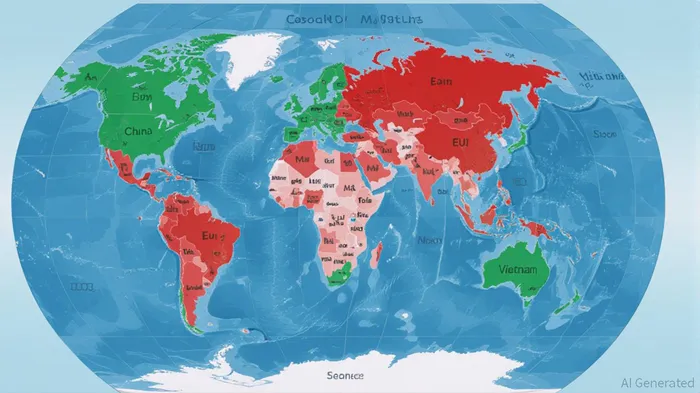
The U.S. trade landscape in 2025 has become a seismic force, reshaping global equity markets under the weight of President Trump's sweeping tariffs. With 71% of U.S. imports now taxed—ranging from 10% baseline rates to 250% on pharmaceuticals—the world is witnessing a dramatic shift from globalization to a fragmented, protectionist order. For investors, this volatility presents both peril and opportunity, particularly in emerging markets. The question is no longer whether tariffs will reshape trade flows but how to navigate the resulting geopolitical risks and capitalize on re-rating opportunities.
Investor Sentiment: From Panic to Pragmatism
Trump's tariffs have triggered a recalibration of global investor sentiment. Initially, markets reacted with alarm to the escalation of duties on China (145%), the EU (15% under a temporary deal), and Brazil (50%). Retaliatory tariffs from trade partners, such as China's 84% on U.S. goods, further fueled fears of a trade war. However, as the year progressed, sentiment shifted toward pragmatism. The July 2025 U.S. jobs report—showing a mere 73,000 nonfarm payrolls added—sparked expectations of a Fed rate cut, weakening the dollar and making emerging market assets more attractive.
The iShares MSCIMSCI-- Emerging Markets ETF (EEM) outperformed the S&P 500 by 8% in the month following the report, while the Mexican peso and Brazilian real appreciated by 5% and 3%, respectively. This divergence reflects a broader trend: investors are increasingly allocating capital to markets where growth potential outweighs short-term trade risks. Yet, the surge is not uniform. The iShares MSCI IndiaINDA-- ETF (EEMI) dipped 0.6% after Trump's 50% tariff threat, underscoring the fragility of sentiment in politically exposed economies.
Emerging Market Re-Rating: A New Geopolitical Order
The Trump tariff regime has accelerated a realignment of global economic blocs. Countries are now forced to choose between aligning with U.S. protectionism or embracing open trade frameworks with China and Russia. This has created a bifurcated landscape:
Resilient Markets: India and Vietnam, for instance, are leveraging their strategic positions in the energy transition and supply chain diversification. India's push into renewable energy and infrastructure, despite its 25% tariff on Russian oil, has attracted investors seeking long-term growth. Vietnam's trade deal with the U.S. (20% tariff) has provided temporary relief, though its reliance on U.S. manufacturing reshoring remains a double-edged sword.
Vulnerable Markets: Brazil and Mexico face acute exposure. Brazil's 50% tariff on U.S. exports could reduce its GDP by 0.6%–1.0%, while Mexico's 30% IEEPA tariff, though partially offset by USMCA exemptions, still strains its auto sector. These markets require careful hedging strategies.
The surge in emerging market ETFs is not merely a short-term hype but a re-rating driven by structural shifts. J.P. Morgan notes that the average effective U.S. tariff rate has settled at 17%, with sector-specific rates as high as 200%. While this raises inflation and risks a global recession, it also creates opportunities for investors who can differentiate between resilient and vulnerable sectors.
Sustainability: A Delicate Balance
The sustainability of this re-rating hinges on three factors:
Trade Deal Dynamics: Temporary reprieves, such as the U.S.-Japan auto tariff cap (15%) and the U.S.-UK deal, provide short-term stability. However, the absence of a comprehensive U.S.-China agreement leaves the door open for further escalations.
Monetary Policy Interactions: The Fed's delayed rate cuts (expected in September 2025) will influence capital flows. If inflation from tariffs proves transitory, emerging markets could continue to attract yield-seeking investors. Conversely, a U.S. recession would trigger capital flight.
Geopolitical Risk Mitigation: Countries like India are diversifying energy imports (shifting from Russian oil to U.S. and Middle Eastern sources) to reduce exposure. Such strategic moves enhance long-term resilience but require time to materialize.
Actionable Strategies for Value-Oriented Investors
For investors navigating this complex environment, a multi-pronged approach is essential:
Sector Rotation: Overweight resilient sectors like energy, steel, and infrastructure. U.S. Steel and Freeport-McMoRanFCX-- have benefited from domestic demand, while emerging market peers in India and Brazil are gaining traction. Underweight vulnerable sectors such as autos and semiconductors, where margin compression is inevitable.
Geographic Diversification: Focus on markets with growth potential and geopolitical agility. India's energy transition and Brazil's agricultural exports offer compelling opportunities, but investors should hedge against tariff risks by diversifying across Southeast Asia (Vietnam, Thailand) and the Middle East.
Thematic ETFs: Use thematic ETFs to hedge volatility and capture long-term trends. The iShares U.S. Tech Independence Focused ETF (IETC) and iShares U.S. Infrastructure ETF (IFRA) align with reshoring and energy transition themes. Gold (IAU) and BitcoinBTC-- (HODL) can serve as inflation hedges in a high-uncertainty environment.
Currency Management: Allocate to emerging market currencies with strong fundamentals. The Brazilian real and Indian rupee have shown resilience, but investors should monitor central bank interventions and trade balances.
Conclusion: A New Era of Strategic Investing
Trump's tariffs have ushered in a new era of geopolitical risk and market fragmentation. While the immediate outlook is volatile, the long-term re-rating of emerging markets offers a compelling case for value investors. Success lies in balancing short-term hedging with long-term positioning—rotating into resilient sectors, diversifying geographically, and leveraging thematic ETFs to navigate the shifting trade landscape.
As the global economy adjusts to this new order, the key for investors is adaptability. The markets may tremble under the weight of tariffs, but those who recognize the structural shifts will find fertile ground for growth.

Delivering real-time insights and analysis on emerging financial trends and market movements.
Latest Articles
Stay ahead of the market.
Get curated U.S. market news, insights and key dates delivered to your inbox.
AInvest
PRO
AInvest
PRO



Comments
No comments yet