
Trump's Tariff Tantrum and Goldman Sachs: A Clash of Power in Financial Markets
 Aime Summary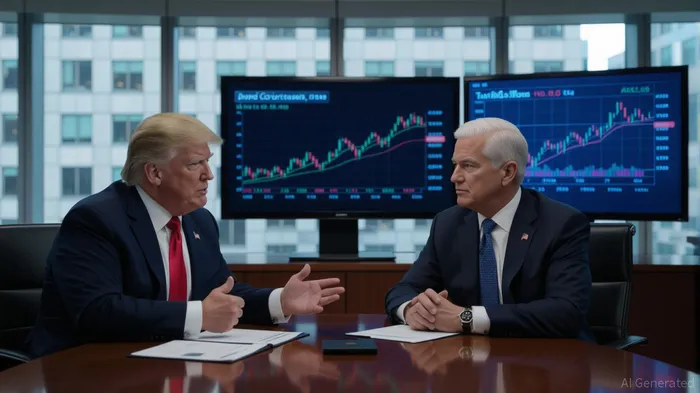
The recent feud between U.S. President Donald Trump and Goldman SachsGS-- CEO David Solomon has escalated beyond a mere spat into a symbolic battle over the future of economic policy and investor confidence. At the heart of the conflict lies a fundamental disagreement: Trump's assertion that tariffs are a net economic gain for the U.S., versus GoldmanGS-- Sachs' warning that they are shifting costs to consumers and fueling inflation. This clash underscores a broader tension between political rhetoric and empirical economic analysis, with far-reaching implications for market volatility, inflation expectations, and the performance of consumer-driven sectors.
Tariffs as a Political Weapon, Not an Economic Tool
Trump's tariffs, now exceeding $28 billion in monthly revenue, are framed as a victory for American industry. Yet Goldman Sachs' research, led by Chief Economist Jan Hatzius, paints a different picture. The bank estimates that U.S. consumers have already absorbed 22% of tariff costs by June 2025, with projections rising to 67% by October 2025. This shift from corporate to consumer burden is not merely a redistribution of pain—it is a structural risk to inflation and economic stability.
The administration's dismissal of these warnings reflects a growing trend of political interference in economic messaging. By attacking Goldman Sachs and other Wall Street institutions, Trump is not just defending his policies; he is undermining the credibility of independent economic analysis. This erodes investor trust in market fundamentals, creating a feedback loop where uncertainty drives volatility.
Sector-Specific Fallout: Retail, Manufacturing, and Precious Metals
The retail and manufacturing sectors are bearing the brunt of Trump's tariff agenda. Tariffs on autos, steel, aluminum, and copper have raised input costs for manufacturers, while retaliatory measures from China, the EU, and Canada have slashed U.S. export competitiveness. Goldman Sachs' modeling suggests that the combined impact of tariffs and foreign retaliation could reduce U.S. GDP by 1.0% as of April 2025, with 675,000 full-time equivalent jobs at risk.
For investors, this means heightened exposure to sector-specific volatility. Retailers face margin compression as they pass on higher costs to consumers, while manufacturers grapple with supply chain disruptions. The legal uncertainty surrounding the IEEPA tariffs adds another layer of risk. If courts strike down these tariffs, as they did in May 2025, the economic fallout could be abrupt, with GDP and revenue projections plummeting.
Precious metals, however, are emerging as a safe haven in this climate of geopolitical and economic uncertainty. Gold and silver prices have surged in response to conflicts in the Red Sea and the Middle East, with COMEX futures rising 1.2% and 4.2% respectively in 2024. The GARCH-MIDAS model, used in recent studies, confirms that geopolitical risk and economic policy uncertainty (EPU) are key drivers of precious metal volatility. Investors are increasingly allocating to gold and silver as hedges against inflation and policy-driven market instability.
The Inflation Conundrum: Who Bears the Cost?
Goldman Sachs' warning that tariffs could push core PCE inflation to 3.2% by year-end is not just a technical forecast—it is a political challenge. Trump's insistence that tariffs are not inflationary ignores the reality that consumers are already paying more for goods. The Treasury's tariff revenue, while impressive, is a one-sided narrative; it does not account for the broader economic costs of reduced trade efficiency and retaliatory measures.
This disconnect between political messaging and economic reality is reshaping investor behavior. Institutional investors are hedging against inflation by rotating into commodities and Treasury inflation-protected securities (TIPS). Meanwhile, retail investors, influenced by Trump's rhetoric, are overexposed to sectors like manufacturing, which face both input cost pressures and foreign retaliation.
Investment Implications and Strategic Recommendations
For investors navigating this volatile landscape, the key is to balance exposure to high-risk sectors with defensive assets. Here are three actionable strategies:
Diversify into Precious Metals: Gold and silver remain critical hedges against geopolitical and inflationary risks. Given the ongoing conflicts in the Middle East and the Red Sea, allocations to physical gold or ETFs like GLDGLD-- and SLV should be considered.
Avoid Overexposure to Retail and Manufacturing: These sectors are vulnerable to both tariff-driven cost increases and foreign retaliation. Investors should favor companies with diversified supply chains or those benefiting from rate cuts (e.g., consumer discretionary stocks).
Monitor Policy Uncertainty: The legal status of IEEPA tariffs and the outcome of the Federal Reserve's rate-cutting cycle will shape market dynamics. Positioning in short-term bonds or cash equivalents can provide flexibility in a rapidly shifting environment.
Conclusion: A New Era of Political-Economic Uncertainty
The Trump-Goldman clash is emblematic of a larger shift: political leaders are increasingly weaponizing economic policy to advance ideological agendas, often at the expense of market stability. For investors, the lesson is clear—relying solely on political narratives is a recipe for disaster. Instead, a disciplined approach that accounts for geopolitical risks, inflationary pressures, and sector-specific vulnerabilities will be essential in the years ahead.
As the Fed grapples with whether to cut rates in response to tariff-driven inflation, and as courts decide the fate of Trump's tariffs, one thing is certain: the financial markets will remain a battleground for power, policy, and profit. Investors who adapt to this new reality will find opportunities in the chaos.

Delivering real-time insights and analysis on emerging financial trends and market movements.
Latest Articles
Stay ahead of the market.
Get curated U.S. market news, insights and key dates delivered to your inbox.
AInvest
PRO
AInvest
PRO



Comments
No comments yet