
Trump's Tariff Surge and BLS Controversy: A New Era of Geopolitical Risk for Global Markets?
 Aime Summary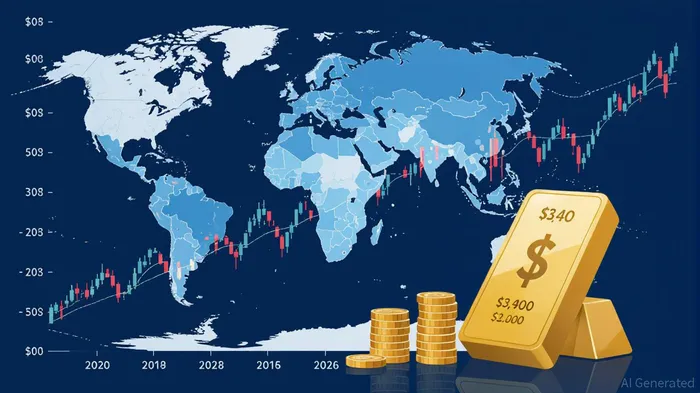
The U.S. economic landscape in 2025 has been reshaped by two seismic events: President Donald Trump's abrupt firing of Bureau of Labor Statistics (BLS) commissioner Erika McEntarfer and the imposition of a sweeping tariff regime. These actions have not only destabilized financial markets but also raised urgent questions about the long-term implications for multinational equities, inflation dynamics, and global trade. As investors grapple with a new era of geopolitical risk, the interplay between policy-driven uncertainty and sector-specific resilience is becoming a critical factor in portfolio strategy.
The BLS Controversy: A Crisis of Trust in Economic Data
The July 2025 jobs report—showing a mere 73,000 jobs added and a 258,000 downward revision for May and June—triggered a political firestorm. Trump's accusation that McEntarfer “rigged” the data to harm his re-election prospects, followed by her immediate dismissal, has eroded confidence in the BLS's independence. While experts like former BLS commissioner Keith Hall argue that data manipulation is implausible due to the agency's collaborative process, the perception of politicization persists. This erosion of trust extends to inflation metrics, as the BLS's Consumer Price Index (CPI) and Producer Price Index (PPI) are foundational to global economic policy.
The fallout is already evident. The S&P 500 dropped 2.5%, gold prices surged to $3,400 per ounce, and investors are increasingly turning to alternative data sources like satellite analytics and real-time hiring trends. If the BLS's credibility continues to decline, the Federal Reserve's ability to anchor inflation expectations could be compromised, leading to higher volatility in bond yields and equity markets.
Trump's Tariff Surge: A Double-Edged Sword for Multinationals
The August 2025 tariff regime—raising the U.S. effective tariff rate to 17%, the highest since the 1933 Smoot-Hawley era—has created a bifurcated market. Defensive sectors like healthcare and utilities are gaining traction, while export-dependent industries face existential threats.
Defensive Sectors: Resilience in a Stagflationary Climate
Utilities and consumer staples have historically outperformed during periods of stagflation, and 2025 is no exception. The S&P 500 Consumer Staples Index, with a 2.3% dividend yield, offers a hedge against cash flow erosion. Companies like Coca-ColaKO-- (KO) and Johnson & JohnsonJNJ-- (JNJ) are leveraging their pricing power to absorb cost shocks from tariffs. JNJ, for instance, has increased R&D spending by 18% year-over-year to maintain margins, while KO's global brand strength allows it to pass on input costs to consumers.
Healthcare: Strategic Reshoring and Innovation
Pharmaceutical giants like Eli LillyLLY-- (LLY) and NovartisNVS-- (NVS) are leading the charge in reshoring production. LLY'sLLY-- $50 billion investment in U.S. manufacturing of active pharmaceutical ingredients (APIs) has insulated it from import tariffs, while NVS's $23 billion expansion in domestic facilities has reduced reliance on European and Asian supply chains. These moves have bolstered their financials: LLY's Q1 2025 revenue surged 45% to $12.7 billion, driven by blockbuster drugs like Mounjaro.
Vulnerable Sectors: Technology and Energy
Conversely, sectors with high foreign revenue exposure—such as technology and energy—are underperforming. The Morgan StanleyMS-- Institutional Equity Division Tariff Risk Index shows that tech stocks with significant China and Mexico exposure have declined by 22% and 10%, respectively, since March 2024. Energy firms like ChevronCVX-- (CVX) face dual pressures from retaliatory tariffs and currency fluctuations, as the U.S. dollar weakens against the euro amid recession fears.
Currency Exposure: A Hidden Risk for Multinationals
The U.S. dollar's decline has amplified the risks for multinational equities. Companies with significant foreign earnings, such as AppleAAPL-- (AAPL) and MicrosoftMSFT-- (MSFT), face margin compression as the dollar weakens. For example, AAPL's Q2 2025 revenue from China dropped 14% year-over-year, partly due to retaliatory tariffs and currency devaluation.
Investors are increasingly hedging currency risk through instruments like forward contracts and diversified portfolios. European industrials (e.g., Siemens, ASML) and Japanese healthcare firms (e.g., Takeda) offer alternative exposures less sensitive to U.S.-centric trade tensions.
Investment Implications and Strategic Recommendations
- Defensive Allocation: Overweight utilities and consumer staples, which offer stable cash flows and pricing power. Consider ETFs like the Vanguard Consumer Staples ETF (VCSH) and the iShares U.S. Utilities ETF (IDU).
- Currency Hedging: For multinational equities, use currency-hedged ETFs (e.g., FXI for China) or diversify into markets with stronger currencies, such as the eurozone.
- Healthcare Exposure: Target companies with robust R&D pipelines and domestic manufacturing capabilities, such as LLY and NVS.
- Inflation Hedges: Allocate to real assets like REITs (e.g., Vanguard Real Estate ETF, VNQ) and inflation-protected securities (TIPS).
Conclusion
Trump's 2025 policies have ushered in a new era of geopolitical risk, characterized by eroded trust in economic data and protectionist trade measures. While defensive sectors and currency-hedged strategies offer a buffer, the long-term implications for global markets remain uncertain. Investors must remain agile, prioritizing resilience over short-term gains in a landscape where policy-driven volatility is the new norm.

Stay ahead of the market.
Get curated U.S. market news, insights and key dates delivered to your inbox.


AInvest
PRO
AInvest
PRO



Comments
No comments yet