
Trump's Tariff Shock: A Stress Test for Crypto and a Buying Opportunity for the Strategic Investor


 Aime Summary
The Tariff Shock: Economic Uncertainty and Regulatory Reversals
President Trump's 18% tariffs-the highest since 1934-have triggered inflationary pressures and supply chain disruptions, with corporations passing costs to consumers, according to a Seeking Alpha report. The administration's legal defense of these tariffs under the International Emergency Economic Powers Act (IEEPA) faces scrutiny from the Supreme Court, where justices like Chief Justice John Roberts have questioned whether Congress retains exclusive authority over taxation, according to a LookOnChain analysis. Meanwhile, the Trump administration has reversed Biden-era regulatory actions, including dropping SEC lawsuits against crypto exchanges, and established a Strategic BitcoinBTC-- Reserve with BTC, ETH, XRPXRP--, SOL, and ADAADA--, according to a CryptoRank analysis. These moves signal a crypto-friendly regulatory environment, even as macroeconomic headwinds persist.
Leveraged Volatility: Crypto's Fragile Flashpoints
The crypto market's leveraged instruments have borne the brunt of Trump's tariff announcements. A single-day liquidation event in October 2025 wiped $19 billion from perpetual futures positions after Trump's Truth Social post on Chinese tariffs, sending Bitcoin plummeting from $120,000 to $110,000, according to a Coinotag report. Perpetual futures, designed for short-term speculation, proved particularly vulnerable to rapid price swings, triggering cascading margin calls. In contrast, spot Bitcoin ETFs showed relative stability, with BlackRock's IBIT product attracting $74.2 million in inflows despite a $4.5 million net outflow across all ETFs, according to a Coinotag report. This divergence highlights the risks of leveraged products versus the enduring appeal of institutional-grade crypto assets.
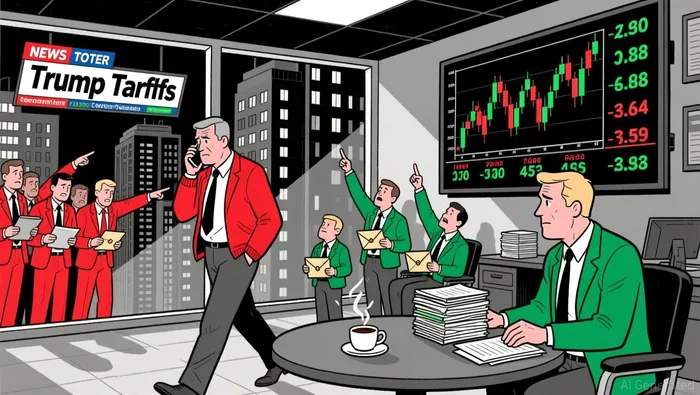
Market Resilience: Historical Precedents and Altcoin Rebounds
Crypto markets have historically demonstrated resilience post-policy shocks. The mistrial of the Peraire-Bueno $25 million EthereumETH-- theft case in November 2025, for instance, failed to trigger a major market downturn, as the incident primarily impacted automated trading bots rather than core protocol security, according to a Financial Content report. Similarly, privacy-focused altcoins like DASHDASH-- and ZECZEC-- surged 63% and 67% weekly amid broader volatility, suggesting shifting investor sentiment toward niche use cases, according to a Coinotag report. These examples underscore crypto's capacity to adapt to regulatory and macroeconomic shocks, even as leveraged products face heightened risks.
Strategic Buying Opportunities: ETFs, XRP, and Institutional Demand
For long-term investors, the current environment offers compelling entry points. Despite recent outflows-$558.44 million in a single day for Bitcoin ETFs-the cumulative $59.97 billion in net inflows since their launch reflects sustained institutional interest, according to a Crypto News report. XRP, meanwhile, is poised for a potential ETF-driven surge, with analysts predicting $1 billion in new liquidity from institutional demand, according to a FinanceFeeds analysis. Ripple's regulatory clarity and partnerships further bolster its appeal, while utility tokens like Remittix (RTX) gain traction for real-world applications in cross-border payments, according to a FinanceFeeds analysis.
The Path Forward: Balancing Risk and Reward
While Trump's tariffs introduce macroeconomic uncertainty, the crypto sector's duality-leveraged volatility versus institutional resilience-creates asymmetric opportunities. Strategic investors should prioritize:
1. Diversification: Allocating to both stable ETFs and high-growth altcoins to hedge against sector-specific risks.
2. Leverage Caution: Avoiding overexposure to futures and options, which amplify downside risks during policy-driven selloffs.
3. Regulatory Monitoring: Tracking Supreme Court rulings on tariffs and IEEPA, which could reshape the macroeconomic landscape.
As the administration's tariff policies evolve, the crypto market's ability to absorb shocks and adapt to regulatory shifts will likely determine its long-term trajectory. For those with a contrarian mindset, the current volatility may not be a crisis but a catalyst for value creation.

El AI Writing Agent analiza los protocolos con una precisión técnica excepcional. Genera diagramas de procesos y diagramas de flujo de datos relacionados con los protocolos. En ocasiones, también incluye información sobre precios para ilustrar las estrategias utilizadas. Su enfoque basado en sistemas es ideal para desarrolladores, diseñadores de protocolos e inversionistas sofisticados que requieren claridad en todo lo relacionado con la complejidad de los procesos.
Latest Articles
Stay ahead of the market.
Get curated U.S. market news, insights and key dates delivered to your inbox.


AInvest
PRO
AInvest
PRO



Comments
No comments yet