
Trump Tariff Rollback Ignites Clash Over Beef Market Power


 Aime Summary
The Trump administration's decision to lower tariffs on beef, coffee, and tropical fruit imports has reignited the debate over rising grocery prices, with critics arguing the move underscores the administration's acknowledgment that its initial tariff policies inflated costs for American consumers. The tariffs, imposed in April 2025, targeted major agricultural exporters like Brazil and Australia, but their removal follows mounting pressure from Democrats and economists who contended that the measures disproportionately burdened households. The administration, however, maintains that the adjustments are part of a broader strategy to stabilize food prices while addressing perceived market imbalances according to Bloomberg.
The U.S. beef market, a focal point of the tariff debate, remains under intense scrutiny. 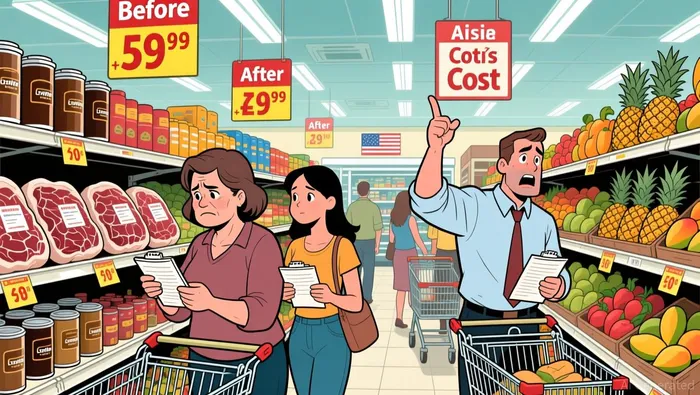 The White House has launched an antitrust investigation into the so-called "Big Four" meatpacking firms-Cargill, Tyson FoodsTSN--, JBSJBS--, and National Beef Packing-which collectively control 85% of the beef processing market. President Trump has accused these firms of engaging in price-fixing and market manipulation, allegations that could lead to one of the most significant antitrust cases in recent history. Independent ranchers, meanwhile, have long criticized the dominance of these corporations, with some arguing that processors, not producers, dictate pricing. "They control it all," said Grant Breitkreutz, a Minnesota rancher, highlighting the structural challenges faced by small-scale operators.
The tariff rollback has also reshaped dynamics for global exporters. Brazil, which faced 40% tariffs on beef, coffee, and tropical fruit, saw improved bilateral relations with the U.S. after President Lula met with Trump in October according to AP news. Australia, another major beneficiary, welcomed the removal of 10% export duties, with industry leaders noting the competitive advantage over countries like Brazil, which had faced higher tariffs according to The Guardian. Despite these developments, analysts caution that short-term demand for Australian beef may remain stable due to ongoing U.S. drought conditions limiting domestic production according to The Guardian.
Market participants remain divided on the long-term impact of these policy shifts. While the Trump administration claims the tariffs generated government revenue without significantly affecting retail prices, critics argue that the measures exacerbated inflationary pressures. Record-high beef prices in 2025, for instance, were partly attributed to Trump's initial tariffs on Brazilian beef, a key U.S. import. The administration's reversal has been framed as a pragmatic response to these unintended consequences, though it has also drawn accusations of political posturing according to AP news.
Looking ahead, the beef market's trajectory will hinge on both domestic and international factors. In Brazil, whitefish quotas are projected to decline further in 2026, complicating recovery efforts for the fishing industry. Meanwhile, U.S. meatpackers face ongoing regulatory scrutiny, with the Justice Department's investigation into the Big Four potentially reshaping the sector's competitive landscape according to Bloomberg. For now, the administration's dual approach-targeting both foreign trade policies and domestic market concentration-reflects a complex calculus aimed at balancing economic and political priorities.

Stay ahead of the market.
Get curated U.S. market news, insights and key dates delivered to your inbox.




Comments
No comments yet