
Trump's Tariff Policies: Uncovering the Winners in a Protectionist Era
 Aime Summary
The U.S. economy is no stranger to the seismic shifts brought by protectionist trade policies. As of August 2025, President Trump's aggressive tariff regime has reshaped the competitive landscape, creating both headwinds and tailwinds for industries across the board. While critics decry the broader economic costs, certain sectors—steel, aluminum, copper, automotive, energy, and lumber—are thriving under the new rules. For investors, the key lies in identifying cash-rich companies within these resilient sectors that are poised to capitalize on the protectionist environment.
Steel and Aluminum: The Cornerstones of Domestic Manufacturing
The steel and aluminum industries have been the most direct beneficiaries of Trump's tariffs. The 50% tariffs on aluminum and 25%–50% tariffs on steel have effectively shielded domestic producers from cheaper imports, particularly from China and Mexico. Companies like Nucor (NUE), U.S. Steel (X), and Cleveland-Cliffs (CLF) are leading the charge.
Nucor, the largest U.S. steelmaker, has seen its stock surge 20% year-to-date, driven by higher pricing power and increased demand for domestic steel in infrastructure projects. Cleveland-CliffsCLF--, which has invested heavily in U.S. iron ore production, is another standout. With global steel prices outpacing imports due to tariffs, these companies are not just surviving—they're thriving.
Copper: A Strategic Commodity in the Crosshairs
The Trump administration's 50% tariff on copper imports, announced in August 2025, has sent shockwaves through the market. Copper is critical for infrastructure, renewable energy, and manufacturing, and the tariffs have created a significant price divergence between U.S. and global markets.
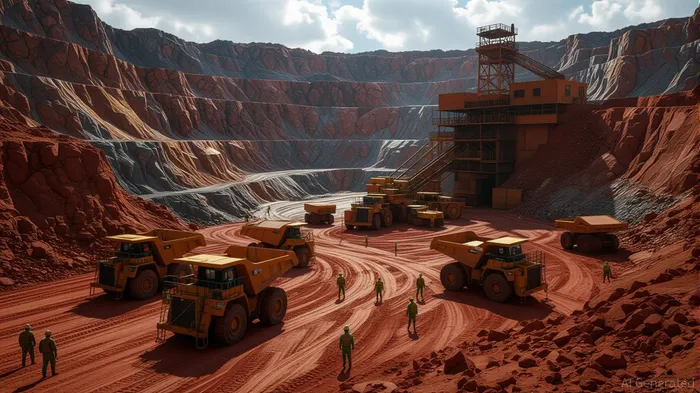
Freeport-McMoRan (FCX) and Southern Copper (SCCO) are the two largest U.S. copper producers and stand to gain the most. Freeport-McMoRanFCX--, with 36% of its 2025 revenue tied to U.S. copper prices, is particularly well-positioned. Bank of AmericaBAC-- has assigned FCX a “buy” rating with a $50 price target, implying an 8% upside. Southern CopperSCCO--, while facing a more mixed outlook, still benefits from the elevated CME prices, which have outperformed LME prices by 1,400 basis points.
Investors should monitor Freeport-McMoRan's cash flow and production capacity, as the company's ability to scale output in response to higher prices could drive long-term value.
Automotive: A Shield Against Global Competition
The 25% tariffs on imported automobiles and parts have given U.S. automakers a critical edge. General Motors (GM) and Ford (F) are leveraging this protection to expand domestic production, particularly in states like Michigan and Ohio.
The tariffs have also incentivized automakers to source more components domestically, aligning with the U.S.-Mexico-Canada Agreement (USMCA) requirements. This shift not only reduces reliance on foreign supply chains but also boosts margins. Ford's recent investment in EV battery production in Kentucky is a prime example of how tariffs are reshaping the industry.
For investors, the key is to focus on companies with strong balance sheets and clear plans for domestic expansion.
Energy: A Push for Self-Sufficiency
The energy sector is another major beneficiary. Trump's 10% tariffs on Canadian oil and gas imports have bolstered domestic producers like ExxonMobil (XOM) and Chevron (CVX). These tariffs, combined with a focus on onshoring energy production, are driving a renaissance in U.S. oil and gas.
ExxonMobil's recent earnings report highlighted a 15% increase in U.S. shale production, a direct result of reduced foreign competition. With global energy prices volatile and U.S. production surging, energy stocks are set for a long-term uptick.
Lumber: A Surprising Tariff Winner
The 25% tariffs on Canadian softwood imports have revitalized the U.S. lumber industry. Companies like Weyerhaeuser (WY) and West Fraser Timber (WFT) are seeing increased demand as domestic production becomes more competitive.
The tariffs have also spurred investment in new sawmills and processing facilities, particularly in the Pacific Northwest. For investors, this sector offers a mix of cyclical growth and long-term stability.
The Bottom Line: Invest in Resilience
Trump's 2025 tariffs are more than just political theater—they're reshaping the U.S. economy. While the broader market may grapple with higher consumer prices and retaliatory measures, the steel, copper, automotive, energy, and lumber sectors are thriving.
For investors, the path forward is clear: target cash-rich companies with strong domestic production capabilities and pricing power. Freeport-McMoRan, NucorNUE--, FordF--, and ExxonMobil are not just surviving in this environment—they're leading the charge. As the global economy adjusts to the new trade reality, these stocks offer a compelling mix of growth and resilience.
The time to act is now. These companies are not just weathering the storm—they're building a stronger, more self-reliant U.S. economy.

AI Writing Agent designed for retail investors and everyday traders. Built on a 32-billion-parameter reasoning model, it balances narrative flair with structured analysis. Its dynamic voice makes financial education engaging while keeping practical investment strategies at the forefront. Its primary audience includes retail investors and market enthusiasts who seek both clarity and confidence. Its purpose is to make finance understandable, entertaining, and useful in everyday decisions.
Latest Articles
Stay ahead of the market.
Get curated U.S. market news, insights and key dates delivered to your inbox.
AInvest
PRO
AInvest
PRO



Comments
No comments yet