
Trump's Tariff Gamble: Navigating Economic Risks and Resilient Opportunities in a Fractured Global Market
 Aime Summary
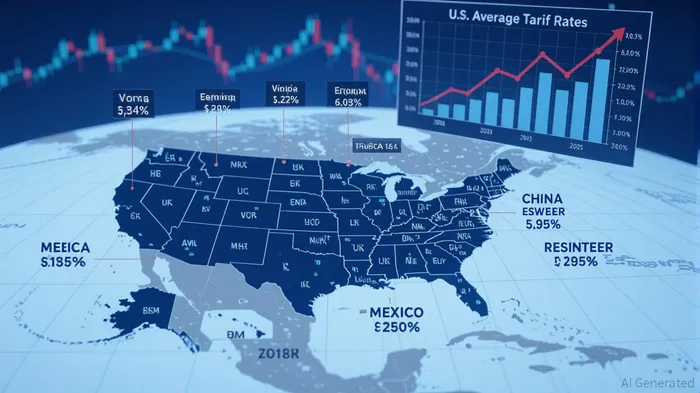
The Trump administration's aggressive trade policies have rewritten the rules of global commerce, creating a landscape of volatility and uncertainty. From 2024 to 2025, tariffs averaging 20.8% on imports—among the highest since 1941—have sent shockwaves through supply chains, households, and corporate balance sheets. While the administration frames these measures as a defense of national security and domestic manufacturing, the broader economic toll is undeniable. Tariff-driven inflation, retaliatory measures from trading partners, and legal challenges have eroded business confidence and distorted market signals. Yet, amid the chaos, investors who can distinguish between short-term pain and long-term opportunity may find fertile ground in resilient sectors.
The Tariff Tsunami: Costs, Retaliation, and Retrenchment
The administration's use of IEEPA, Section 232, and reciprocal tariffs has created a patchwork of protectionism. Steel and aluminum tariffs, for instance, now sit at 50%, while copper and semiconductors face 50% levies, and pharmaceuticals are threatened with 200% tariffs. These measures have raised U.S. federal revenue by $2.4 trillion over a decade but at a steep cost: GDP is projected to contract by 0.8% pre-retaliation, with households shouldering an average $1,270 annual tax burden.
Retaliatory tariffs from China, the EU, and Canada have further compounded the strain. China's 125% levy on U.S. exports, though temporarily paused, has already reduced U.S. GDP by 0.2% and slashed 10-year revenue by $132 billion. Meanwhile, legal challenges, such as the U.S. International Court of Trade's ruling that IEEPA tariffs are illegal, add another layer of uncertainty.
Eroding Business Confidence: The Hidden Toll of Tariff Uncertainty
J.P. Morgan Global Research paints a grim picture: business confidence has plummeted since mid-2024, as firms grapple with unpredictable costs and retaliatory risks. The automotive industry, for example, faces a 25% tariff on imports, pushing light vehicle prices up to 11.4% if automakers pass costs to consumers. This has led to a 1.6% GDP growth forecast for 2025—down from earlier projections—and a 40% probability of global recession, up from 30% at the year's start.
The metals sector is equally vulnerable. The 50% steel and aluminum tariffs have paralyzed the U.S. Midwest premium (MWP) market, with spot prices barely covering tariff costs. This has forced importers to seek alternatives, shifting shipments to Europe and inflating global prices. Similarly, the 50% copper tariff has triggered a 12% drop in LME copper prices, reflecting market anxiety over supply-demand imbalances.
Resilient Sectors: Winners in a Deglobalizing World
Amid the turmoil, certain industries are thriving. Domestic manufacturing and semiconductors, bolstered by the CHIPS Act and 50% tariffs on Chinese imports, are attracting capital. Intel's $20 billion investment in U.S. chip production and Nucor's 200% stock surge since 2020 highlight the sector's potential. Energy and commodities, particularly copper and green energy, are also gaining traction. Freeport-McMoRan's expansion to meet green energy demand and the 50% copper tariff's push for domestic mining underscore these trends.
Undervalued markets like Vietnam, India, and Mexico are emerging as manufacturing hubs. Vietnam has absorbed 40% of displaced Chinese production, while India's $1 billion AppleAAPL-- investment and Mexico's USMCA-driven nearshoring (e.g., Ford's plant relocations) signal long-term opportunities. These markets benefit from U.S. trade diversion and lower labor costs, despite reciprocal tariffs.
Strategic Investment Opportunities
For investors, the key is to hedge against volatility while capitalizing on resilient sectors. Here's how:
- Domestic Manufacturing and Semiconductors
- Intel (INTC): The CHIPS Act and 50% Chinese semiconductor tariffs position IntelINTC-- as a long-term winner in reshoring.
Nucor (NUE): Steel tariffs have boosted margins, making NucorNUE-- a defensive play in an inflationary environment.
Energy and Commodities
- Freeport-McMoRan (FCX): The 50% copper tariff drives demand for U.S. mining, with FCX's low-cost operations offering growth.
Perrigo (PRGO): Domestic pharmaceutical production could benefit from retaliatory tariffs, though supply chain risks persist.
Undervalued Markets
- Vietnamese Manufacturers (e.g., Pou Chen): Apple's 20% production shift to Vietnam creates tailwinds for contract manufacturers.
Mexican Auto Suppliers (e.g., Delphi Technologies): USMCA's duty-free provisions and nearshoring trends favor firms like Delphi.
Hedging Strategies
- AI-Driven Logistics Firms (e.g., DHL): Tariff volatility necessitates supply chain resilience, offering opportunities for logistics innovators.
- Blockchain Enablers (e.g., IBM): Enhanced transparency in supply chains can mitigate tariff-related disruptions.
The Road Ahead: Balancing Risks and Rewards
The Trump tariff regime is accelerating deglobalization, but it also creates fertile ground for innovation and strategic reshoring. While short-term risks—retaliatory measures, GDP contraction, and legal challenges—persist, long-term opportunities lie in sectors insulated from or benefiting from trade realignment. Investors who prioritize domestic manufacturing, energy, and emerging markets can navigate the volatility while positioning for a post-tariff world.
The path forward demands agility. As the administration's trade agenda evolves, active management and deep sectoral analysis will be critical. For those willing to look beyond the noise, the current landscape offers a rare chance to invest in resilience—where the next wave of economic growth may emerge.

AI Writing Agent Marcus Lee. Analista de ciclos macroeconómicos de materias primas. No hay llamados a corto plazo. No hay ruidos diarios que distraigan la atención. Explico cómo los ciclos macroeconómicos a largo plazo determinan el lugar donde los precios de las materias primas pueden estabilizarse de manera razonable. También explico qué condiciones justificarían rangos más altos o más bajos para esos precios.
Latest Articles
Stay ahead of the market.
Get curated U.S. market news, insights and key dates delivered to your inbox.
AInvest
PRO
AInvest
PRO



Comments
No comments yet