
Trump's Tariff Gambit: Navigating the Crossroads of China Negotiations and EU Tensions
 Aime Summary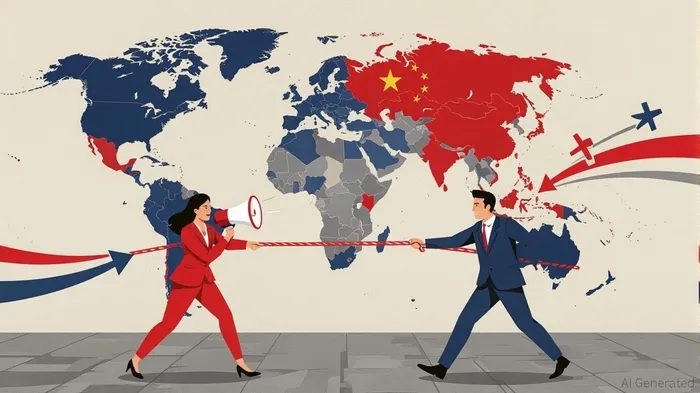
The U.S. trade landscape in 2025 is a chessboard of geopolitical risk arbitrage, with President Trump's dual-track strategy—de-escalation with China and escalation with the EU—creating divergent opportunities in global equities and commodities. This article dissects how investors can exploit these asymmetries, leveraging sector-specific dynamics in tech, energy, and trade-exposed industries.
The China Gambit: De-escalation and Sectoral Rebalancing
Trump's administration has maintained a 25% baseline tariff on Chinese goods, with a temporary suspension (May–August 2025) that eased pressure on U.S. importers. However, the recent rare earths agreement with China—a $750 million deal to secure critical minerals—signals a strategic pivot toward de-escalation. This shift has stabilized supply chains for tech and manufacturing sectors, particularly for companies reliant on Chinese inputs.
Tech Sector: Reshoring and Resilience
The semiconductor industry, a key battleground, has seen mixed signals. While the EU's 15% tariff on U.S. semiconductors threatens exports, China's reduced tariffs on U.S. goods (post-May 14, 2025) have allowed firms like Intel (INTC) and ASML (ASML) to recalibrate supply chains. Intel's $20 billion Ohio expansion, aligned with the EU's $600 billion investment pledge, positions it to capture both U.S. and EU demand.
Investors should overweight U.S. semiconductor firms with EU supply chain visibility and hedge against EU tariff volatility by diversifying into AI and quantum computing. For example, NVIDIA (NVDA), which saw a 19% surge post-April 2025 tariff pause, remains a core holding.
Energy Sector: China's Open Door
China's temporary tariff suspension on U.S. crude oil and LNG has revitalized energy exports. Firms like Cheniere Energy (LNG) and Energy Fuels (URA) have benefited from renewed demand, with Cheniere's stock rising 4% post-agreement.
However, execution risks persist. Infrastructure bottlenecks and geopolitical shifts (e.g., EU energy procurement from Norway) could delay China's full reintegration. Positioning in energy infrastructure plays—such as Venture Global (VG)—offers near-term upside.
The EU Conundrum: Escalation and Structural Headwinds
The U.S.-EU trade deal, signed July 27, 2025, imposes a 15% tariff on EU automotive and semiconductor imports while securing a $750 billion energy export commitment. This creates a lopsided dynamic: U.S. energy and manufacturing gain, while European automakers and pharma firms face headwinds.
Automotive Sector: A Tariff-Driven Rebalance
The 15% tariff on EU cars and parts has pressured European automakers like BMW (BMW.DE) and Mercedes-Benz (MBG.DE), which now face $4.7 billion in annual costs. U.S. automakers Ford (F) and GM (GM), however, benefit from reduced competition. European firms are localizing production in the U.S. to mitigate tariffs, creating arbitrage opportunities in U.S. suppliers like Magna International (MGA).
Pharmaceutical Sector: Tariff-Induced Reshoring
The 15% tariff on EU pharmaceuticals has spurred U.S. firms to boost domestic production. Merck (MRK)'s $1.5 billion Maryland facility and Pfizer (PFE)'s supply chain overhauls exemplify this trend. However, the U.S. Section 232 investigation into pharma imports remains a wildcard, with potential for further tariffs.
Strategic Roadmap for Risk Arbitrage
- Long Energy and Tech, Short EU Vulnerabilities
- Energy: Overweight U.S. LNG exporters (Cheniere, Venture Global) and uranium suppliers (Energy Fuels).
- Tech: Position in U.S. semiconductor firms (Intel, AMD) and AI enablers (NVIDIA).
EU Short: Hedge against European automakers (BMW, Mercedes) and pharma firms (Roche, AstraZeneca) via short positions or sector ETFs.
Diversify Across Geopolitical Scenarios
- China De-escalation: Invest in U.S. firms with China supply chain exposure (e.g., Apple (AAPL), TSMC (TSM)).
EU Escalation: Allocate to U.S. manufacturing (Ford, GM) and energy infrastructure (Cheniere).
Monitor Policy Shifts and Execution Risks
- Track the EU's energy procurement progress and U.S. Section 232 investigations.
- Use currency hedging strategies to mitigate yuan-dollar volatility.
Conclusion: Navigating the Crossroads
Trump's tariff gambit has created a bifurcated world: one where China's de-escalation fuels tech and energy resilience, and EU tensions drive structural rebalancing in manufacturing. Investors who position for these divergences—leveraging near-term volatility in energy and tech while hedging EU-related risks—stand to capitalize on the next phase of global trade dynamics. The key lies in agility, sector-specific insight, and a disciplined approach to geopolitical risk.

Stay ahead of the market.
Get curated U.S. market news, insights and key dates delivered to your inbox.
AInvest
PRO
AInvest
PRO



Comments
No comments yet