
Trump Tariff Developments and Their Implications for Global Markets: Navigating Risk Rebalance in Gold and China-Exposed Equities
 Aime Summary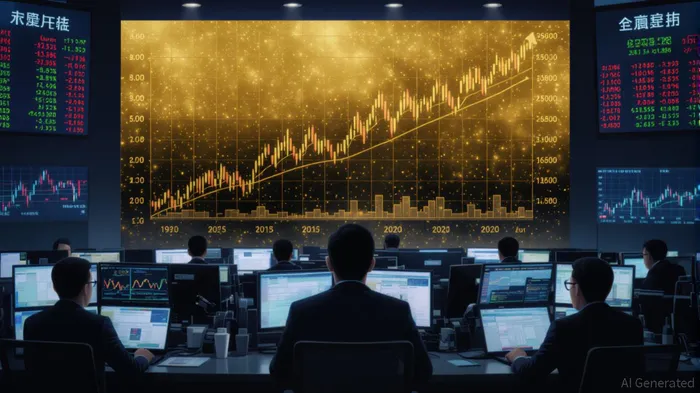
The re-election of Donald Trump in 2024 has ushered in a new era of protectionism, with his 2025 tariff regime reshaping global trade dynamics. From a baseline 10% import tax to punitive 70% levies on Chinese goods, these policies have triggered a cascade of economic and market responses. For investors, the challenge lies in identifying risk-rebalance opportunities in assets like gold and China-exposed equities, which are now at the epicenter of geopolitical and trade policy volatility.
Gold: A Safe Haven in a Tariff-Driven World
Gold has emerged as a critical hedge against the uncertainty generated by Trump's tariffs. By early 2025, prices surged to $3,500 per ounce, driven by a confluence of factors: central bank demand (244 tonnes added in Q1 2025), dollar weakness (down 5.2% year-to-date), and inflationary pressures. The U.S. dollar's decline has made gold more accessible to global buyers, while central banks in China and India—projected to purchase 710 tonnes quarterly—have accelerated their shift toward gold as a reserve diversification tool.
J.P. Morgan analysts project gold to average $3,675 per ounce by Q4 2025, with a potential climb toward $4,000 by mid-2026. This trajectory reflects not only macroeconomic tailwinds but also the “tariff uncertainty premium” embedded in gold's price. For investors, allocating 5-10% of portfolios to gold or gold-related assets (e.g., ETFs, mining equities) offers a tangible way to hedge against currency devaluation and geopolitical shocks.
China-Exposed Equities: Navigating a Volatile Landscape
China-exposed equities, particularly in technology, manufacturing, and automotive sectors, face a dual threat: higher tariffs and the specter of renewed trade tensions. Despite a 90-day reprieve in May 2025 that temporarily reduced U.S. tariffs on Chinese imports from 145% to 30%, the long-term outlook remains precarious. These sectors, which derive 57% of their profits overseas, are vulnerable to margin compression and delayed capital expenditures.
The S&P 500's sharp one-day rally in May 2025—its largest in over a month—illustrates the market's sensitivity to tariff-related news. However, this optimism is fragile. BlackRock's Target Allocation Model warns that a 20% effective tariff increase could reduce global GDP growth by 2-2.5%, with shallow recession risks depending on the duration of trade tensions. For China-exposed equities, this means heightened volatility and the need for tactical hedging strategies.
Strategic Rebalancing: Balancing Risk and Opportunity
Investors must adopt a dual approach to navigate this environment:
Gold as a Core Hedge: Given its role as a store of value and inflationary buffer, gold should be a cornerstone of risk-rebalancing strategies. Central bank demand and dollar weakness suggest this trend will persist, making gold a compelling long-term asset.
China-Exposed Equities: Selective Exposure: While these equities face headwinds, selective exposure to companies with diversified supply chains or strong domestic demand in China could offer asymmetric returns. For example, firms pivoting to nearshoring or investing in AI-driven efficiency gains may mitigate tariff impacts.
Active Strategies for Volatility: Market-neutral funds, liquid alternatives, and low-volatility equities can help manage downside risks. Investors should also consider sector rotation, favoring defensive industries (e.g., utilities, healthcare) over cyclical ones during periods of tariff uncertainty.
Conclusion: Preparing for a New Trade Reality
Trump's 2025 tariffs have created a fragmented global trading landscape, with gold and China-exposed equities serving as barometers of economic and political risk. While the former offers a reliable hedge, the latter demands careful scrutiny of corporate resilience and geopolitical developments. For investors, the key lies in balancing these assets within a diversified portfolio, leveraging both defensive and tactical opportunities to navigate an era of uncertainty.
As the U.S. dollar's dominance faces challenges and trade wars evolve into a new normal, adaptability will be the hallmark of successful investing. The time to act is now—before the next round of tariff announcements reshapes markets once again.

Delivering real-time insights and analysis on emerging financial trends and market movements.
Latest Articles
Stay ahead of the market.
Get curated U.S. market news, insights and key dates delivered to your inbox.


AInvest
PRO
AInvest
PRO



Comments
No comments yet