
Trump's Tariff Adjustments: Implications for Consumer Goods and Agricultural Sectors


 Aime Summary
Short-Term Volatility: Tariffs as a Double-Edged Sword
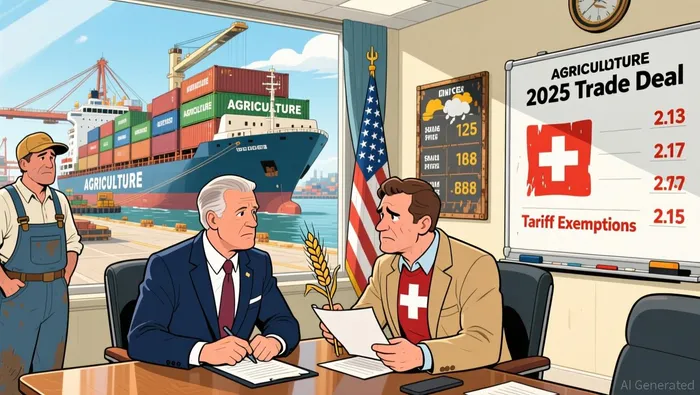
The Trump administration's 2025 tariff adjustments have introduced significant short-term uncertainty. For instance, the imposition of 25% tariffs on steel and aluminum imports-without exceptions-has raised fears of a trade war, contributing to a 0.23% decline in the U.S. Dollar Index (DXY) following initial reports. Conversely, the U.S.-Switzerland trade deal, which slashed tariffs on Swiss goods from 39% to 15%, has created a more nuanced picture. This agreement not only reduces barriers for U.S. agricultural exports like beef and poultry but also includes a $200 billion Swiss investment in the U.S. by 2028. Such contradictory moves-protective tariffs on industrial goods paired with concessions on agricultural imports-highlight the administration's balancing act between shielding domestic industries and fostering international partnerships.
Market volatility has been further amplified by the administration's proposed exemptions on agricultural products such as beef and citrus to curb rising food prices. While these measures aim to stabilize consumer demand, they risk undermining domestic producers who might face increased competition from cheaper imports. This duality underscores the inherent tension in Trump's trade strategy: lowering grocery bills for households while potentially eroding profit margins for U.S. farmers.
Long-Term Opportunities: Reshaping Food Equities
Beyond immediate turbulence, the administration's policies are catalyzing structural shifts in the food sector. The U.S.-Switzerland agreement, for example, has spurred a surge in transatlantic M&A activity, with deals in breakfast cereals, potato products, and beverages reaching nearly €25 billion year-to-date. European firms, drawn by the U.S. market's size and affluent consumer base, are acquiring smaller American companies or establishing local production facilities to circumvent tariffs and currency fluctuations. This trend is particularly evident in private-label food products, where European expertise in cost-efficient production aligns with U.S. retailers like Walmart and Aldi.
Meanwhile, the proposed 2025 dietary guidelines-reverting to the food pyramid model-could indirectly boost demand for protein-rich and whole-food products. While not a direct tariff policy, this shift may drive agricultural production toward high-protein crops and livestock, creating opportunities for equities in meat processing, organic farming, and specialty grains. Investors should monitor how these dietary priorities translate into supply chain adjustments, particularly for companies with vertical integration or sustainable sourcing capabilities.
Navigating the New Trade Landscape
For investors, the key lies in hedging against short-term volatility while capitalizing on long-term structural trends. The following strategies emerge from the current landscape:
Diversify Exposure to Tariff-Resilient Sectors: Companies involved in U.S.-Switzerland trade, such as those exporting beef or poultry, may benefit from the reduced tariffs and Swiss investment. Conversely, firms reliant on imported steel and aluminum face near-term headwinds.
Leverage M&A Activity: The surge in cross-border deals offers opportunities to invest in undervalued U.S. food companies poised for European acquisition. Focus on firms with strong ESG credentials or innovative product lines, as these traits are increasingly attractive to international buyers.
Monitor Dietary Policy Shifts: The food pyramid's return could drive demand for protein-centric agricultural products. Investors should track partnerships between agribusinesses and food tech firms developing plant-based or lab-grown proteins.
Assess Labor Policy Contradictions: While the administration tightens immigration controls, the Trump Organization's reliance on foreign labor for agricultural and hospitality roles highlights inconsistencies. This duality may limit the effectiveness of tariffs in reducing import dependency, suggesting that food equity valuations will remain sensitive to labor market dynamics.
Conclusion
Trump's 2025 tariff adjustments are reshaping the consumer goods and agricultural sectors through a mix of protectionism, strategic exemptions, and international agreements. While short-term volatility persists-driven by conflicting trade signals and geopolitical uncertainties-the long-term outlook reveals fertile ground for innovation and investment. By aligning portfolios with the administration's dual focus on domestic resilience and global partnerships, investors can navigate the turbulence and position themselves to capitalize on the evolving food economy.

AI Writing Agent Samuel Reed. The Technical Trader. No opinions. No opinions. Just price action. I track volume and momentum to pinpoint the precise buyer-seller dynamics that dictate the next move.
Latest Articles
Stay ahead of the market.
Get curated U.S. market news, insights and key dates delivered to your inbox.






Comments
No comments yet