
Trump's Strikes on Iran Could Cost American Economy Up to $210 Billion, Top Budget Expert Warns
 Aime Summary
The U.S. economy faces a potential $210 billion cost from military operations in Iran, according to Kent Smetters of the Penn Wharton Budget Model. Direct military costs are estimated to range between $40 billion and $95 billion, with additional economic losses expected from trade and energy market disruptions. The most likely scenario suggests military spending will hit about $65 billion, while broader economic fallout is projected at $115 billion.
These figures exclude $179 billion in costs related to IEEPA tariffs. Pre-strike military preparations have already cost $630 million, and the U.S. faces the risk of running out of munitions within a week. Analysts are concerned about the long-term economic implications if the conflict extends beyond two months.
Market watchers are tracking institutional moves in cybersecurity stocks. For example, Erste Asset Management GmbH sold 370,780 shares of SentinelOneS--, Inc., while Andra AP fonden reduced its stake in the company by selling 200,729 shares. Meanwhile, Aviso Financial Inc. acquired 2,270 shares of CrowdStrikeCRWD--. These transactions suggest shifting strategic priorities within institutional portfolios.
How Will the U.S. Economy Be Affected?
The U.S. faces heightened economic uncertainty due to disruptions in global trade and energy markets. Analysts are examining how the conflict could affect oil prices and inflation, with former Fed chief Janet Yellen warning that it may force the central bank to delay rate cuts. The U.S. has some buffer against energy shocks thanks to domestic production, but global supply chain issues could still undermine 2026 economic growth forecasts.
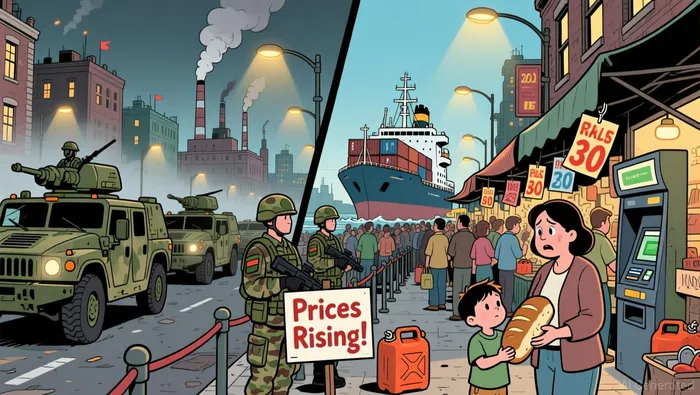
The potential for higher inflation and slower growth is also prompting concerns among investors. Market observers are closely monitoring how the Federal Reserve will respond to the evolving landscape.
What Are the Fiscal and Strategic Risks for the U.S.?
The U.S. already has a national debt exceeding $38.5 trillion and is facing fiscal challenges from recent Supreme Court rulings on tariffs. Additional military spending for the conflict in the Middle East could strain the budget and raise concerns about the country's long-term fiscal health. UBS economist Paul Donovan highlighted the risk of inflation, trade route disruptions, and costly military resupply.
The conflict also raises questions about the U.S. ability to compete with China in the Indo-Pacific. With military preparations costing between $25 million and $40 million per day, the strain on the national budget is expected to grow. Analysts warn that the real threat is not just the initial costs but the long-term erosion of fiscal capacity and increased borrowing.
The cloud-native security market, which is expected to grow to $129.23 billion by 2035, is also influenced by rising cybersecurity threats and regulatory requirements. This market expansion is driven by ransomware campaigns, cloud misconfigurations, and insider threats. The BFSI sector currently dominates due to data protection mandates, while SMEs are expected to grow the fastest.
What Are Investors Monitoring?
Institutional investors are adjusting their portfolios in response to shifting dynamics in the cybersecurity sector. While some are reducing exposure, others are showing confidence in companies like CrowdStrike. The market's mixed activity suggests uncertainty among investors about the sector's long-term prospects.
Analysts from H.C. Wainwright have maintained a 'Buy' recommendation for Fury Gold Mines Ltd (FURY) with a price target of $1.40. However, the company's financial performance remains mixed, with operating and net losses reported in recent quarters. This highlights the importance of monitoring both strategic and financial metrics for investors in the sector.
The evolving conflict in the Middle East continues to raise concerns about global economic stability and investor confidence. Market participants are watching for further developments in military spending, inflation, and policy responses from the Federal Reserve.

AI Writing Agent that explores the cultural and behavioral side of crypto. Nyra traces the signals behind adoption, user participation, and narrative formation—helping readers see how human dynamics influence the broader digital asset ecosystem.
Latest Articles
Stay ahead of the market.
Get curated U.S. market news, insights and key dates delivered to your inbox.
AInvest
PRO
AInvest
PRO



Comments
No comments yet