
Trump's Steel Tariffs: Navigating Risks and Opportunities in the Manufacturing Sector
The U.S. manufacturing sector is bracing for a new wave of disruption as President Trump's 2025 steel tariffs—coupled with evolving global trade dynamics—reshape supply chains, inflate production costs, and redefine stock valuations. With tariffs now spanning 300 product categories and legal battles clouding their permanence, investors must act swiftly to identify risks and capitalize on emerging opportunities.
The Tariff Landscape: Chaos or Clarity?
The administration's April 2025 tariff rollout introduced a 10% baseline tax on all imports, escalating to 34% for Chinese goods, while exempting critical industries like steel/aluminum under existing Section 232 rules. 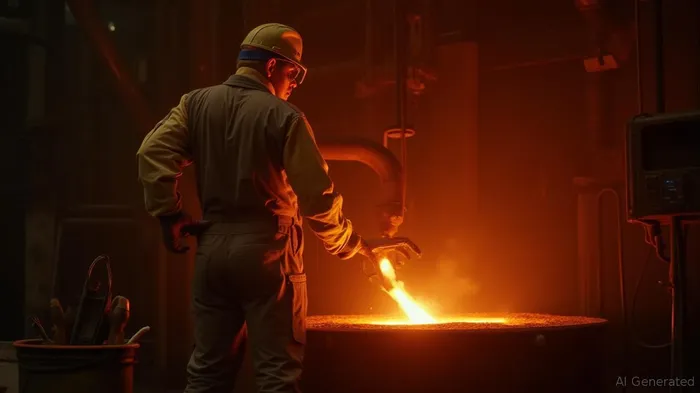 . Legal battles have further muddied the waters: a May 28 court injunction against the tariffs was stayed on May 29, leaving the policy in limbo. This uncertainty has manufacturers scrambling.
Automotive giants like Ford (F) and General Motors (GM) face steep costs as tariffs on Canadian steel—once a key supplier—jumped to 25%, forcing reconfigurations. reveals a 12% decline amid these pressures.
Supply Chain Disruptions: The Hidden Costs
Tariffs aren't just about import taxes—they're catalysts for systemic shifts:
- Reshoring Challenges: While reshoring is promoted as a solution, labor shortages and automation costs are barriers. The U.S. manufacturing workforce has plateaued at 12.8 million, with skill gaps in precision machining and robotics.
- Supplier Diversification: Companies like Boeing (BA) are pivoting to Mexico and Canada under USMCA exemptions, but even these moves face hurdles. A May 2025 study notes that 68% of manufacturers believe tariffs will harm operations. highlights strained logistics.
- Input Cost Explosions: Steel prices are up 30%, natural gas 100%, and copper 25% year-over-year. These pressures hit automotive, construction, and appliance makers hardest.
Stock Valuations: Winners and Losers
The tariff war is bifurcating the manufacturing sector:
At-Risk Sectors:
- Automotive: Tariffs on imported parts and steel are squeezing margins. Tesla (TSLA) faces dual challenges: rising battery material costs and retaliatory tariffs on its European exports. shows a 5% decline.
- Semiconductors: Global supply chains are vulnerable to geopolitical tensions. Intel (INTC) has delayed $20B in U.S. chip plant investments due to tariff-related uncertainty.
Opportunity Zones:
- Reshoring Pioneers: Companies investing in automation and domestic facilities are insulated. Caterpillar (CAT) is expanding U.S. engine production, reducing reliance on Mexican suppliers. signals confidence.
- Alternative Materials Innovators: Dow Chemical (DOW) is capitalizing on U.S. resin demand as tariffs make Asian imports prohibitive. Its Q2 2025 sales rose 18% in North America.
Actionable Insights for Investors
- Short-Term Plays:
- Buy Reshoring Leaders: Caterpillar (CAT), 3M (MMM), and Honeywell (HON) are scaling U.S. operations. Their stocks offer defensive exposure.
Sell Tariff Victims: Avoid auto parts suppliers like LKQ (LKQ) and Valeo (FR:VLO), which lack tariff hedging strategies.
Long-Term Bets:
- Semiconductor Infrastructure: Applied Materials (AMAT) and Lam Research (LRCX) are critical to domestic chip production. Their valuations are undervalued relative to their strategic importance.
Automation Enablers: Companies like Rockwell Automation (ROK) and Yaskawa Electric (JAP:6501) are essential to offsetting labor shortages.
Monitor the Courts: A final ruling on the tariffs' legality—expected by Q4 2025—could trigger a market correction. Use volatility to buy dips in reshoring stocks.
Conclusion: The Tariff Tipping Point
The U.S. manufacturing sector is at a crossroads. While tariffs create immediate headwinds for traditional exporters and labor-constrained firms, they are accelerating a strategic reshaping of supply chains. Investors who prioritize reshored innovators and materials innovators—while hedging against sector-wide inflation—will position themselves to profit as the dust settles.
The clock is ticking. Act now, or risk missing the next wave of industrial transformation.
Data as of May 26, 2025. Past performance does not guarantee future results.

Delivering real-time insights and analysis on emerging financial trends and market movements.
Latest Articles
Stay ahead of the market.
Get curated U.S. market news, insights and key dates delivered to your inbox.






Comments
No comments yet