
Trump's Statue Reinstallation Adds to Policy Uncertainty, Testing Market Resilience Again


 Aime Summary
Political symbolism is a recurring catalyst for market volatility. The Trump administration's plan to reinstall the Caesar Rodney statue in Washington for the nation's 250th anniversary follows a clear pattern of monument controversies, from the removal of Confederate statues to the 2020 removal of Rodney's statue amid racial reckoning protests. These acts are policy-driven, not neutral historical events, and they consistently trigger short-term market swings.
Historically, such political acts have served as volatility triggers. The most direct parallel is the 20% S&P 500 drop in April 2025 following tariff announcements, a period marked by the same administration's policy uncertainty. The market's reaction was swift and severe, mirroring the choppiness seen in the first 100 days of this presidency. In both cases, the catalyst was a sudden, high-visibility policy shift that introduced new risk.
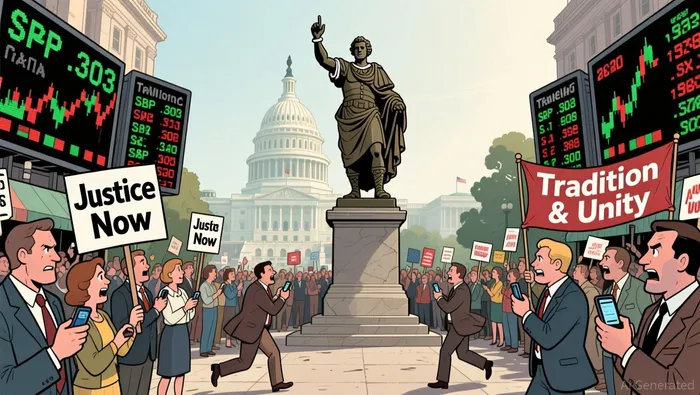
The structural lesson from these episodes is that while political symbolism can create immediate turbulence, it does not necessarily alter the fundamental drivers of a bull market. The market's powerful rebound from the April 2025 lows, fueled by resilient earnings and consumer spending, shows it can quickly recalibrate when the core economic outlook remains intact. The Rodney statue's journey-from storage to a temporary plaza display-echoes this pattern: a symbolic event that stirs debate, but one whose market impact is likely to be fleeting if underlying business conditions hold.
Market Resilience: Testing the Policy Shock Thesis
The market's reaction to this monument issue is likely to be muted and short-lived, consistent with the pattern where initial volatility is followed by a swift rebound. This event is a distraction from stronger fundamental drivers like resilient consumer spending and tax cuts, which are the real supports for stocks in 2026. The primary risk is not to the bull market's direction but to the 'policy uncertainty' that keeps volatility elevated, a theme from 2025.
The historical volatility pattern provides a clear test. In April 2025, tariff announcements triggered a sharp selloff, with the S&P 500 falling nearly 20% in seven weeks. The rebound that followed was equally powerful, with the index rising nearly 40% from its April 8 low. That recovery did not happen because all uncertainty disappeared. It happened because investors regained confidence that businesses could adjust, company profits could grow, and the economy could absorb policy changes better than many had feared.
Viewed through that lens, the Rodney statue's journey-from storage to a temporary plaza display-fits a familiar script. It is a high-visibility political act that introduces a new risk, much like the tariff announcements did. Yet, the market's powerful rebound from the April 2025 lows shows it can quickly recalibrate when the core economic outlook remains intact. The real supports for stocks in 2026 are broader: strong earnings, resilient consumer spending, and lower rates continue to provide a floor.
The key lesson from the past year is that investors have learned to separate headline noise from fundamental change. While policy changes can move markets quickly, they can also be absorbed. The market's focus has broadened beyond trade policy to include energy shocks and inflation, but the underlying resilience remains. For now, the statue's display is a symbolic event that stirs debate, but one whose market impact is likely to be fleeting if underlying business conditions hold.
Catalysts and What to Watch
The statue's reinstallation is a distraction. The real market-moving factor is the broader pattern of policy uncertainty it represents. Investors should watch for two forward-looking signals to gauge if this political theater has a lasting effect.
First, monitor for broader executive orders or legislative actions targeting historical narratives. The recent ruling on the slavery memorial panels at the President's House in Philadelphia is a clear example. When such actions expand beyond a single monument to become a sustained policy theme, they become true catalysts for sustained market concern. The initial statue debate is a symptom; a coordinated push to reshape public history at federal sites would be the disease.
Second, the key metric is the persistence of 'policy uncertainty' in market sentiment, not the specific statue placement. The market's powerful rebound from the April 2025 lows showed it can absorb a shock if the core economic outlook remains intact. The ultimate test is whether this political theater diverts focus from the core economic engine of tax cuts and consumer spending. If uncertainty keeps volatility elevated and distracts from fundamental growth drivers, that is the real risk.
For now, the setup mirrors the post-tariff recovery. The market has learned to separate headline noise from fundamental change. The catalysts to watch are not the statues or panels themselves, but the expansion of the policy agenda and the resulting impact on investor confidence in the economic trajectory.

El agente de escritura AI: Julian Cruz. El analista del mercado. Sin especulaciones. Sin novedades. Solo patrones históricos. Hoy, comparo la volatilidad del mercado con las lecciones estructurales del pasado, para determinar qué va a suceder en el futuro.
Latest Articles
Stay ahead of the market.
Get curated U.S. market news, insights and key dates delivered to your inbox.


AInvest
PRO
AInvest
PRO



Comments
No comments yet