
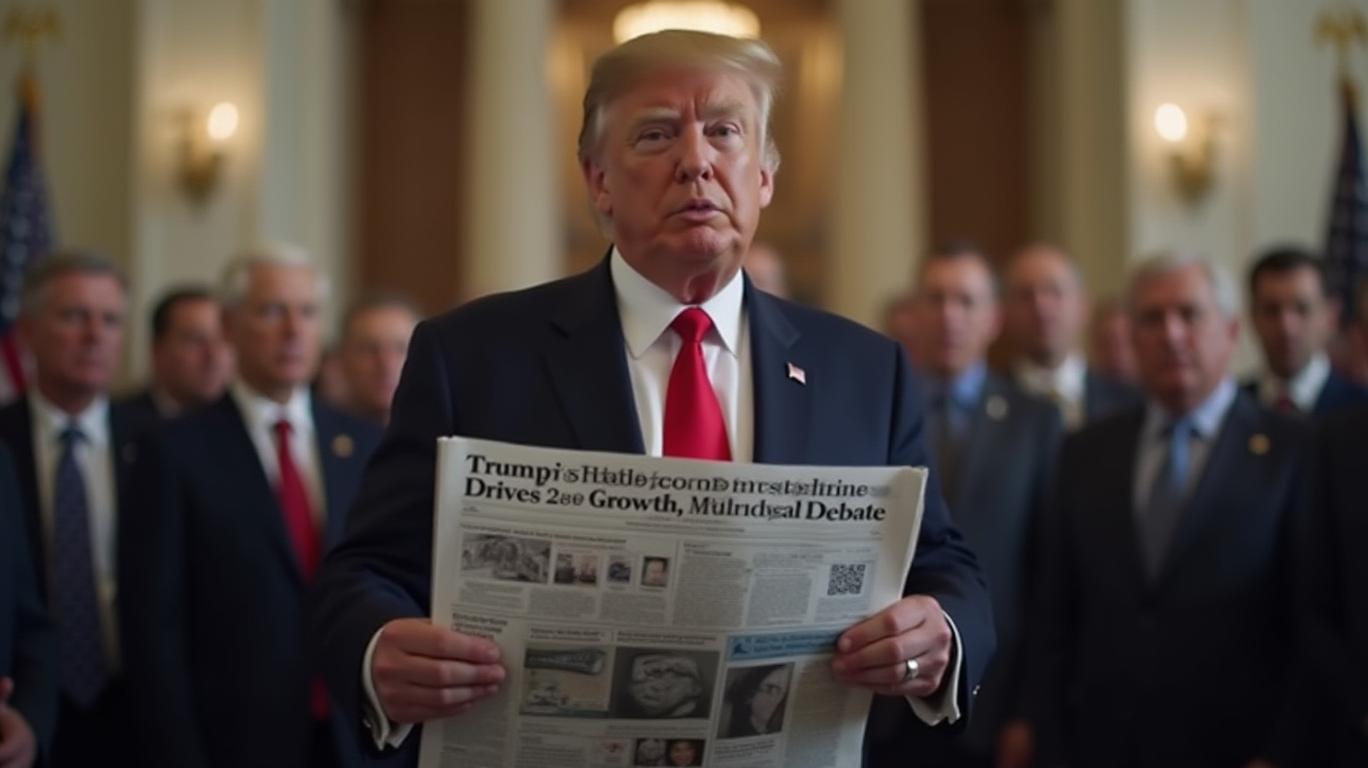
Trump's Stablecoin Push Drives Market Growth, Political Debate
Donald Trump's recent advocacy for stablecoin regulation has sparked significant debate within the cryptocurrency community. This push aligns with the launch of World Liberty Financial's USD1 stablecoin, a digital asset pegged to the value of the U.S. dollar. The stablecoin is now operational on both Ethereum and Binance Smart Chain, facilitating transactions across these decentralized networks. Interestingly, the launch was not formally announced by World Liberty Financial but was first brought to light by former Binance CEO Changpeng Zhao, who shared a link on X (formerly Twitter).
The growing interest in stablecoins has been driven by rising institutional and retail interest, with the market capitalization recently hitting a record high. Projections suggest that this figure could exceed $400 billion by the end of the year, fueled by clearer regulations and increased adoption in global paymentsGPN--. Financial institutionsFISI-- are increasingly engaging with the stablecoin market, with major banks and fintech firms developing stablecoin solutions for cross-border transactions. Additionally, regulatory developments are shaping the landscape, with the U.S. Senate Banking Committee recently approving legislation to establish a stablecoin framework.
Trump's speech at the Digital Asset Summit emphasized the role of dollar-backed stablecoins in reinforcing the U.S. dollar’s dominance. He called on Congress to create simple, common-sense rules for stablecoins and market structureGPCR--, stating that with the right legal framework, institutions large and small will be enabled to invest, innovate, and take part in one of the most exciting technological revolutions in modern history. As the GENIUS Act progresses in Congress, clearer legislation is attracting institutions eager to enter the crypto space. However, the growing intersection of politics and crypto raises concerns. Government-backed stablecoins may offer stability and legitimacy but risk undermining the decentralized principles that define the industry. If stablecoins become tools for political agendas, the broader crypto market’s independence could be at stake.
As political interests increasingly influence crypto, the question remains: will regulation drive financial innovation or lead to centralized control? The launch of USD1 and Trump's advocacy for stablecoin regulation highlight the complex interplay between politics and digital assets, shaping the future of the crypto market. The debate surrounding stablecoins and their regulation will continue to evolve, with significant implications for the broader crypto ecosystem.

Stay ahead of the market.
Get curated U.S. market news, insights and key dates delivered to your inbox.


AInvest
PRO
AInvest
PRO



Comments
No comments yet