
Trump’s SOTU Targets Capitol ‘Stock Gods’: How Deep Is Washington’s Insider Trading?
 Aime Summary
On February 24, 2026, the intersection of US politics and equity markets reached a boiling point in Washington D.C., as President Donald TrumpTRUMP-- used his State of the Union address to aggressively promote the "Stop Insider Trading Act," aiming to restrict congressional stock trading. The immediate impact of this confrontation raises critical questions for institutional and retail investors regarding the structural fairness of the US stock market. Our stance is clear: while political rhetoric frames this as a partisan issue, quantitative data reveals that insider trading and informational arbitrage are deeply entrenched across the entire political spectrum. This systemic exploitation allows lawmakers and executive insiders to consistently outmaneuver macroeconomic trends and secure outsized returns in the technology, defense, and commodities sectors, creating an uneven playing field that broad market indices like the S&P 500 (SPY) cannot easily reflect.
The State of the Union Clash and The Reaction
During the high-stakes address, Trump directly challenged the trading habits of lawmakers. He explicitly stated, "As we ensure that all Americans can profit from a rising stock market, let's also ensure that members of Congress cannot corruptly profit from using insider information". When a segment of the Democratic audience stood to applaud, Trump seized the moment to single out former Speaker Nancy Pelosi, remarking, "Did Nancy Pelosi stand up, if she's here? Doubt it. Pass the 'Stop Insider Trading Act' without delay".
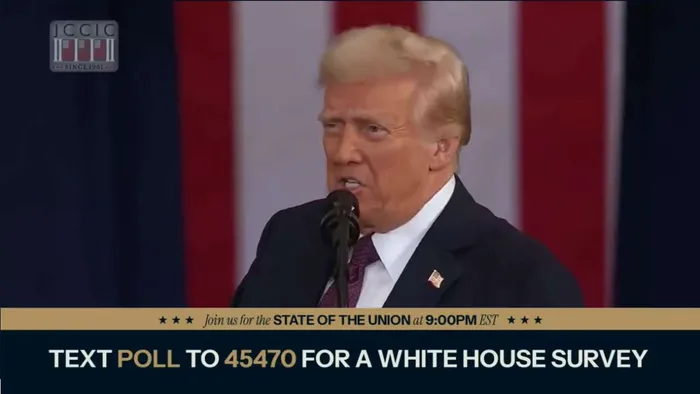
The legislative chamber quickly descended into chaos, providing a stark visualization of Washington's fractured ecosystem. According to on-the-ground reporting from the Associated Press, Democratic Representative Mark Takano of California shouted back, "How about you first!". Moments later, Representative Rashida Tlaib of Michigan escalated the confrontation, yelling, "You're the most corrupt president!". Analysts at Morgan Stanley suggest that this public spectacle, while politically volatile, may eventually force stricter compliance mechanisms. Such regulatory shifts could temporarily disrupt the high trading volumes traditionally seen in sectors heavily overseen by congressional committees, particularly within defense and clean energy ETFs.
Is Pelosi Really the Capitol Hill Stock God? Who is the Real Hidden God?
Nancy Pelosi has long been the poster child for congressional trading, maintaining an extremely high trading volume exceeding $37 million. In January 2026, she executed massive deep-in-the-money LEAPS (options) on "Magnificent 7" tech stocks, including Nvidia (NVDA), Alphabet (GOOGL), and Amazon (AMZN). Her Alphabet call options alone yielded returns surpassing 60%. However, evaluating whether she is the true apex trader of Washington requires looking at broader datasets.
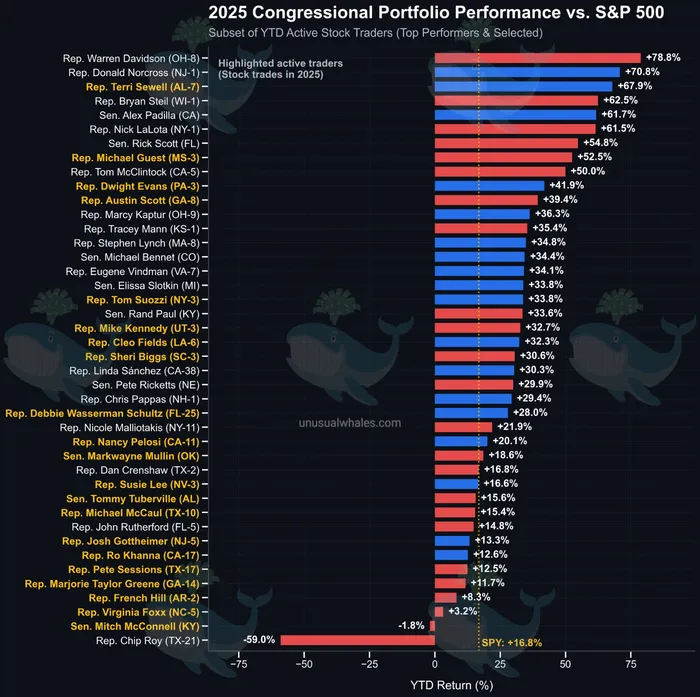
Based on the 2025 Congressional Portfolio Performance data published by Unusual Whales , Pelosi's annual return stood at roughly 20.1%, which only moderately beat the SPY's baseline return of 16.8%. The actual "Stock Gods" operate further from the media spotlight. The Unusual Whales data identifies Representative Warren Davidson (OH-8) as the top performer with a staggering 78.8% return, followed by Representative Donald Norcross (NJ-1) at 70.8%, and Representative Terri Sewell (AL-7) at 67.9%.
This exceptional outperformance heavily correlates with committee intelligence. Sewell, for example, sits on the Ways and Means Committee, granting her direct oversight of taxes and trade policies. Similarly, Representative Bryan Steil achieved a 62.5% return while overseeing Wall Street on the Financial Services Committee. Volume leaders also highlight systemic issues; Representative Josh Gottheimer executed over 500 trades totaling more than $90 million, while Senator Tommy Tuberville made over 1,300 trades, heavily focused on commodities and defense infrastructure. For financial engineers utilizing Python libraries to backtest congressional trade signals, these patterns point to distinct informational asymmetry rather than traditional fundamental analysis.
Is Insider Trading Deeply Rooted in the US Executive Branch?
The shadow of insider arbitrage extends well beyond Congress and deep into the executive branch. In February 2026, the US Supreme Court voted 6-3 to strike down Trump's controversial global tariff policy. Prior to this market-altering ruling, Cantor Fitzgerald—a Wall Street financial firm managed by Brandon and Kyle Lutnick, the sons of current Commerce Secretary Howard Lutnick—launched a highly controversial "tariff rebate product". The firm preemptively bought the potential tax refund rights of heavily impacted corporations at a steep 20% to 30% discount.
With the government now required to refund an estimated $175 billion, Cantor Fitzgerald is positioned to realize billions in risk-free arbitrage. Financial commentators at Reuters and Bloomberg have highlighted widespread accusations that the Lutnick family leveraged insider knowledge of the Commerce Department's strategic legal position to execute this trade.
Simultaneously, the Trump family's deep ties to digital assets have triggered intense volatility. Prior to a massive crypto sell-off triggered by Trump's announcement of 100% tariffs on Chinese goods, rumors circulated that 19-year-old Barron Trump had utilized 50x leverage to short the market, purportedly netting $200 million. Objectively, a trader named Garrett Jin later publicly claimed responsibility for this specific trade, denying Trump family involvement. However, broader family ventures remain under pressure. American Bitcoin (ABTC), founded by Eric and Donald Trump Jr., plummeted nearly 40% in just 30 minutes in early December 2025 as early investors dumped shares the moment the IPO lock-up period expired. The family's alternative token, World Liberty FinancialWLFI-- (WLFI), has also suffered devastating losses amid the recent "crypto winter".
Conclusion
Ultimately, Washington's regulatory architecture functions as an exclusive trading floor where non-public policy shifts precede market reactions. Whether through a Congressman's 78% equity yield or a Cabinet-linked firm's billion-dollar tariff arbitrage, the data confirms that insider advantage is structurally embedded in the US system. Until sweeping legislation like the Stop Insider Trading Act forces genuine blind trusts, investors must continue to account for the "Washington premium" when forecasting movements in technology, defense, and commodity markets.

Tianhao Xu is currently a financial content editor, focusing on fintech and market analysis. Previously, he worked as a full-time forex trader for several years, specializing in global currency trading and risk management. He holds a master’s degree in Financial Analysis.
Latest Articles
Stay ahead of the market.
Get curated U.S. market news, insights and key dates delivered to your inbox.


AInvest
PRO
AInvest
PRO



Comments
No comments yet