
Trump Signs GENIUS Act to Regulate Stablecoins, Aiming to Position U.S. as Digital Finance Leader
 Aime Summary
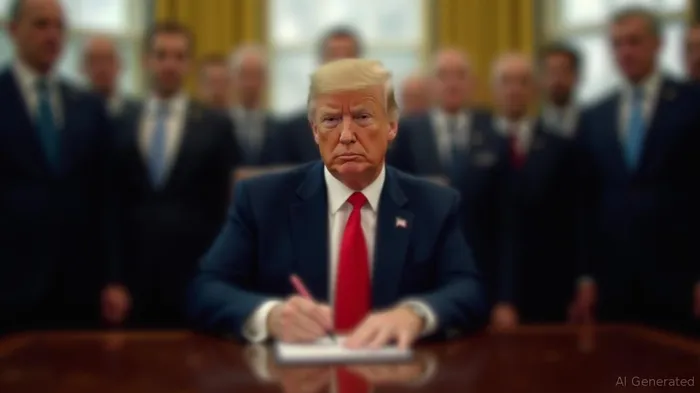
President Donald J. Trump signed the Guiding and Establishing National Innovation for U.S. Stablecoins Act (GENIUS Act) into law on July 18, 2025, marking a pivotal step in the U.S. strategy to dominate the global cryptocurrency landscape. The bipartisan legislation establishes a regulatory framework for stablecoin issuance, requiring asset-backed collateral tied to U.S. dollar reserves, and aims to position the nation as a leader in digital finance innovation. By enabling banks and financial institutionsFISI-- to issue “one-for-one” asset-backed crypto assets, the act seeks to streamline stablecoin compliance while fostering economic growth and technological advancement [1].
The GENIUS Act introduces a structured approach to stablecoin governance, mandating transparency and collateralization requirements to build trust in digital assets. Industry experts have hailed the law as a “seal of approval” for the crypto sector, signaling broader governmental acceptance of digital finance [2]. Analysts note that the act’s focus on institutional accountability and real-asset backing could attract new investment, though risks such as systemic volatility and regulatory gaps in non-stablecoin markets remain unaddressed [3]. Trump emphasized the legislation’s role in making the U.S. the “crypto capital of the planet,” underscoring its potential to drive innovation and economic competitiveness [4].
Market observers anticipate shifts in investor sentiment and liquidity dynamics as the U.S. government accumulates BitcoinBTC-- reserves. While current on-chain data shows minimal weekend volatility, the act’s implementation is expected to amplify demand for digital assets. Historical trends suggest that institutional and government investments often boost market activity, potentially leading to increased price adjustments and liquidity fluctuations [5]. The legislation’s timing aligns with global efforts by nations like the European Union to strengthen crypto frameworks, though the U.S. now has a clearer regulatory model for stablecoins [6].
Challenges persist in balancing innovation with oversight, particularly as technological advancements outpace regulatory frameworks. The act does not address broader crypto regulations for non-stablecoin assets or decentralized finance platforms, leaving gaps in the sector’s governance. Implementation will require collaboration between federal agencies and industry stakeholders to adapt to evolving market conditions [7].
Sources:
[1] [GENIUS Act Ushers in New Era for US Stablecoin] (https://www.jdsupra.com/legalnews/genius-act-ushers-in-new-era-for-us-7696722/)
[2] [Industry praises slate of crypto bills, economists unsure] (https://www.upi.com/Top_News/US/2025/07/25/stablecoin-cryptocurrency-regulation-genius-act/6401229/)
[3] [Trump signs landmark GENIUS Act, hailing "exciting new"] (https://www.aol.com/trump-sign-landmark-crypto-bill-153416465.html)
[4] [Crypto lobby gains ground under Trump] (https://thehill.com/policy/technology/5421229-crypto-lobby-gains-ground-under-trump/)
[5] [GENIUS Act Signed Into Law: A Game Changer for Legal] (https://complexdiscovery.com/genius-act-signed-into-law-a-game-changer-for-legal-discovery-and-information-governance/)
[6] [President Trump Signs GENIUS Act: A Major Milestone] (https://altsignals.io/post/trump-signs-genius-act-crypto-law-2)
[7] [Stablecoins and the Genius Act: What You Need to Know] (https://www.jdsupra.com/legalnews/stablecoins-and-the-genius-act-what-you-7588000/)

Stay ahead of the market.
Get curated U.S. market news, insights and key dates delivered to your inbox.


AInvest
PRO
AInvest
PRO



Comments
No comments yet