
Trump Signs GENIUS Act Establishing Stablecoin Regulations
 Aime Summary
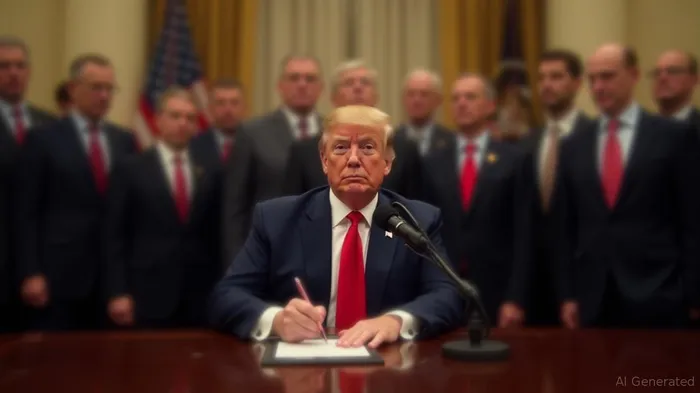
US President Donald Trump signed the Guiding and Establishing National Innovation for US Stablecoins (GENIUS) Act into law on Friday, marking a significant milestone for the cryptocurrency industry. The signing ceremony was attended by numerous cryptocurrency company executives and high-ranking Republicans, including Vice President JD Vance and House Speaker Mike Johnson. The GENIUS Act establishes a regulatory framework for stablecoins, which are cryptocurrencies tied to assets like the U.S. dollar to mitigate price volatility.
Trump acknowledged the support of several prominent crypto figures, including Kraken co-CEO David Ripley, Gemini co-founders Cameron and Tyler Winklevoss, Coinbase CEO Brian Armstrong, CircleCRCL-- CEO Jeremy Allaire, Tether CEO Paolo Ardoino, and Robinhood CEO Vladimir Tenev. In his remarks, Trump praised the resilience of the crypto community, stating, "The entire crypto community, for years, you were mocked and dismissed and counted out, you were counted out as little as a year and a half ago, but this signing is a massive validation [...] of your hard work and your pioneering spirit."
David Sacks, Trump’s AI and crypto czar, highlighted the potential impact of the GENIUS Act, stating that it would "unlock American dominance in the crypto industry by creating crypto rules of the road, it will update archaic payment rails with a revolutionary new payment system, and it will extend US dollar dominance [...] globally by creating a digital dollar that people all over the world can use."
The president also summarized initiatives introduced since January in response to demands from the crypto industry, including pardoning Silk Road founder Ross Ulbricht, establishing a national Bitcoin (BTC) reserve, and nominating Paul Atkins to head the US Securities and Exchange Commission (SEC). Trump admitted that his support for the industry was partly motivated by political considerations, stating that he backed the industry "for the votes" in 2024.
SEC Chair Paul S. Atkins emphasized the potential of blockchain and crypto asset technologies to revolutionize America’s financial infrastructure, stating that "blockchain and crypto asset technologies have the potential to revolutionize America’s financial infrastructure and deliver new efficiencies, cost reductions, transparency, and risk mitigation for the benefit of all Americans."
The GENIUS Act includes provisions to protect consumers by setting initial guardrails for stablecoins. It also bans members of Congress and their families from profiting off stablecoins, although this prohibition does not extend to the president and his family. Trump's family holds a significant stake in World Liberty Financial, a crypto project that launched its own stablecoin earlier this year. The president's support for the crypto industry is seen as a strategic move to bolster his political standing.
The signing of the GENIUS Act is part of a broader effort by the Trump administration to support the crypto industry. Earlier steps included the Securities and Exchange Commission dropping several enforcement actions against large crypto companies. Additionally, the House passed two other bills aimed at helping the crypto industry. One bill creates a new market structure for cryptocurrency, while the other prohibits the Federal Reserve from issuing a new digital currency. Both measures are now headed to the Senate for further consideration.
The GENIUS Act's passage is a significant development for the crypto industry, which has long sought regulatory clarity and legitimacy. The law's provisions are designed to foster innovation while protecting consumers, potentially paving the way for broader adoption of stablecoins and other cryptocurrencies. The industry's rapid growth and increasing influence underscore its potential to shape the future of digital finance.

Stay ahead of the market.
Get curated U.S. market news, insights and key dates delivered to your inbox.
AInvest
PRO
AInvest
PRO



Comments
No comments yet