
Trump secures EU trade deal with $600B investment, 15% tariffs on exports
 Aime Summary
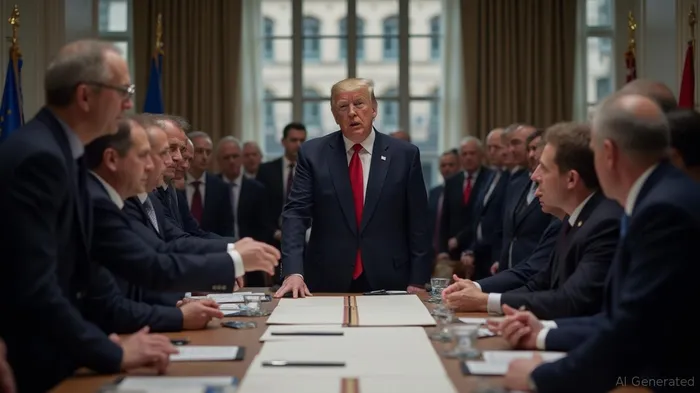
President Donald Trump announced a major trade agreement with the European Union, which includes a $600 billion investment in U.S. infrastructure and manufacturing, along with $750 billion in purchases of American energy products and “vast amounts” of weapons, in exchange for a 15% tariff on EU exports [1]. This deal follows a similar arrangement with Japan, which pledged $550 billion in investments to key U.S. industrial sectors under a 15% tariff framework. The agreements come as the U.S. seeks to pressure China into further concessions during upcoming high-stakes negotiations, though analysts warn that Beijing is unlikely to yield as easily as its trade partners [2].
The U.S. Treasury’s Scott Bessent and Chinese Vice Premier He Lifeng are set to begin talks in Stockholm, with the current trade truce between the two nations expected to extend by 90 days beyond its Aug. 12 expiration [3]. However, the U.S. has imposed higher tariffs on other Asian countries, including 19% on the Philippines and Indonesia and 20% on Vietnam, to deter the trans-shipment of Chinese goods. These measures reflect Trump’s strategy of using tariff threats to secure trade compliance, a tactic that has drawn scrutiny from legal experts and financial markets.
Legal challenges to Trump’s tariff policies are intensifying, with a court hearing scheduled to assess whether the president’s use of the International Emergency Economic Powers Act to justify tariffs is lawful. Analysts at Piper SandlerPIPR-- have argued that the $550 billion Japanese investment lacks concrete details and that the tariffs lack a solid legal foundation, suggesting many trading partners may be hesitant to commit to long-term investments [4]. European Commission President Ursula von der Leyen confirmed that the EU’s $750 billion in energy purchases would span three years, aligning with Trump’s term, but critics note that U.S. tariffs could be invalidated before any funds are realized.
The administration’s approach hinges on leveraging investment pledges as a bargaining chip, as demonstrated by the Japan-EU deals. Bessent attributed the lower 15% tariff rate to innovative financing mechanisms in these agreements, which deviated from Trump’s initial threats of 25% on Japan and 30% on the EU [5]. However, analysts caution that China’s economic resilience and strategic leverage in global supply chains may complicate U.S. efforts to replicate these successes. Jamie Cox of Harris Financial Group noted that while Japan and the EU had little choice but to comply, China “is unlikely to be as willing to fold” in ongoing negotiations [6].
Financial markets have responded cautiously, with U.S. stocks fluctuating amid uncertainty over trade policy. While Trump’s team frames the deals as a “win” for American workers, economists highlight risks of prolonged volatility from shifting tariffs and retaliatory measures. A report from the Hoover Institution underscored that businesses may avoid investing in an environment of regulatory unpredictability [7]. The administration’s reliance on aggressive tariff threats could further strain relationships with key partners, particularly as China’s trade resistance grows.
Sources:
[1] [Trump Scores Another Big Trade Deal After Securing Promise of Massive Investment, but China Will Be Less Willing to Cave, Analyst Says](https://fortune.com/2025/07/27/trump-tariff-deal-us-china-trade-war-talks-bessent-investments/)
[2] [Trump Signals U.S. Is Nearing Trade Deals but Says Some Countries Will Face Tariffs](https://www.nytimes.com/section/business/economy/economy?page=5)
[3] [Trump Signals U.S. Is Nearing Trade Deals but Says Some Countries Will Face Tariffs](https://www.nytimes.com/international/section/business/economy/economy?page=7)
[4] [Piper Sandler Report on Trump Tariffs](https://pipersandler.com/trump-tariff-analysis)
[5] [Bloomberg TV Interview with Scott Bessent](https://bloomberg.com/video/trump-trade-deals-explained)
[6] [Jamie Cox, Harris Financial Group](https://harrisfinancialgroup.com/analysis)
[7] [Hoover Daily Report](https://www.hoover.org/publications/daily-report)

Stay ahead of the market.
Get curated U.S. market news, insights and key dates delivered to your inbox.


AInvest
PRO
AInvest
PRO



Comments
No comments yet