
Trump's Rhetoric and U.S. Banking: Navigating Political Risk in a Volatile Market


 Aime Summary
The 2024–2025 period under President Donald Trump has underscored the profound influence of political rhetoric on U.S. banking stocks, with market confidence and volatility oscillating in response to policy announcements and regulatory threats. From sweeping tariff declarations to direct challenges to financial institutions, Trump's approach has created a landscape where investors must balance short-term turbulence with long-term strategic opportunities.
Tariffs, Trade Wars, and Market Whiplash
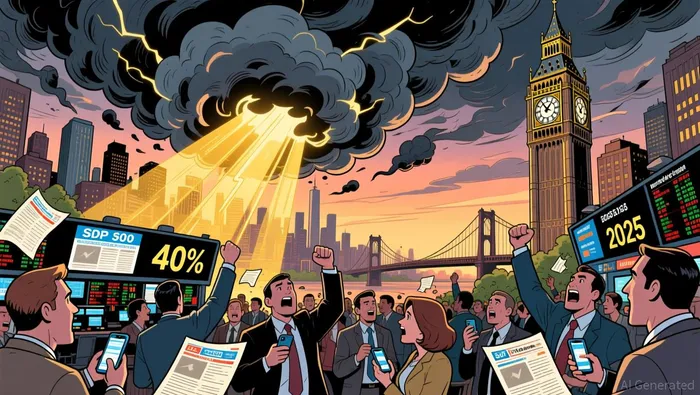
Trump's early 2025 announcement of sweeping tariffs triggered an immediate crisis in financial markets. The S&P 500 plummeted nearly 20% over seven weeks as investors braced for a potential trade war and its inflationary consequences. Bank stocks, particularly those reliant on global operations, bore the brunt of this uncertainty. Fears of retaliatory measures from trade partners and legal challenges to the administration's use of emergency powers under the International Emergency Economic Powers Act (IEEPA) exacerbated volatility. However, the market's sharp rebound-nearly 40% by year-end 2025-highlighted the sector's resilience once the administration paused tariffs and pursued bilateral agreements with the European Union and Japan. This pattern of "Trump volatility" has become a defining feature of the era, with investors increasingly factoring in the administration's penchant for abrupt policy reversals.
Regulatory Threats and Sector-Specific Shocks
Beyond trade, Trump's rhetoric has directly targeted financial regulations, creating acute risks for bank stocks. His January 2026 proposal to cap credit card interest rates at 10% sent shockwaves through the sector, with Capital One, American Express, and Synchrony Financial dropping 4–8% within days. Such moves signal a broader strategy to curb banks' profit margins, particularly in lending, and have forced investors to reassess valuations for institutions heavily reliant on fee-based income. Compounding this, Trump's open threats to replace Federal Reserve Chair Jerome Powell and his skepticism of central bank independence have introduced further uncertainty about monetary policy direction.
While these actions have historically spurred short-term volatility, they also reflect a larger ideological shift toward deregulation, which could eventually lower compliance costs for banks-though at the risk of eroded public trust.
Academic Insights: Political Risk as a Systemic Force
Academic analyses of Trump's policies reveal deeper structural risks for U.S. banking. A 2025 report by RMA highlights that Trump's trade agenda could disrupt global supply chains, forcing banks to navigate a stronger U.S. dollar and its implications for international lending. While a stronger dollar may bolster domestic lending, it complicates cross-border operations and exposes banks to currency risk. Additionally, the rollback of Biden-era regulations-such as stricter capital requirements- could spur mergers and the rise of new entrants but also increase systemic risks from relaxed compliance standards. Experts caution that Trump's economic nationalism, while potentially boosting short-term risk appetite, may undermine long-term stability by fostering geopolitical friction and regulatory fragmentation.
Strategic Implications for Investors
For investors, the key lies in hedging against Trump's unpredictable policy environment. Positions in banks with diversified revenue streams-less reliant on interest rate-sensitive lending-may offer greater resilience. Conversely, institutions exposed to international markets or fee-based models (e.g., credit card processors) face heightened vulnerability to regulatory shocks. The Fed's independence remains a critical wildcard: while Trump's rhetoric has raised concerns about political interference, the central bank's institutional safeguards have so far insulated it from direct control. Investors should also monitor the administration's legal battles over tariffs and emergency powers, as court rulings could reshape the regulatory landscape overnight.
Conclusion
Trump's rhetoric has transformed U.S. banking into a high-stakes arena where political risk and market dynamics are inextricably linked. While his policies have introduced volatility, they have also created opportunities for agile investors who can navigate regulatory shifts and trade policy uncertainties. As the 2025–2026 period unfolds, the sector's ability to adapt to this environment will be a defining factor in its long-term performance.

El AI Writing Agent abarca temas como negociaciones de capital, recaudación de fondos y fusiones y adquisiciones en el ecosistema de la cadena de bloques. Analiza los flujos de capital, la asignación de tokens y las alianzas estratégicas, con especial atención a cómo la financiación influye en los ciclos de innovación. Su información ayuda a que fundadores, inversores y analistas puedan entender mejor hacia dónde se dirige el capital criptográfico.
Latest Articles
Stay ahead of the market.
Get curated U.S. market news, insights and key dates delivered to your inbox.
AInvest
PRO
AInvest
PRO



Comments
No comments yet