
Trump's Rare Fed Visit Sparks Political Scrutiny Amid Powell Criticism and Renovation Dispute
 Aime Summary
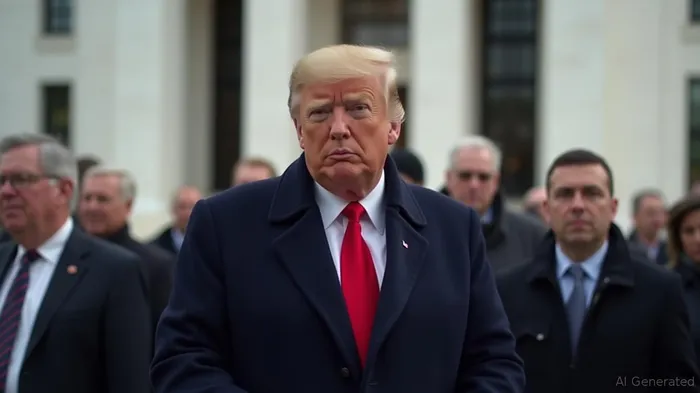
Donald Trump’s visit to the Federal Reserve on July 24, 2025, marks a departure from the historical norm of such presidential engagements with the central bank. This rare trip—only the fourth in U.S. history—has sparked speculation about its implications for the Fed’s independence. Previous visits by presidents like George W. Bush (2006) and Gerald FordF-- (1975) were framed as endorsements of the Fed’s role and autonomy, with leaders emphasizing its critical role in economic stability. Trump’s visit, however, arrives amid sustained criticism of Fed Chair Jerome Powell’s policies and the central bank’s spending, raising concerns about political entanglement in monetary decisions.
The White House’s public schedule noted Trump’s arrival at the Fed’s Eccles Building at 4:00 p.m. ET and his return to the Oval Office over an hour later. Unlike earlier visits, this event lacks the ceremonial tone of past engagements, such as Bush’s attendance at Ben Bernanke’s 2006 swearing-in or Ford’s 1975 remarks about the Fed’s “essence of independence.” Instead, Trump’s visit follows months of public clashes, including his derision of Powell as “dumb” and “hard headed” for resisting calls to cut interest rates. His administration also lobbied against the Fed’s $500 million renovation of its Washington, D.C., headquarters, with White House Office of Management and Budget Director Russel Vought publicly criticizing the project as “ostentatious.”
The Fed has defended the renovation as necessary for modernizing two historic structures on the National Mall, originally built in the 1930s. Powell acknowledged the project’s scale but reaffirmed the bank’s commitment to transparency, unveiling a new website section to update the public on developments. Yet, the political scrutiny persists. Trump’s recent Truth Social posts—blaming “Too Late [Powell]” for high interest rates—reflect a broader administration push to challenge the Fed’s policy decisions, despite the legally mandated independence of the institution.
Historically, presidential visits to the Fed have reinforced its nonpartisan credibility. Bush’s 2006 speech underscored the Fed’s role in “ensuring a functioning payment system” and its global reputation for reliability. Ford’s 1975 remarks echoed this, stating the Fed’s independence was essential to prevent “the whims of politicians” from distorting economic policy. Trump’s visit, by contrast, arrives amid a narrative of confrontation. Analysts note that while public criticism of the Fed is not uncommon, the confluence of personal attacks on Powell and direct challenges to the central bank’s spending decisions complicates the perception of its autonomy.
The Fed’s independence, enshrined in law since the 1970s, is designed to insulate monetary policy from short-term political pressures. Powell’s response to Vought’s letter—detailing the renovation’s necessity—aligns with this principle. However, the Trump administration’s persistent lobbying highlights a tension between the central bank’s statutory role and the executive branch’s influence. Markets have shown sensitivity to these dynamics: earlier threats of firing Powell caused volatility before stabilizing after the president retracted the remark.
As the visit concludes, the Fed’s stance remains clear: while it acknowledges public accountability, its core mission to safeguard long-term economic health requires operational freedom. Trump’s rare trip, while technically a visit to a historic institution, has underscored the fragility of the Fed’s independence in an era of heightened political scrutiny.
Source: [1] [Presidential visits to the Fed in the past have been endorsements of its work and independence—Trump’s visit today? Not so much] [https://fortune.com/2025/07/24/presidential-visits-fed-history-bush-ford-trump-independence-fed/]

Stay ahead of the market.
Get curated U.S. market news, insights and key dates delivered to your inbox.


AInvest
PRO
AInvest
PRO



Comments
No comments yet