
Trump's Proposed $2000 Tariff Dividend and Its Implications for the U.S. Economy and Markets


 Aime Summary
Fiscal Sustainability: Revenue vs. Economic Costs
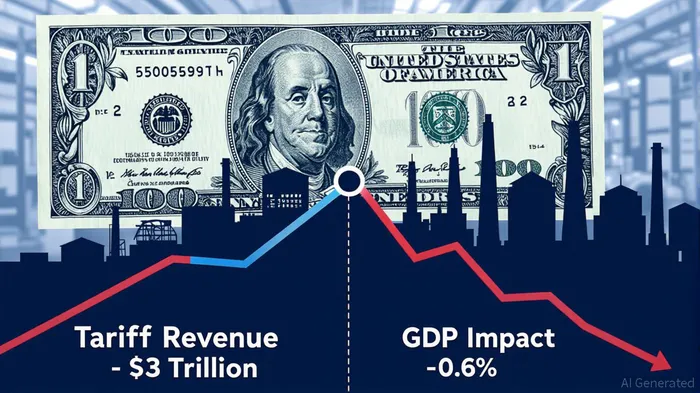
Trump's tariffs, averaging 18.2% on imports (the highest since 1941), are projected to generate $3 trillion in revenue over the next decade, according to the Tax Foundation. By September 2025, tariff collections had already reached $195 billion, as noted by Yahoo Finance. Treasury Secretary Scott Bessent suggested the funds could be distributed as tax cuts or direct payments. Yet, economic models paint a nuanced picture. The Tax Foundation's General Equilibrium Model estimates that these tariffs will reduce U.S. GDP by 0.6% over the long term, even before accounting for foreign retaliation, according to the Tax Foundation.
The fiscal math is precarious. While Trump claims the revenue will offset the $37 trillion national debt, Yahoo Finance notes critics argue that inflationary pressures-driven by higher import prices-could erode the dividend's value. For instance, households face an estimated $1,200 tax increase in 2025 and $1,600 in 2026 due to tariff-driven price hikes, according to the Tax Foundation. If the Supreme Court rules against the administration's use of emergency powers (IEEPA) to impose tariffs, refunds exceeding $100 billion could destabilize the plan, as reported by Financial Express.
Political Risks: Legal Battles and Public Sentiment
The tariff dividend's political feasibility hinges on its legal standing. The Supreme Court's upcoming ruling on the constitutionality of Trump's broad tariff powers could force refunds or curtail the policy entirely, as reported by Financial Express. Additionally, the plan's exclusion of "high-income people" raises questions about eligibility criteria and administrative complexity, as noted by Yahoo Finance.
Public opinion is polarized. While Trump's base may applaud the populist appeal of direct payments, opponents argue that tariffs disproportionately harm low-income households, who spend a larger share of income on goods like electronics and apparel, according to the Tax Foundation. The manufacturing labor shortage-100,000 unfilled jobs monthly-further complicates the policy's goals, as higher wages and retraining programs remain unaddressed, as reported by Inc.com.
Market Impacts: Winners, Losers, and Sector Volatility
The tariff dividend will reshape sector dynamics. Domestic manufacturers, particularly in semiconductors and energy, stand to benefit. For example, Nvidia and AMD are stockpiling GPUs to avoid 40% tariff hikes, signaling a shift toward U.S. production, according to GuruFocus. Conversely, import-dependent sectors like retail and technology face margin compression. A analysis reveals stock volatility tied to tariff announcements, reflecting investor uncertainty.
Global supply chains are also fracturing. Japanese companies are reevaluating China operations, with 40% of executives considering relocation, according to Nikkei Asia. This could accelerate nearshoring trends but strain U.S. infrastructure and logistics networks. Meanwhile, bond yields have risen on inflationary expectations, pressuring fixed-income investors, as noted by Yahoo Finance.
Wealth Redistribution: A Double-Edged Sword
The dividend's redistributive intent is ambitious but fraught. While lower-income households may gain $2,000, higher prices for essentials could negate these benefits. The Tax Foundation notes that the average household's tax burden will rise by $1,200 in 2025 alone, according to the Tax Foundation. This paradox-wealth redistribution offset by inflation-mirrors past stimulus checks, which saw mixed economic outcomes, as noted by Yahoo Finance.
Conclusion: Navigating Uncertainty for Investors
Trump's tariff dividend represents a high-stakes experiment in economic nationalism. For investors, the key risks lie in legal challenges, inflationary pressures, and sector-specific disruptions. Those with exposure to manufacturing and energy may find opportunities in nearshoring trends, while import-heavy sectors face headwinds. Monitoring the Supreme Court's IEEPA ruling and inflation data will be critical. As the policy unfolds, the U.S. economy's resilience-or fragility-will hinge on balancing fiscal ambition with structural realities.

Delivering real-time insights and analysis on emerging financial trends and market movements.
Latest Articles
Stay ahead of the market.
Get curated U.S. market news, insights and key dates delivered to your inbox.


AInvest
PRO
AInvest
PRO



Comments
No comments yet