
Trump's Proposed $2,000 Tariff Dividend: Implications for U.S. Equities and Inflation


 Aime Summary
Economic Rationale and Revenue Realities
The Trump administration frames the $2,000 dividend as a tool to correct trade imbalances and reward American workers. Treasury Secretary Scott Bessent emphasized that tariff revenues could fund tax cuts, such as eliminating taxes on tips and Social Security, while shifting production back to the U.S., according to a Financialexpress report. President Trump has also claimed that tariffs have made the U.S. "the richest, most respected country in the world" and projected trillions in revenue over several years, as explained in a NDTV article.
Yet, the U.S. Treasury's fiscal year 2025 customs duties-$195 billion-fall far short of these projections, according to the Financialexpress report. This gap raises questions about the dividend's feasibility, particularly if tariffs face legal challenges or global trade partners retaliate. The Supreme Court's ongoing review of the tariffs' legality adds another layer of uncertainty, with justices like Amy Coney Barrett and Neil Gorsuch skeptical of the administration's use of emergency powers, as noted in a Republicworld piece.
Historical Precedents and Sector Rotation
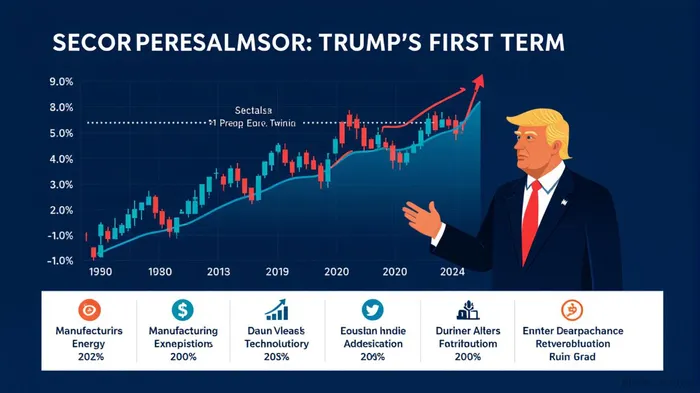
During Trump's first term, tariffs on Chinese imports (e.g., 25% on $250 billion in goods) disrupted global supply chains and triggered retaliatory measures, creating volatility in import-reliant sectors like consumer goods and agriculture, as reported by The Balance Money. The 2018–2019 trade war saw the S&P 500 and Dow Jones Industrial Average fluctuate sharply, with the latter surging 21.8% in 2019 amid hopes for a "Phase 1" trade deal, according to a MarketWatch report.
A similar pattern could emerge under Trump 2.0. Sectors like manufacturing and energy, which benefit from protected domestic markets, may see inflows as investors anticipate a "Made in America" boom. Conversely, import-reliant industries-such as technology (reliant on Chinese components) and retail (dependent on low-cost goods)-could face margin pressures. The International Monetary Fund (IMF) warns that renewed U.S.-China trade tensions could cut global growth by 0.3 percentage points in 2026, with Asian exporters like China and India experiencing lower inflation due to weaker demand, as detailed in a CBS News report.
Inflation Dynamics and Consumer Spending
The dividend's potential to boost consumer spending could offset some inflationary pressures from tariffs. By distributing $2,000 to households, the administration aims to stimulate demand for domestically produced goods, potentially reducing reliance on imports. However, tariffs themselves raise input costs for businesses, which may pass these expenses to consumers. The IMF notes that U.S. inflation forecasts have already risen as firms begin absorbing tariff costs, as detailed in the CBS News report.
This creates a trade-off: while the dividend could temporarily bolster consumption, higher prices for imported goods (e.g., electronics, automobiles) might erode purchasing power. Sectors like retail and e-commerce could face headwinds, while domestic manufacturers might benefit from increased demand.
Market Volatility and Investor Strategies
The uncertainty surrounding the tariffs' legal and economic outcomes is likely to amplify market volatility. During Trump's first term, trade tensions caused sharp swings in equity indices, with the Dow peaking in 2019 as a Phase 1 deal loomed, as noted in the MarketWatch report. A Trump 2.0 scenario could replicate this pattern, with investors rotating into defensive sectors (e.g., utilities, healthcare) during periods of heightened uncertainty and shifting to cyclical sectors (e.g., industrials, materials) when trade optimism resurges.
Moreover, the administration's focus on manufacturing could drive capital into infrastructure and industrial stocks, while import-reliant tech firms might see outflows. The recent performance of Trump Media and Technology Group-despite a $54.8 million Q3 loss-illustrates how political narratives can influence sector-specific volatility, as reported in a Grantspasstribune article.
Conclusion
Trump's $2,000 tariff dividend represents a bold attempt to reshape U.S. economic policy, but its success hinges on navigating legal, global, and market challenges. While the policy could benefit domestic manufacturing and provide short-term consumer relief, it risks inflating prices, destabilizing import-reliant sectors, and triggering retaliatory trade measures. Investors should brace for heightened volatility and consider hedging against sector-specific risks while monitoring the Supreme Court's rulings and congressional negotiations.

Delivering real-time insights and analysis on emerging financial trends and market movements.
Latest Articles
Stay ahead of the market.
Get curated U.S. market news, insights and key dates delivered to your inbox.


AInvest
PRO
AInvest
PRO



Comments
No comments yet