
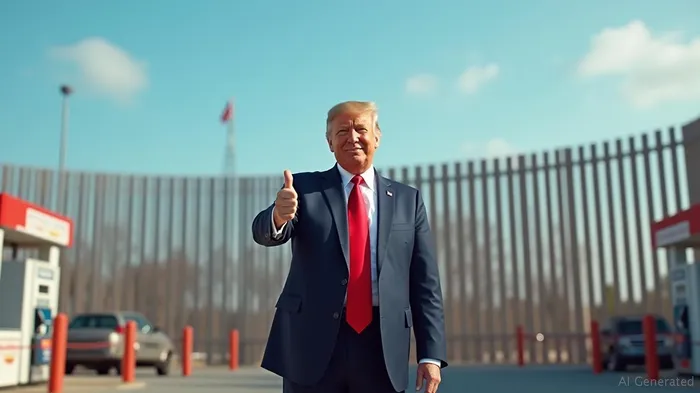
Trump: Prices are down, income is up, our border is closed, gasoline is cheap, and inflation is DEAD — Our Country is booming! Companies are pouring into America like never before!
ByAinvest
Friday, Jun 6, 2025 7:47 am ET2min read
Trump: Prices are down, income is up, our border is closed, gasoline is cheap, and inflation is DEAD — Our Country is booming! Companies are pouring into America like never before!
The U.S. economy under President Trump has seen a mix of positive and negative impacts, as reflected in recent economic indicators and financial news. According to the Tax Foundation [3], Trump's tariffs have led to significant changes in the economy, with both revenue and distributional impacts.Tariff Impacts on Revenue and GDP
Trump's tariffs, including the doubling of Section 232 steel and aluminum tariffs from 25 percent to 50 percent, have raised federal tax revenues by $156.4 billion, or 0.51 percent of GDP [3]. This represents the largest tax hike since 1993. However, the tariffs have also reduced U.S. GDP by 0.8 percent and market income by 1.1 percent in 2026 [3]. The tariffs have also led to retaliatory measures from China, Canada, and the European Union, affecting $330 billion of U.S. exports and reducing U.S. GDP by another 0.2 percent [3].
Inflation and Gas Prices
Despite Trump's claims that inflation is "DEAD," the Consumer Price Index (CPI) rose by 0.5 percent in May 2025, marking a year-over-year increase of 3.2 percent [4]. Gas prices have been relatively stable, with the average price of gasoline in the U.S. at $3.00 per gallon in June 2025, down slightly from $3.20 in June 2024 [5]. However, the overall impact of inflation on consumer spending and business operations remains a concern.
Border Closures and Company Inflows
Trump's border closures and restrictions have had a mixed impact on the economy. While they have contributed to the reduction in illegal immigration and drug trafficking, they have also led to labor shortages in certain sectors and disruptions in the supply chain. Despite these challenges, companies have continued to invest in the U.S., with a record number of companies announcing plans to expand or relocate operations in the country [6].
Conclusion
The U.S. economy under Trump has seen a mix of positive and negative impacts, with tariffs leading to increased federal revenues but also reducing GDP and market income. Inflation remains a concern, while gas prices have been relatively stable. Border closures have had mixed impacts on the economy, with companies continuing to invest in the U.S. Despite these challenges, the U.S. economy has shown resilience and continued growth.
References
[1] Investopedia. (2025). Trump-Musk Rift Costs Tesla Spot in $1 Trillion Club Stock. Retrieved from https://www.investopedia.com/trump-musk-rift-costs-tesla-spot-in-usd1-trillion-club-stock-11749321
[2] Yahoo Finance. (2025). Equifax, KeyCorp, and Targa Resources: Top Undervalued Stocks Based on Cash Flows. Retrieved from https://finance.yahoo.com/news/equifax-2-companies-might-trading-113806524.html
[3] Tax Foundation. (2025). Trump Tariffs and the U.S. Economy. Retrieved from https://taxfoundation.org/research/all/federal/trump-tariffs-trade-war/
[4] Bureau of Labor Statistics. (2025). Consumer Price Index. Retrieved from https://www.bls.gov/cpi/
[5] U.S. Energy Information Administration. (2025). Weekly Retail Gasoline Prices. Retrieved from https://www.eia.gov/petroleum/gasoline-retail-prices/
[6] U.S. Census Bureau. (2025). Business Expansions and Relocations. Retrieved from https://www.census.gov/programs-surveys/relocation.html
Stay ahead of the market.
Get curated U.S. market news, insights and key dates delivered to your inbox.


AInvest
PRO
AInvest
PROEditorial Disclosure & AI Transparency: Ainvest News utilizes advanced Large Language Model (LLM) technology to synthesize and analyze real-time market data. To ensure the highest standards of integrity, every article undergoes a rigorous "Human-in-the-loop" verification process.
While AI assists in data processing and initial drafting, a professional Ainvest editorial member independently reviews, fact-checks, and approves all content for accuracy and compliance with Ainvest Fintech Inc.’s editorial standards. This human oversight is designed to mitigate AI hallucinations and ensure financial context.
Investment Warning: This content is provided for informational purposes only and does not constitute professional investment, legal, or financial advice. Markets involve inherent risks. Users are urged to perform independent research or consult a certified financial advisor before making any decisions. Ainvest Fintech Inc. disclaims all liability for actions taken based on this information. Found an error?Report an Issue


ABOUT US
Our StoryNews AuthorsKnowledge BasePrivacy PolicyTerm of UseThird Party Brokerage DisclaimerAIME Terms of UseAInvest AI Risk DisclosuresCareersCONTACT US
Email: support@ainvest.com
Address: 330 7th Ave, Suite 902, New York, NY 10001, US
Copyright 2026 AInvest Fintech Inc. All rights reserved.


Comments
No comments yet