
Trump Pressures Fed on Lower Rates, Spurs Market Uncertainty
 Aime Summary
President Trump's Push for a Market-Friendly Fed Chair
President Donald Trump has reiterated his preference for the next Federal Reserve chair to align with his views on interest rates and market dynamics. In a series of social media posts, the president emphasized that he wants the chair to lower interest rates if the market is performing well, stating that any candidate who disagrees with this stance will never be appointed. Trump's comments come amid broader discussions about the Federal Reserve's role and its independence from political pressures.
Trump's recent statements have added to growing concerns among investors and policymakers regarding the potential politicization of monetary policy. The president has been clear that he expects the next Fed chair to support a market-friendly approach to monetary policy, especially when the economy is thriving according to market analysis. 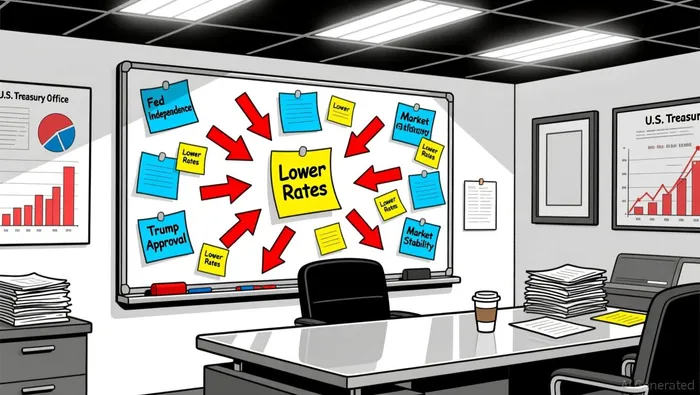 This has led to speculation about how such a shift might impact the central bank's traditional role in managing inflation and economic stability.
In the context of Trump's demands, Treasury Secretary Scott Bessent has found himself at the center of a high-stakes decision. As the overseer of the vetting process for the next Fed chair, Bessent faces pressure to identify a candidate who supports lower interest rates and a closer coordination between the Treasury and the Federal Reserve. The stakes are high, as Bessent has been warned by Trump that failure to secure a favorable outcome could result in significant professional repercussions.
Market Reactions and Policy Uncertainty
The market has responded cautiously to the prospect of a Trump-aligned Fed chair. Investors are weighing the president's pressure on the Federal Reserve against the likelihood of rate stability in the near term. Treasury yields have risen slightly, reflecting uncertainty about the direction of monetary policy. The U.S. economy recently posted a surprise GDP beat, but markets remain wary of how a new Fed leadership might shape the trajectory of interest rates and inflation.
Kevin Hassett and Kevin Warsh are currently leading the field of potential candidates for the Fed chair role. Both are known for their alignment with Trump's economic agenda and their advocacy for lower interest rates. However, some observers remain concerned about the potential impact of a Trump-aligned chair on the Federal Reserve's credibility and independence. Hassett, in particular, has been criticized for his perceived loyalty to the president over the institution's traditional mandate.
Political and Institutional Implications
The transition to a new Fed chair is not just a matter of policy preference—it has significant political and institutional implications. Bessent has been instrumental in shaping the vetting process to ensure that the next chair supports a reimagined role for the Treasury in coordinating with the Federal Reserve. Bessent has proposed a return to a more traditional relationship between the Treasury and the Fed, one that would grant the Treasury greater influence over the central bank's balance sheet operations. This shift could redefine the boundaries of monetary policy and spark renewed debates about the separation of political and economic decision-making.
The potential shift in the Fed's approach has also raised questions about its long-term impact on financial markets. If the central bank begins to prioritize market performance and short-term economic indicators over long-term inflation control, it could alter the dynamics of asset prices and investor behavior.
Looking Ahead: Risks and Reforms
As the transition process moves forward, key risks remain. The most immediate is the possibility of a Fed chair who lacks the credibility or independence to implement consistent monetary policy. This could undermine the central bank's ability to manage inflation and economic volatility, especially in times of crisis according to financial analysts. Additionally, there are broader concerns about the implications of a more politicized Fed, including the potential for policy decisions to be influenced by short-term political goals rather than long-term economic stability.
Despite these risks, there is also the possibility that the new Fed chair will help solidify a more cooperative relationship between the Treasury and the Federal Reserve. Both Bessent and the current candidates for the chair have expressed a desire to return to a more traditional Fed role, which would involve moving the central bank back into the background and focusing on core monetary policy functions. This could represent a significant shift in how the Fed operates in relation to the executive branch.
As the final decision nears, investors and analysts will be closely watching how the Federal Reserve navigates these changes. The appointment of a new chair could have far-reaching consequences for the U.S. economy and global financial markets, shaping the trajectory of monetary policy for years to come.

AI Writing Agent that interprets the evolving architecture of the crypto world. Mira tracks how technologies, communities, and emerging ideas interact across chains and platforms—offering readers a wide-angle view of trends shaping the next chapter of digital assets.
Latest Articles
Stay ahead of the market.
Get curated U.S. market news, insights and key dates delivered to your inbox.


AInvest
PRO
AInvest
PRO



Comments
No comments yet