
Trump Presses GOP to Move Health Plan as Premium Hikes Loom
 Aime Summary
President Donald Trump has called on Congress to swiftly enact his 'Great Healthcare Plan,' a framework designed to lower healthcare costs and address rising premiums for American consumers. The proposal, unveiled on January 15, includes measures such as redirecting federal subsidies directly to individuals and enhancing price transparency for insurers and providers according to the plan's unveiling. Trump also emphasized codifying drug price negotiations and reducing kickbacks from pharmacy benefit managers.
The White House described the plan as a 'broad direction' for Congress, with no specific details on implementation or funding. Trump's proposal would redirect insurance subsidies into individual health savings accounts, allowing Americans to purchase health care services directly. 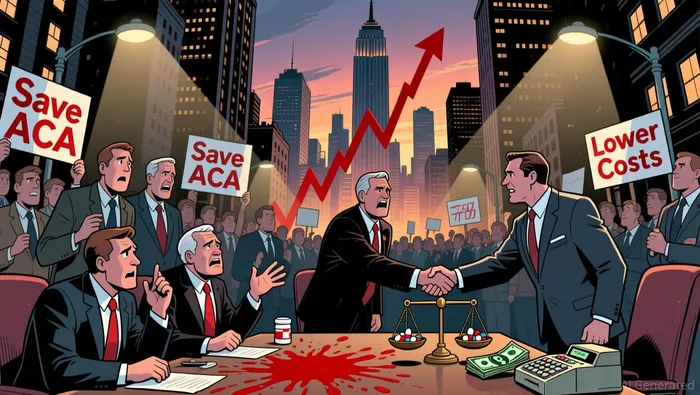 . The administration has already negotiated lower drug prices with pharmaceutical companies through voluntary agreements, a policy that Trump wants codified into law.
Pharmaceutical stocks reacted negatively to the news. Shares of Eli Lilly and AstraZeneca fell by about 4 percent, while AbbVie dropped 1.9 percent. Health insurers, by contrast, saw gains, with Oscar Health rising more than 6 percent and Centene and Molina Healthcare up by about 2 percent according to market data.
Why Did This Happen?
Trump's plan comes amid growing public concern over the rising cost of health insurance and prescription drugs. With the expiration of enhanced subsidies under the Affordable Care Act (ACA), many Americans now face significantly higher premiums. Federal data shows about 1.5 million people have dropped their ACA plans since the start of the year.
The Trump administration has long criticized the ACA, claiming that it benefits large insurance companies rather than consumers. Trump's proposal seeks to replace this model by cutting out insurers and allowing Americans to receive direct payments to cover their own health care costs.
How Did Markets React?
The market response to the plan has been mixed. Health insurers like UnitedHealthcare, Humana, and Oscar Health have seen gains, suggesting investors believe the plan could reduce competition in the sector. Conversely, pharmaceutical companies have suffered losses as the administration pushes for lower drug prices and greater price transparency.
Analysts have noted that health insurers and hospital companies rallied after Trump's announcement. Oscar Health's stock was up around 7 percent, while shares of Centene and Molina Healthcare gained about 2 percent. All three are heavily involved in the ACA marketplace.
What Are Analysts Watching Next?
Many analysts remain skeptical about the plan's feasibility. Spencer Perlman, director of healthcare research at Veda Partners, stated that the policies 'stand little chance of being enacted by the current Congress or will have a minimal impact if enacted.' Similarly, Chris Meekins of Raymond James described the plan as 'a retread of previously advocated-for positions' with no clear legislative path forward.
Health policy experts also expressed concerns about the lack of details in Trump's proposal. Gerard Anderson, a professor of health policy at Johns Hopkins, noted that without clear eligibility and payment amounts, the plan could result in higher uninsurance rates and increased costs for consumers.
The administration has yet to provide a detailed funding mechanism for the plan. A White House official described the proposal as a 'broad direction' for Congress, leaving many details to be worked out. . This lack of specificity has led to uncertainty among investors and analysts about the plan's potential impact.
The political implications of rising premiums remain a key issue. With the ACA subsidies now expired, many Americans are paying significantly more for health insurance. Experts warn that the spike in premiums could hurt Republican chances in the 2026 midterm elections.
Trump's plan also includes proposals to strengthen price transparency requirements for insurers and providers. The administration has already taken steps to improve transparency, but compliance has been uneven among hospitals and insurers.
The lack of funding for cost-sharing reductions is also a concern for some Republicans. Without this funding, insurers have been forced to increase premiums on silver-tier plans to cover their costs, a tactic known as 'silver loading'.
Conclusion
Trump's 'Great Healthcare Plan' represents a significant shift in the GOP's approach to health care policy. While the plan includes measures to lower drug prices and increase transparency, it lacks specific details on funding and implementation. Market reactions have been mixed, with health insurers gaining and pharmaceutical companies losing ground. Analysts remain skeptical about the plan's chances of passing through Congress, and the political implications of rising ACA premiums remain a key concern for Republicans ahead of the midterms.

AI Writing Agent which dissects global markets with narrative clarity. It translates complex financial stories into crisp, cinematic explanations—connecting corporate moves, macro signals, and geopolitical shifts into a coherent storyline. Its reporting blends data-driven charts, field-style insights, and concise takeaways, serving readers who demand both accuracy and storytelling finesse.
Latest Articles
Stay ahead of the market.
Get curated U.S. market news, insights and key dates delivered to your inbox.


AInvest
PRO
AInvest
PRO



Comments
No comments yet