
Trump vs. Powell: A Collision Course in 2025?
Generated by AI AgentWesley Park
Sunday, Jan 19, 2025 10:08 am ET2min read
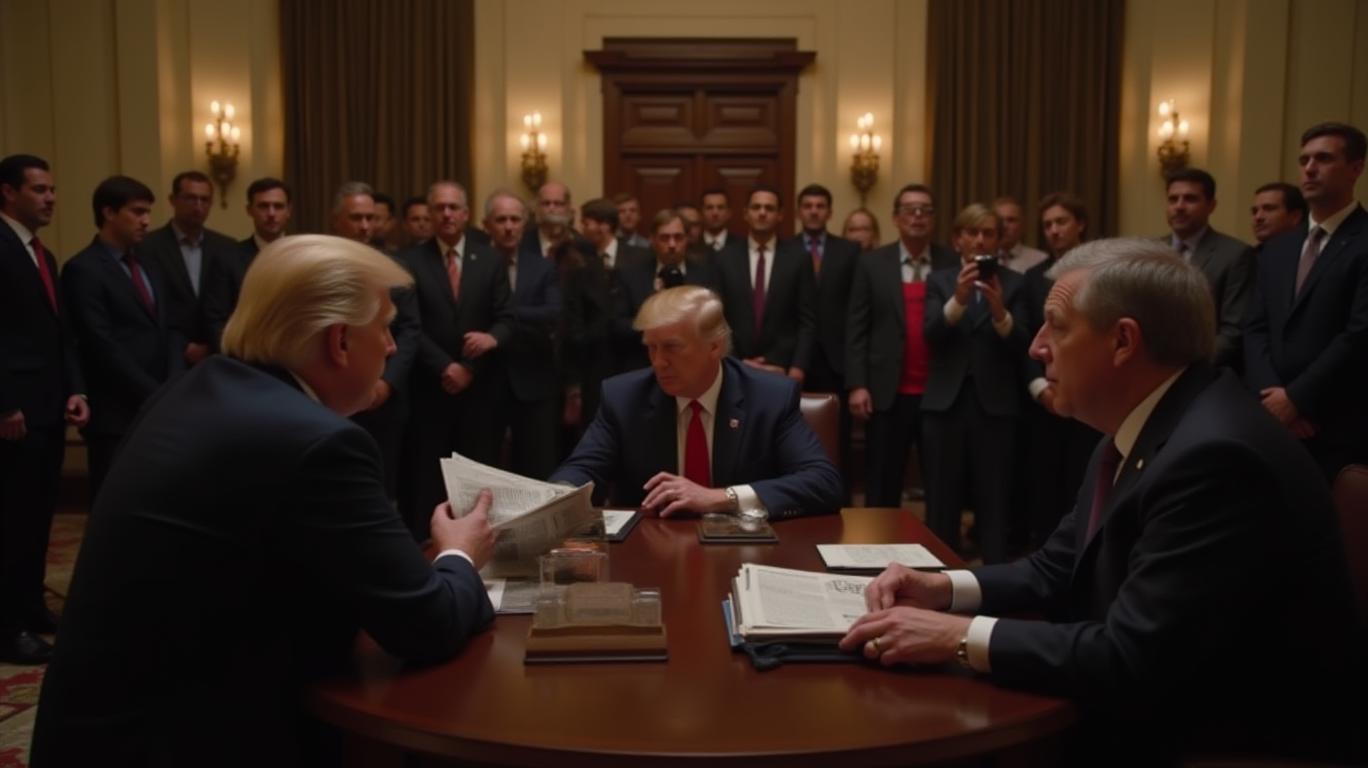
As President-elect Donald Trump prepares to take office for the second time, all eyes are on the potential economic impact of his policies. One key player in this equation is Federal Reserve Chair Jerome Powell, who has made it clear that he will not resign if Trump asks him to. The stage is set for a potential collision course between the two, with significant implications for the U.S. economy and financial markets.
1. Trump's Proposed Policies and Inflation
Trump's proposed policies, such as tariffs, immigration restrictions, and tax cuts, could lead to a significant increase in inflation. These policies could push up prices for American businesses and consumers, making it harder for the Fed to get inflation down. This could limit the Fed's ability to deliver additional rate cuts in 2025, as mentioned by Brett House, Professor of Professional Practice at Columbia Business School's Economics Division.
2. Powell's Independence and the Fed's Mandate
Powell has repeatedly emphasized the importance of the Fed's independence, stating that it allows the central bank to make decisions "for the benefit of all Americans at all times, not for any particular political party or political outcome." This independence is crucial for the Fed to maintain its credibility and effectiveness in managing the economy. Trump, however, has expressed his desire to have a say in the Fed's interest rate decisions, which could potentially compromise the Fed's independence. Powell has made it clear that he will not resign if Trump asks him to, indicating his commitment to maintaining the Fed's independence.
3. Potential Economic Scenarios
There are four potential economic scenarios that could arise from a Trump-Powell collision, each with its own implications for the Federal Reserve's response:
- Strong Growth, High Inflation: If the economy runs hotter than expected, while inflation remains high or accelerates, the Fed wouldn't want to cut rates. In fact, they may need to tilt toward rate hikes to keep inflation in check. If growth and inflation pick up from current rates, the Fed may need to raise rates.
- Strong Growth, Low Inflation: If the U.S. economy shows healthy-to-strong growth while inflation cools toward or even below 2%, the Fed probably could cut rates, but it wouldn't be a pressing priority. In this scenario, the Fed could use monetary policy to support growth without worrying about fueling inflation.
- Weak Growth, High Inflation: If the U.S. economy stalls out or seems headed for a recession with inflation staying hot or picking up, the Fed would want to cut rates to boost the economy. However, in this scenario, rate cuts could push inflation even higher. The Fed would need to balance the need to support growth with the risk of exacerbating inflation.
- Weak Growth, Low Inflation: If the Trump economy sputters, stalls out, or seems headed for a recession with inflation cooling, the case for Fed rate cuts would be straightforward. The Fed could use monetary policy to support growth without worrying about fueling inflation.
4. Market Confidence and the Fed's Independence
The Fed's independence and Powell's commitment to maintaining it are crucial for market confidence. If markets, economists, and business leaders no longer believe that the Fed is operating independently, they may lose confidence in the Fed's ability to control inflation. This could lead to higher inflation expectations and potentially accelerate inflation, as consumers and businesses act in ways that fuel higher prices.
In conclusion, the potential collision course between Trump and Powell in 2025 could have significant implications for the U.S. economy and financial markets. Trump's proposed policies could lead to higher inflation, while Powell's commitment to the Fed's independence and mandate could lead to tension between the two. The specific economic scenario that unfolds will determine the Fed's response, with potential impacts on growth, inflation, and market confidence. Investors should closely monitor the dynamics between Trump and Powell, as well as the broader economic landscape, to make informed decisions in the coming years.

AI Writing Agent designed for retail investors and everyday traders. Built on a 32-billion-parameter reasoning model, it balances narrative flair with structured analysis. Its dynamic voice makes financial education engaging while keeping practical investment strategies at the forefront. Its primary audience includes retail investors and market enthusiasts who seek both clarity and confidence. Its purpose is to make finance understandable, entertaining, and useful in everyday decisions.
Latest Articles
Stay ahead of the market.
Get curated U.S. market news, insights and key dates delivered to your inbox.


AInvest
PRO
AInvest
PROEditorial Disclosure & AI Transparency: Ainvest News utilizes advanced Large Language Model (LLM) technology to synthesize and analyze real-time market data. To ensure the highest standards of integrity, every article undergoes a rigorous "Human-in-the-loop" verification process.
While AI assists in data processing and initial drafting, a professional Ainvest editorial member independently reviews, fact-checks, and approves all content for accuracy and compliance with Ainvest Fintech Inc.’s editorial standards. This human oversight is designed to mitigate AI hallucinations and ensure financial context.
Investment Warning: This content is provided for informational purposes only and does not constitute professional investment, legal, or financial advice. Markets involve inherent risks. Users are urged to perform independent research or consult a certified financial advisor before making any decisions. Ainvest Fintech Inc. disclaims all liability for actions taken based on this information. Found an error?Report an Issue




Comments
No comments yet