
Trump's Potential Nomination of Kevin Hassett as Fed Chair: Implications for U.S. Monetary Policy and Financial Markets


 Aime Summary
Hassett's Policy Stance and Trump's Economic Agenda
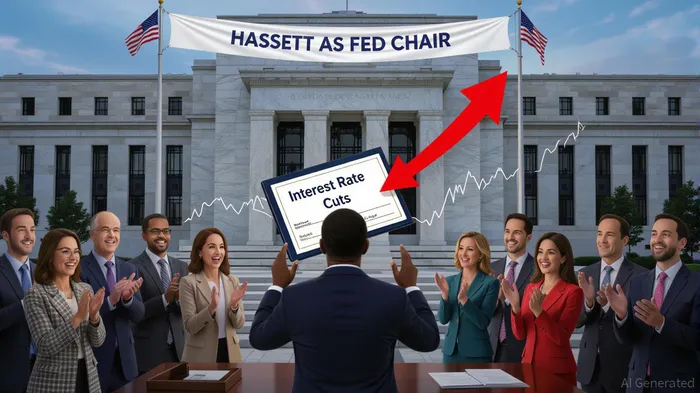
Kevin Hassett, currently the Director of the National Economic Council, has long championed policies that align with Trump's economic vision. His public statements emphasize the need for the Fed to lower interest rates to stimulate growth and ease housing market conditions according to analysis. This dovish stance contrasts with the more cautious approach of current Fed Chair , who has prioritized balancing inflation control with economic stability as reported.
Hassett's policy positions extend beyond monetary issues. As a former chair of the Council of Economic Advisers in the first Trump administration, he has consistently supported tax cuts, expanded energy production, and trade policies favoring American industries according to Investopedia. His recent co-authorship of a white paper advocating for portable retirement savings accounts further underscores his focus on labor market flexibility and long-term economic growth according to Investopedia. If confirmed as Fed Chair, Hassett would likely amplify these priorities, embedding them into the central bank's policy framework.
Monetary Policy Shifts and Institutional Challenges
A Hassett-led Fed could accelerate the pace of rate cuts, particularly if Trump's administration pressures the central bank to prioritize growth over inflation risks. According to a Bloomberg report, Hassett has argued that the Fed should act "immediately" to cut rates, a position that reflects his belief in the stimulative power of accommodative monetary policy according to Bloomberg. However, such a shift faces challenges within the Federal Open Market Committee (FOMC), where members hold diverse views on inflation and labor market dynamics as reported.
Historically, Fed Chair transitions introduce policy continuity risks, as new leaders may struggle to unify the FOMC behind their vision. For example, the transition from to Powell in 2018 saw initial market volatility as the committee adjusted to a more hawkish stance. A Hassett appointment could similarly test the Fed's cohesion, particularly if his dovish agenda clashes with members who remain cautious about inflationary pressures according to analysis.
Financial Market Implications
The potential nomination has already influenced market dynamics. Treasuries rallied in response to speculation about Hassett's candidacy, pushing the 10-year yield below 4% according to Bloomberg. Analysts suggest that a dovish Fed under Hassett could weaken the U.S. dollar over time, as lower rates reduce the currency's appeal to foreign investors according to Reuters. This scenario mirrors the 2010s, when prolonged low rates under Ben Bernanke and Janet Yellen contributed to dollar depreciation and a surge in emerging-market debt.
Gold markets have also reacted to the uncertainty. A Reuters report notes that the prospect of Fed leadership changes has driven increased allocations to precious metals, as investors seek safe-haven assets amid policy ambiguity according to analysis. This trend reflects broader institutional behaviors where central bank transitions prompt systematic reallocation to non-yielding, store-of-value commodities.
The Fed's Independence and Political Constraints
Despite Hassett's close ties to the Trump administration, the Fed's independence remains a critical factor. While the chair plays a pivotal role in shaping policy, the FOMC's 12 voting members collectively determine monetary decisions according to analysis. This institutional structure limits the extent to which any single individual, including the chair, can unilaterally dictate policy. For instance, even under a dovish chair, the Fed's -price stability and maximum employment-would constrain extreme deviations from established norms.
However, Hassett's political alignment raises concerns about perceived politicization of the Fed. A Reuters analysis highlights that markets are monitoring how his leadership might affect the dollar and Treasury yield curve, with some investors pricing in a higher probability of rate cuts according to Reuters. Such perceptions could amplify volatility, particularly if the Fed's actions are interpreted as overly responsive to political pressures.
Conclusion
Kevin Hassett's potential nomination as Fed Chair represents a pivotal moment for U.S. monetary policy. His advocacy for rapid rate cuts aligns with Trump's economic agenda but risks exacerbating inflationary pressures and introducing market uncertainty. While the Fed's institutional structure provides a buffer against extreme policy shifts, the appointment could still influence financial markets through its impact on the dollar, Treasuries, and gold. Investors and policymakers alike will need to closely monitor how the FOMC navigates these dynamics, balancing political priorities with the central bank's mandate to ensure long-term economic stability.

Delivering real-time insights and analysis on emerging financial trends and market movements.
Latest Articles
Stay ahead of the market.
Get curated U.S. market news, insights and key dates delivered to your inbox.


AInvest
PRO
AInvest
PRO



Comments
No comments yet