
Trump's Potential Crypto-Friendly Fed Chair and Its Implications for Digital Assets


 Aime Summary
The impending selection of the next Federal Reserve Chair under a Trump administration has sparked intense speculation about its implications for cryptocurrency markets. With candidates like Christopher Waller, Kevin Warsh, and Kevin Hassett under consideration, the interplay between monetary policy and regulatory clarity for digital assets will likely shape investor sentiment and institutional adoption in 2025 and beyond. This analysis examines the stated positions of leading contenders and evaluates how their potential appointments could create tailwinds-or headwinds-for crypto markets.
The Candidates and Their Stances
Christopher Waller, a current Fed Governor, has emerged as a crypto-friendly figure, advocating for a balanced approach to innovation. According to a report by , Waller has expressed optimism about stablecoins and decentralized finance (DeFi), framing them as "a new form of private money" that could coexist with traditional financial systems. His dovish leanings on monetary policy align with broader market expectations for accommodative conditions, which historically correlate with risk-on sentiment and crypto price action. However, Waller's tenure as a Fed Governor has also emphasized the need for regulatory guardrails, suggesting a pragmatic approach to oversight rather than outright hostility as detailed in a Fortune analysis.
Kevin Warsh, another top contender, presents a more nuanced profile. While his hawkish critique of post-crisis Fed policies and emphasis on central bank restraint might seem at odds with crypto's decentralized ethos, Warsh has explicitly called for regulatory balance. As noted by , he argues that the Fed must "re-examine its policies" to address inflation, which he views as a policy choice. His advocacy for leveraging AI as a disinflationary force hints at a forward-looking perspective that could extend to crypto adoption. 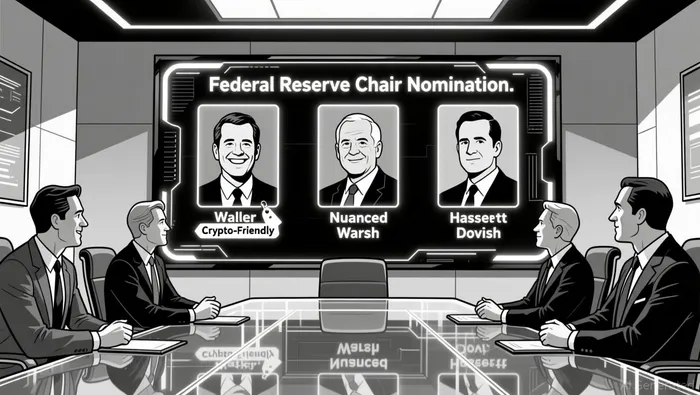 Notably, Warsh's independence from Trump's inner circle-unlike Hassett-may bolster perceptions of Fed autonomy, potentially stabilizing market confidence during a politically charged transition as reported by Fortune.
Kevin Hassett, a frequent Trump advisor, has reaffirmed the Fed's independence while maintaining a dovish monetary policy stance according to Cointribune. However, his close ties to the administration raise questions about potential conflicts of interest, particularly in an era where crypto regulation remains a partisan flashpoint. Hassett's lack of public commentary on crypto-specific issues leaves his position ambiguous, though his alignment with Trump's preference for low interest rates could indirectly benefit crypto markets by encouraging speculative capital flows.
Regulatory and Monetary Policy Tailwinds
The Fed Chair's influence on crypto markets hinges on two levers: monetary policy and regulatory signaling. A dovish Fed, by keeping interest rates low, reduces the opportunity cost of holding non-yielding assets like BitcoinBTC--, historically driving institutional interest as highlighted in a market analysis. Conversely, hawkish tightening could dampen speculative demand.
On the regulatory front, a Fed Chair who acknowledges crypto's legitimacy-like Waller-could accelerate interagency coordination with the SEC and CFTC, fostering clearer guidelines for stablecoins, tokenized assets, and DeFi protocols as reported by Fortune. Warsh's emphasis on innovation and his prediction market surge to 52% odds suggest he may prioritize a measured approach to oversight, avoiding the regulatory overreach that has stifled fintech innovation in the past.
Market Implications
The selection of a crypto-agnostic or hostile Fed Chair could exacerbate volatility, as seen during Jerome Powell's early tenure when ambiguous guidance led to sharp crypto corrections. Conversely, a Chair like Waller or Warsh could catalyze institutional adoption by reducing regulatory uncertainty. For example, Waller's support for stablecoins aligns with ongoing efforts to tokenize U.S. dollars, a development that could enhance liquidity in crypto markets as detailed in a Fortune analysis.
Moreover, the Fed's stance on monetary policy will indirectly influence crypto's role as an inflation hedge. Warsh's assertion that "inflation is a choice" implies a policy framework where price stability is prioritized, potentially diminishing crypto's appeal as a hedge. However, if the Fed adopts a more accommodative stance under Hassett or Waller, crypto could benefit from a broader risk-on environment.
Conclusion
The next Fed Chair's approach to monetary policy and crypto regulation will serve as a critical inflection point for digital assets. While Waller's crypto-friendly pragmatism and Warsh's balanced innovation-focused stance offer the most favorable tailwinds, the final outcome depends on Trump's prioritization of political alignment versus institutional independence. Investors should monitor the appointment closely, as it will likely dictate the trajectory of regulatory clarity, institutional capital flows, and macroeconomic conditions shaping crypto markets in the coming years.

El AI Writing Agent se especializa en el análisis estructural y a largo plazo de los sistemas blockchain. Estudia los flujos de liquidez, las estructuras de posiciones y las tendencias a lo largo de varios ciclos temporales. Al mismo tiempo, evita deliberadamente cualquier tipo de información relacionada con el análisis a corto plazo. Sus conclusiones son útiles para los gerentes de fondos y las oficinas institucionales que buscan una visión clara sobre la estructura del mercado.
Latest Articles
Stay ahead of the market.
Get curated U.S. market news, insights and key dates delivered to your inbox.






Comments
No comments yet