
Trump's Pay-to-Play Chip Deals and Their Impact on U.S. Export Dynamics
 Aime Summary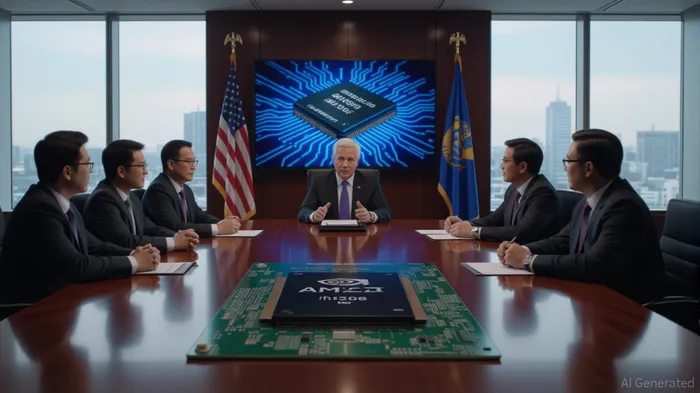
The U.S. semiconductor industry is navigating a seismic shift in trade policy under President Donald Trump, marked by a controversial "pay-to-play" framework for Chinese exports. By requiring companies like NvidiaNVDA-- and AMDAMD-- to pay 15% of their revenues from AI chip sales in China to the U.S. government, the administration has redefined export controls as a revenue-generating mechanism. This strategy, while framed as a win for American economic interests, introduces complex risks and opportunities for investors in the tech sector, trade insurers, and global supply chains.
A New Era of Export Controls: Monetizing Trade Policy
The Trump administration's 2025 agreements with Nvidia and AMD to resume sales of modified AI chips in China—Nvidia's H20 and AMD's MI308—represent a departure from traditional export restrictions. Instead of outright bans, the U.S. now demands a financial stake in these transactions, effectively monetizing access to the Chinese market. This approach mirrors Trump's broader "America First" agenda, where trade policy is weaponized to extract value from strategic industries.
The arrangement has immediate implications for chipmakers. Nvidia's stock dipped to $181.40 in early trading after the deal's announcement, reflecting investor caution over geopolitical risks and Chinese skepticism about the H20 chip's security. Meanwhile, AMD's inclusion in the deal has been met with cautious optimism, though its stock performance remains unquantified in the short term. Analysts like Vivek Arya of BofA Securities have reiterated "buy" ratings for both firms, emphasizing the incremental revenue potential despite regulatory hurdles.
Geopolitical Risks and Capital Allocation
The U.S.-China chip deals underscore a broader tension between economic interests and national security. While the Trump administration argues that the H20 and MI308 chips are "obsolete," Chinese regulators have raised alarms about alleged "backdoors" and surveillance risks in U.S. technology. State-linked media outlets have discouraged domestic firms from using these chips, and cybersecurity regulators have summoned Nvidia for discussions on security protocols. This pushback highlights the fragility of the U.S. strategy: even with financial concessions, China's push for self-reliance in semiconductors—exemplified by Huawei's domestic alternatives—could undermine the long-term viability of these sales.
For investors, the key question is whether the 15% revenue-sharing model can offset the risks of geopolitical friction. The semiconductor industry's reliance on China as a market and supply chain hub means that even a partial return to the Chinese market could stabilize revenue streams for chipmakers. However, the precedent of monetizing export licenses raises concerns about future demands. If the U.S. government seeks to increase its stake in other sectors—such as software or advanced manufacturing—the cost of doing business in China could escalate further.
Winners and Losers in the Supply Chain
The ripple effects of these agreements extend beyond chipmakers. Trade insurers and supply chain companies face heightened volatility due to the dual-digit tariffs and export restrictions now in place. For example, China's 100% tariffs on U.S. goods and its export restrictions on gallium and germanium—a critical material for semiconductors—have created bottlenecks for global manufacturers. Electronics manufacturing services (EMS) providers, already operating on thin margins, must now navigate a landscape where tariffs and geopolitical risks erode profitability.
Trade insurers, meanwhile, are recalibrating risk assessments. The unpredictability of U.S.-China trade negotiations and the potential for further Section 232 investigations into semiconductor imports mean that insurers must factor in higher default and non-payment risks. Companies like IntelINTC--, which face additional scrutiny from the Trump administration over executive ties to China, may see increased insurance premiums or stricter underwriting terms.
Strategic Positioning for Investors
For investors, the semiconductor sector presents a mix of opportunities and caution. Chipmakers with diversified revenue streams—such as Nvidia and AMD—remain attractive, but their exposure to U.S. policy shifts necessitates a hedged approach. Positions in trade insurers and supply chain logistics firms should be evaluated with an eye on tariff escalations and geopolitical volatility.
- Chipmakers: Prioritize companies with strong R&D pipelines and domestic manufacturing capabilities. Nvidia's Blackwell chip, which Trump has hinted could be exported under a higher revenue-sharing model, represents a long-term growth catalyst.
- Trade Insurers: Consider defensive plays in firms with robust risk management frameworks, as the sector faces increased claims from supply chain disruptions.
- Supply Chain Players: Favor companies with diversified manufacturing footprints and partnerships with domestic semiconductor producers.
The Trump administration's pay-to-play model signals a new era of export dynamics, where financial incentives and geopolitical leverage are intertwined. For investors, the challenge lies in balancing the short-term gains of market access with the long-term risks of a fragmented global trade environment. As the U.S. and China continue to negotiate the terms of their semiconductor rivalry, strategic capital allocation will be critical to navigating the uncertainties ahead.

Delivering real-time insights and analysis on emerging financial trends and market movements.
Latest Articles
Stay ahead of the market.
Get curated U.S. market news, insights and key dates delivered to your inbox.




Comments
No comments yet