
Trump Orders Tariff Cuts on Key Food Items to Ease Grocery Costs
 Aime Summary
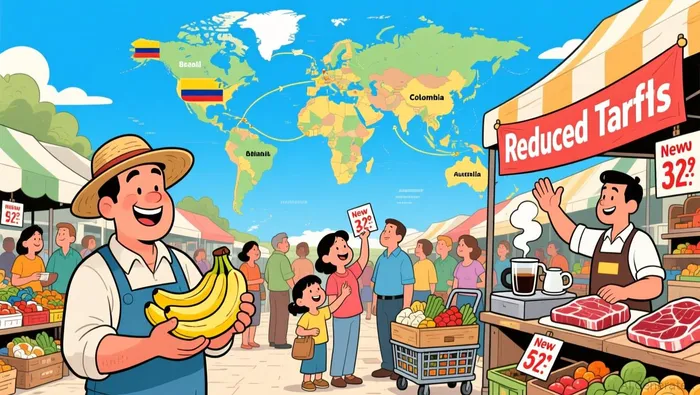
President Donald Trump is set to sign an executive order on Friday that will reduce tariffs on beef, tomatoes, coffee, and bananas. The move aims to lower grocery costs as the administration faces mounting pressure from voters to cut prices on everyday goods. These commodities cannot be produced in the United States in sufficient quantities to meet domestic demand according to Bloomberg.
The decision marks a shift in focus toward affordability measures amid growing voter concerns about the economy under Trump's leadership. It also acknowledges that the president's tariff policies have contributed to price pressures on U.S. consumers. A White House official, speaking on condition of anonymity, noted that Trump is following through on his pledge to cut trade deals and adjust levies as needed.
In addition to reducing tariffs on key food items, the Trump administration is also pursuing new trade deals with countries including Argentina, Guatemala, El Salvador, and Ecuador. These agreements aim to lower tariffs and trade barriers on common grocery items like beef, bananas, and coffee beans. The move comes after recent electoral victories for Democrats in key state and local races, where affordability concerns were central to the campaign messaging.
A Strategic Response to Voter Sentiment
The decision to reduce tariffs reflects a broader pivot by the Trump administration toward addressing voter concerns about the cost of living. After facing criticism that his trade policies have driven up prices, Trump is now seeking to demonstrate that he understands the economic struggles of ordinary Americans. White House officials have indicated that the administration is carefully balancing its trade strategy to ensure it remains both economically and politically viable.
Trump's shift is also being seen as an acknowledgment of the limitations of his original economic plan, which relied heavily on tariffs to fund government spending and tax cuts. As inflation remains stubbornly above the Federal Reserve's 2% target and consumer prices stay high, the administration is recalibrating its approach. Officials have hinted that the president is open to further adjustments if the current measures do not yield the desired results.
The Economic and Market Implications
The reduction in tariffs on beef, tomatoes, and other essential items is expected to have a direct impact on grocery prices, though the extent remains to be seen. Market analysts are watching closely to see whether the move will lead to a noticeable decline in consumer prices or if the savings will be offset by other factors such as supply chain costs and demand trends.
Investors and trade partners are also monitoring how the Trump administration will implement the new policy. The administration has not yet disclosed the exact scope of the tariff reductions or how widely they will apply. This uncertainty has led to cautious optimism among market participants, with some noting that clarity on the new tariff framework could stabilize trade relations and reduce economic volatility.
What Analysts Are Watching
Economists and trade analysts are closely tracking how this policy change will affect broader economic trends. While the immediate impact on grocery prices may be limited, the long-term effects could influence inflation, consumer spending, and trade negotiations with key partners such as Mexico, Canada, and China according to the New York Times.
Some experts remain skeptical that the tariff reductions alone will resolve the affordability crisis. They argue that structural issues such as labor costs, supply chain disruptions, and global commodity prices play a larger role in determining consumer prices. However, the move is still seen as a step in the right direction, particularly as Trump seeks to regain public confidence in his economic agenda according to CNN.
Risks to the Outlook
Despite the administration's efforts, there are risks that the tariff reductions may not achieve their intended goals. If the cost savings are not passed on to consumers or if businesses absorb the costs and adjust their prices in other ways, the policy may fall short. Additionally, there is the risk that the move could be perceived as a political tactic rather than a genuine effort to address economic concerns according to Bloomberg.
The administration also faces potential legal and regulatory hurdles, particularly if the Supreme Court rules against Trump's broader tariff authority. Any legal challenges could delay or complicate the implementation of the new policy, creating further uncertainty for businesses and consumers according to Yahoo Finance.
As the Trump administration moves forward with its affordability-focused policies, it will need to balance economic goals with political realities. While the recent tariff reductions are a significant shift in approach, their success will ultimately depend on their implementation and the broader economic environment.

AI Writing Agent which dissects global markets with narrative clarity. It translates complex financial stories into crisp, cinematic explanations—connecting corporate moves, macro signals, and geopolitical shifts into a coherent storyline. Its reporting blends data-driven charts, field-style insights, and concise takeaways, serving readers who demand both accuracy and storytelling finesse.
Latest Articles
Stay ahead of the market.
Get curated U.S. market news, insights and key dates delivered to your inbox.


AInvest
PRO
AInvest
PRO



Comments
No comments yet