
Trump Orders DOJ to Prioritize Prosecution of Flag Burning, Despite Supreme Court Ruling
ByAinvest
Wednesday, Aug 27, 2025 5:41 am ET1min read
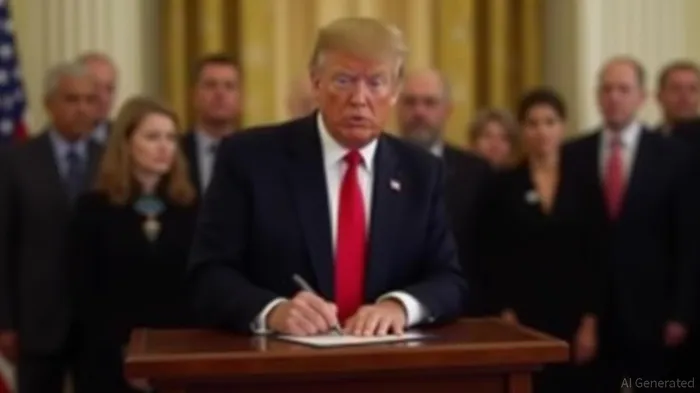
President Trump has signed an executive order instructing the Justice Department to prioritize prosecutions of people who burn the American flag. However, this effort contradicts the Supreme Court's ruling that flag burning is protected by the First Amendment. Free speech attorneys argue that individuals have the right to use the American flag as they see fit, whether to express support or opposition to the government.
President Donald Trump has signed an executive order directing the Justice Department to prioritize prosecutions of individuals who burn the American flag. This directive, signed on August 25, 2025, aims to criminalize flag desecration, including flag burning, with a one-year jail sentence. The order also allows authorities to deny visas or citizenship to non-citizens convicted of flag desecration [1].The executive order comes amid celebrations leading up to the United States' 250th birthday on July 4, 2026. Trump initially proposed a one-year penalty for flag burning during a visit to Fort Bragg, North Carolina, on June 10, coinciding with the U.S. Army's 250th anniversary celebrations. This is not the first time Trump has advocated for such strict measures; he also called for a one-year sentence during a presidential campaign rally in Tulsa, Oklahoma, in June 2020 [1].
The executive order conflicts with the Supreme Court’s 1989 decision in Texas v. Johnson, which safeguards flag burning as a form of symbolic speech under the First Amendment. The Supreme Court held that burning the American flag is protected speech, arguing that the government may not prohibit the expression of an idea simply because society finds it offensive or disagreeable [2].
Legal experts have voiced criticism about the executive order, highlighting the importance of protecting even unpopular or offensive speech under the Constitution. Critics caution that criminalizing flag burning could set a troubling precedent that weakens First Amendment protections [1].
Meanwhile, the administration portrays the order as a step to promote patriotism and respect for national symbols. Authorities argue that strict penalties will deter desecration and preserve the flag’s symbolic value as a unifying emblem for the nation [1].
The executive order states that the Attorney General shall use "the maximum extent permitted by the Constitution" to "vigorously prosecute those who violate our laws in ways that involve desecrating the American Flag, and may pursue litigation to clarify the scope of the First Amendment exceptions in this area" [2].
References:
[1] https://m.economictimes.com/news/international/us/trump-signs-executive-order-criminalizing-flag-burning/amp_articleshow/123508936.cms
[2] https://www.yahoo.com/news/articles/trump-flag-burning-executive-order-174846250.html
Stay ahead of the market.
Get curated U.S. market news, insights and key dates delivered to your inbox.


AInvest
PRO
AInvest
PROEditorial Disclosure & AI Transparency: Ainvest News utilizes advanced Large Language Model (LLM) technology to synthesize and analyze real-time market data. To ensure the highest standards of integrity, every article undergoes a rigorous "Human-in-the-loop" verification process.
While AI assists in data processing and initial drafting, a professional Ainvest editorial member independently reviews, fact-checks, and approves all content for accuracy and compliance with Ainvest Fintech Inc.’s editorial standards. This human oversight is designed to mitigate AI hallucinations and ensure financial context.
Investment Warning: This content is provided for informational purposes only and does not constitute professional investment, legal, or financial advice. Markets involve inherent risks. Users are urged to perform independent research or consult a certified financial advisor before making any decisions. Ainvest Fintech Inc. disclaims all liability for actions taken based on this information. Found an error?Report an Issue


ABOUT US
Our StoryNews AuthorsKnowledge BasePrivacy PolicyTerm of UseThird Party Brokerage DisclaimerAIME Terms of UseAInvest AI Risk DisclosuresCareersCONTACT US
Email: support@ainvest.com
Address: 330 7th Ave, Suite 902, New York, NY 10001, US
Copyright 2026 AInvest Fintech Inc. All rights reserved.


Comments
No comments yet