
Who Will Trump Nominate as Fed Chair? Odds Are 95% — But the 3% Reversal Bet Could Return 30x
 Aime Summary
Polymarket Fed Chair Bet Explodes: Why Kevin Warsh Is at 95% — and Why Judy Shelton Still Has 3%
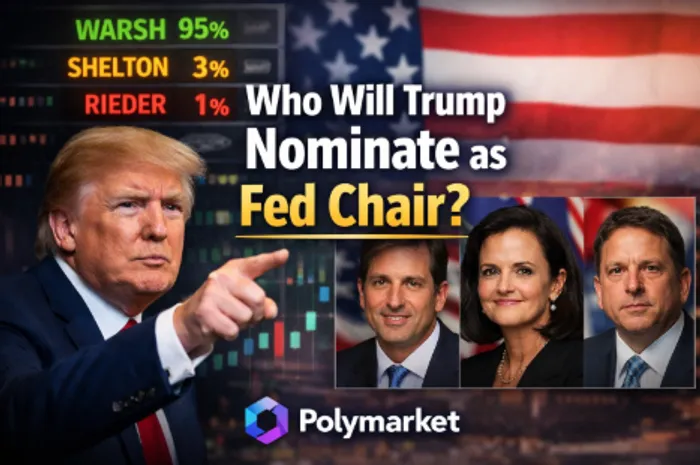
Prediction markets rarely move this hard, this fast. On Polymarket, the contract "Who will Trump nominate as Fed Chair?" has surged toward a near-lock — with Kevin Warsh trading around 95% probability. Yet one detail is confusing many investors: Judy Shelton still holds ~3%. Is that just noise — or a real reversal risk?
🟦 Warsh Contract https://polymarket.com/event/who-will-trump-nominate-as-fed-chair/will-trump-nominate-kevin-warsh-as-the-next-fed-chair → Trading at ~$0.95 (95% probability) → Settles at $1 if correct → Likely return: ~1.05× (~5%) — very low risk, low yield
🟨 Shelton Contract https://polymarket.com/event/who-will-trump-nominate-as-fed-chair/will-trump-nominate-judy-shelton-as-the-next-fed-chair → Trading at ~$0.03 (3% probability) → Settles at $1 if reversal happens → Likely return: ~32× (3,200%+)
🟥 Rieder Contract https://polymarket.com/event/who-will-trump-nominate-as-fed-chair/will-trump-nominate-rick-rieder-as-the-next-fed-chair → Trading below $0.01 → Settles at $1 if shock outcome occurs → Likely return: 100×+ (10,000%+)
The Timeline: How the Market Repriced the Fed Chair Race⏳
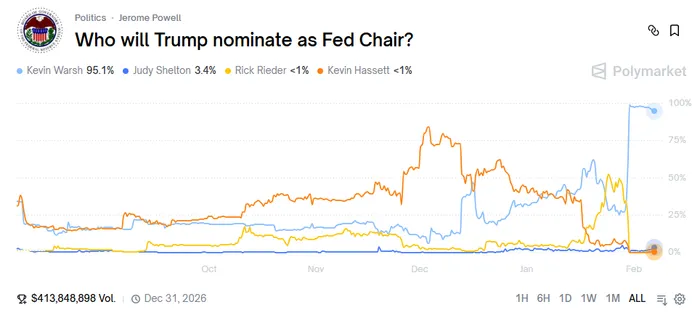
Phase 1 — Early speculation
Multiple names circulated: Kevin Hassett, Judy Shelton, Kevin Warsh, Rick Rieder
Odds were fragmented; no dominant favorite
Market traded mostly on rumor flow and media mentions
Phase 2 — First major repricing
Warsh odds began rising sharply after insider / policy-circle signals
Other candidates' probabilities compressed
Prediction market liquidity increased — signaling institutional participation
Phase 3 — Late-stage rotation
A short-lived surge in alternative candidates (including Rieder / Hassett)
Traders rotated positions rapidly — classic "last rumor spike"
Phase 4 — Announcement shock
Trump publicly named Kevin Warsh
Warsh contract repriced vertically toward 90–95%
Most other candidates collapsed toward near-zero
Phase 5 — Dispute & rule check
Market entered resolution dispute phase
Tail probabilities (Shelton ~3%) remained instead of going to zero
That last step is the key to understanding the remaining 3%.
Why Judy Shelton Still Trades at ~3% ⚠️
This is not popularity. It's rule risk pricing.
Traders are pricing four tail risks:
Procedural risk — Senate nomination filing not yet posted
Withdrawal risk — nominee changed before formal submission
Delay risk — nomination timing dispute before cutoff date
Resolution dispute risk — Polymarket adjudication reversal
Prediction markets always leave a tail when:
Resolution depends on legal wording
There is an active dispute
Settlement authority is external
So Shelton's 3% is basically:
"There is a small but non-zero chance the formal rule trigger fails or changes."
Not momentum — insurance.
Could There Still Be a Reversal? 🚀
Yes — but low probability and rule-driven, not political.
Reversal would require one of these:
Formal nomination never submitted
Nomination withdrawn and replaced
Filing wording mismatch vs market rules
Resolution authority overturns proposed outcome
This is process risk, not candidate strength.
Think of it as:
Legal settlement risk, not election risk.
Trading Strategy: How to Position From Here 📈
Let's translate this into trade math.
Polymarket contracts settle at $1 if correct, $0 if wrong.
Current pricing (example from your screen):
Warsh YES ≈ $0.95
Shelton YES ≈ $0.03
If You Believe Warsh Is Locked In
Trade: Buy Warsh YES at $0.95 Max payout: $1.00 Profit: $0.05 per share Return: ~5.3%
Use when:
You trust Senate filing will occur
You think dispute resolves cleanly
You want low-risk yield style trade
This is basically a legal-process carry trade.
If You Believe There's a Rule Failure / Reversal
Trade: Buy Shelton YES at $0.03
If reversal happens:
Payout = $1.00
Profit = $0.97
Return ≈ 32x
Use when:
You believe nomination wording risk exists
You expect procedural disruption
You want asymmetric lottery-style exposure
This is a tail hedge trade.
Neutral Arbitrage Style
Some traders do:
Long Warsh YES
Small long Shelton YES
This creates:
Core outcome capture
Tail protection if settlement flips
It's not pure arbitrage — but it's resolution-risk hedging.
Bottom Line
Warsh at 95% = market believes the nomination outcome is decided
Shelton at 3% = market is pricing rule and settlement risk, not political odds
The remaining volatility is about process, not preference
Prediction markets don't go to 100% on headlines. They go to 100% on paperwork.
The Rules That Actually Decide the Outcome (Critical)
This market does not resolve based on headlines.
It resolves only if:
✅ A formal nomination message is submitted to the U.S. Senate
✅ The nominee is explicitly for Fed Chair
✅ It appears in the official Senate nominations record
Does NOT count:
❌ Press releases alone
❌ Verbal announcements
❌ Acting / interim appointments
❌ "Intended nominee" language without Senate filing
Primary resolution source:
U.S. Senate nominations system
Fallback: consensus of credible reporting
This rule gap = why odds never go to 100% immediately.
👉 Explore live markets and top-volume prediction trades here: https://polymarket.com

Rodder Shi is a market analyst covering U.S. stocks and prediction markets. He holds a Master’s degree in Financial Engineering from UCLA and dual degrees from UC San Diego, with research experience at CICC and Rayliant. An IAQF quantitative research award winner, he has over six years of equity and options investing experience focused on data-driven and risk-aware market analysis.
Latest Articles
Stay ahead of the market.
Get curated U.S. market news, insights and key dates delivered to your inbox.


AInvest
PRO
AInvest
PRO



Comments
No comments yet