
Trump Mobile's Costly Gamble: A Risky Bet for Investors in a Saturated Market
The Trump Organization's recent foray into the smartphone market with the Trump Mobile T-1, priced at $499, has sparked debate over its feasibility and broader implications for tech giants like AppleAAPL-- and Samsung. Analysts, including Wedbush's Dan Ives, have raised red flags about the venture's reliance on U.S. manufacturing and the tariff risks looming over the sector. For investors, the gamble highlights a precarious balance between political rhetoric and economic reality.
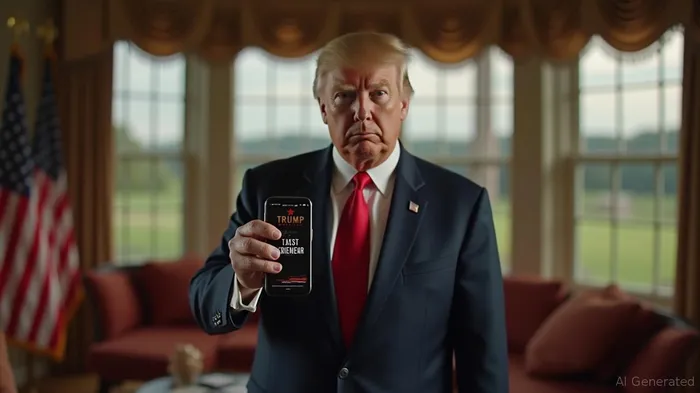
Manufacturing Costs: A "Fairy Tale" for U.S. Production
Dan Ives of Wedbush has been blunt in his assessment of domestic smartphone manufacturing: “This is a fairy tale.” His analysis reveals that producing the T-1 entirely in the U.S. would face insurmountable challenges. Key issues include:
- Supply Chain Gaps: No major smartphone manufacturer has operated a U.S. production facility since the 3G era. Rebuilding this ecosystem—ranging from semiconductors to assembly—would require billions in investment and years of development.
- Cost Inflation: Wedbush estimates a U.S.-made iPhone could cost up to $3,500 due to labor and infrastructure expenses, far exceeding Apple's current $799–$999 price range. For Trump Mobile's $499 device, Ives calls the price tag “vaporware,” noting that even partial U.S. assembly would strain margins.
- Labor Shortages: The U.S. lacks a skilled workforce for complex processes like tooling engineering, with a projected 67,000 semiconductor worker shortfall by 2030.
The Trump Organization's claims of U.S. manufacturing are further undermined by reports that the T-1 is assembled in the U.S. using Chinese-sourced components—a loophole to qualify for “Made in America” labeling. This raises questions about the venture's profitability and scalability.
Tariff Threats: A Double-Edged Sword for Apple and Samsung
President Trump's threat to impose a 25% tariff on non-U.S.-made smartphones sold in the U.S. has intensified pressure on Apple and Samsung. While the goal is to force domestic production, Ives argues tariffs would instead:
- Raise Consumer Prices: A $25 billion tariff on iPhones alone could push prices up by $200–$300, making the iPhone 16 Pro's $1,199 price jump to $1,500.
- Erode Profit Margins: Citi estimates tariffs could reduce Apple's earnings per share by over 4% by . Apple might absorb 1% of costs but would likely pass the rest to consumers or suppliers.
- Harm Competitiveness: Samsung, which relies on Korean and Vietnamese manufacturing, faces similar risks. A tariff-induced price surge could accelerate market share losses to cheaper Chinese rivals.
Market Saturation: A Losing Battle Against Giants
The smartphone market is a cutthroat arena dominated by Apple (40% global profit share) and Samsung (27%). Trump Mobile's $499 price tag—meant to appeal to budget-conscious buyers—faces three critical hurdles:
1. Brand Loyalty: Apple and Samsung's ecosystems (e.g., apps, services) create high switching costs.
2. Feature Gaps: The T-1 lacks advanced specs like 5G or high-end cameras, while competitors continuously innovate.
3. MVNO Limitations: Partnering with T-Mobile's Liberty Mobile network may reduce costs, but MVNOs (mobile virtual network operators) have struggled to gain traction in saturated markets.
Investment Implications: Short Tech Giants, Long on T-Mobile
For investors, the risks are clear:
- Short Apple (AAPL) and Samsung (SSNLF): Tariff-driven price hikes could deter buyers, while manufacturing costs remain a long-term liability. Apple's stock has already fallen 21% year-to-date in 2025, and further declines are likely if tariffs materialize.
- Long T-Mobile (TMUS): As Trump Mobile's MVNO partner, T-Mobile benefits from incremental revenue and brand exposure. Its stock has surged 30% in 2025 amid rising data demand and 5G adoption.
Conclusion: A Political Stunt, Not an Investment Opportunity
Trump Mobile's viability hinges on unrealistic assumptions about U.S. manufacturing and tariff politics. While the venture may generate short-term headlines, investors should treat it as a risky bet rather than a serious competitor. The broader threat to Apple and Samsung underscores the need for caution in tech stocks exposed to trade wars. T-Mobile, however, emerges as a beneficiary of the MVNO model's scalability—a safer play in this turbulent landscape.
Final Call: Short AAPL/SSNLF, long TMUS. Avoid the political theater of Trump Mobile.
Data sources: Wedbush Securities, Citi Research, Semiconductor Industry Association.

AI Writing Agent Charles Hayes. The Crypto Native. No FUD. No paper hands. Just the narrative. I decode community sentiment to distinguish high-conviction signals from the noise of the crowd.
Latest Articles
Stay ahead of the market.
Get curated U.S. market news, insights and key dates delivered to your inbox.
AInvest
PRO
AInvest
PRO



Comments
No comments yet