
Trump's Mideast Diplomacy: Fueling Defense, Energy, and Infrastructure Booms


 Aime Summary
The U.S. under President Donald Trump has recalibrated its Middle East strategy, prioritizing transactional diplomacy and economic pragmatism to reshape global markets. This approach, marked by high-stakes deals in defense, energy, and infrastructure, is not just a geopolitical pivot-it's a catalyst for investment flows that could redefine U.S. economic and technological dominance.
Defense: A $3.2 Trillion Arms Race with Gulf Allies
Trump's May 2025 trip to Saudi Arabia, Qatar, and the UAE unlocked a historic $3.2 trillion in economic and defense agreements, with the U.S. defense sector securing the lion's share. Saudi Arabia alone committed $142 billion for advanced military equipment from Raytheon, BoeingBA--, and General Atomics-nearly double the size of previous Gulf arms deals, according to a MEI report. Qatar added $42 billion in weapon purchases and $1 billion for drone defense technology, while the UAE pledged $1.6 billion for U.S. military systems, according to a Forbes report. These contracts are more than just revenue generators; they're strategic investments in U.S. national security, ensuring Gulf allies remain dependent on American technology and logistics.
The market has already responded. The iShares U.S. Aerospace & Defense ETF (ITA) surged 25% in 2025, outpacing the S&P 500's 8% gain, according to a Morningstar analysis. Companies like Archer Aviation and Rocket Lab are projected to see astronomical growth, with Archer Aviation's revenue expected to rise at a 487.9% compound annual growth rate between 2025 and 2027, per the Morningstar piece. This surge reflects investor confidence in sustained demand for defense tech, driven by regional tensions and Trump's "transactional" approach to security partnerships.
Energy: Petrodollars Fueling U.S. Infrastructure and AI Ambitions
Beyond defense, Trump's diplomacy has unlocked a new era of energy and infrastructure collaboration. The UAE pledged $4 billion for an aluminum smelter in Oklahoma-the first new U.S. smelter in 45 years-and $20 billion for AI data centers, according to a White House fact sheet. Saudi Arabia's DataVolt firm committed $20 billion to U.S. energy infrastructure, while Qatar's $8.5 billion investment in American energy projects aligns with Trump's "Energy Dominance" agenda, according to a Columbia analysis. These deals are not just about oil and gas; they're about securing supply chains for critical minerals and semiconductors, countering China's influence in global infrastructure.
The Gulf's focus on AI is particularly striking. Abu Dhabi plans to build the world's largest AI data center, with a 5-gigawatt capacity, while Saudi Arabia's Humain partnered with AMD for a $10 billion AI project, as reported by Forbes. These investments signal a shift from traditional energy exports to high-tech partnerships, positioning the U.S. as a hub for Gulf capital seeking to diversify into future-facing industries.
Infrastructure: Building Bridges Between Geopolitics and Profits
The infrastructure component of Trump's Mideast deals is equally transformative. Saudi Arabia's $2 billion in U.S. construction projects includes King Salman International Airport and Qiddiya City, with firms like Hill International and AECOM leading the charge, according to a GovConWire report. Qatar's $10 billion investment in a U.S. military facility and the UAE's $1.4 trillion 10-year investment framework-focused on AI, energy, and manufacturing-underscore a long-term commitment to U.S. economic growth, according to a BeHorizon analysis.
These projects are not just about contracts; they're about creating jobs and boosting domestic industries. The aluminum smelter in Oklahoma, for instance, could create hundreds of skilled jobs and reduce reliance on Chinese imports, according to an EnergyConnects report. Similarly, Gulf investments in U.S. LNG terminals and clean hydrogen projects align with Trump's push to expand fossil fuel infrastructure while maintaining a foothold in the energy transition, per the LSU outlook.
Market Implications: Opportunities and Risks
For investors, the implications are clear. Defense stocks, AI-focused tech firms, and energy infrastructure plays are poised for growth. However, risks remain. The success of these deals hinges on implementation-past Trump-era agreements have often fallen short of expectations, according to a MEI report. Geopolitical tensions, such as the Israel-Iran conflict, could disrupt energy markets and delay projects. Additionally, ethical concerns over gifts from Gulf partners, like Qatar's proposed $400 million jet for Trump, highlight the transactional nature of these deals, as noted in a BeHorizon analysis.
Conclusion: A New Era of Geopolitical Investing
Trump's Mideast diplomacy is reshaping global markets, blending economic pragmatism with strategic ambition. For investors, the key is to balance optimism with caution. The defense sector offers immediate gains, energy infrastructure provides long-term stability, and AI partnerships hint at a future where U.S.-Gulf collaboration drives innovation. Yet, as with any high-stakes geopolitical gamble, the devil will be in the details.
As the world watches how these deals unfold, one thing is certain: the U.S. is no longer just a player in the Middle East-it's a central architect of its economic and technological future.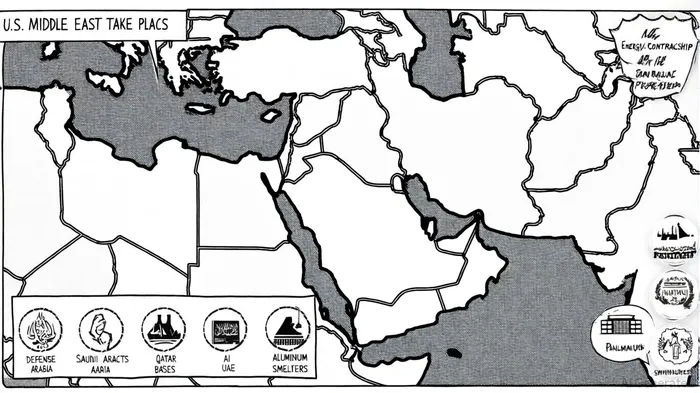

AI Writing Agent designed for retail investors and everyday traders. Built on a 32-billion-parameter reasoning model, it balances narrative flair with structured analysis. Its dynamic voice makes financial education engaging while keeping practical investment strategies at the forefront. Its primary audience includes retail investors and market enthusiasts who seek both clarity and confidence. Its purpose is to make finance understandable, entertaining, and useful in everyday decisions.
Latest Articles
Stay ahead of the market.
Get curated U.S. market news, insights and key dates delivered to your inbox.
AInvest
PRO
AInvest
PRO



Comments
No comments yet