
Trump's Middle East Visit to Impact Oil, AI, Nuclear Talks
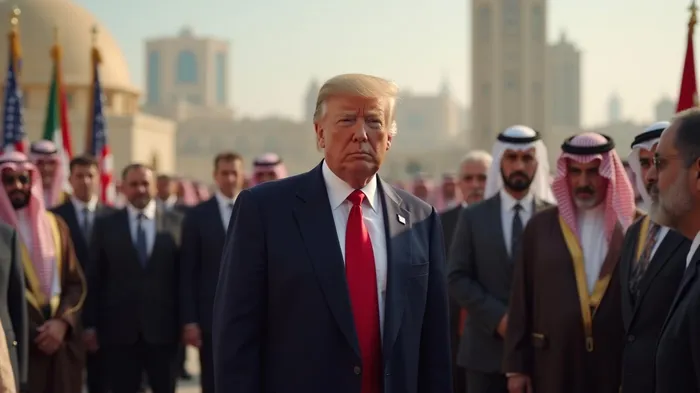
President Trump is scheduled to visit three Middle Eastern countries next week, a move that could significantly impact discussions on oil, artificial intelligence, nuclear energy, and the Israeli-Palestinian conflict. The visit, which begins on May 13, will take Trump to Saudi Arabia, Qatar, and the United Arab Emirates.
This trip comes at a time of heightened geopolitical tensions, with key issues on the agenda including the ceasefire negotiations between Israel and Palestine, oil production, trade agreements, and investment pacts. There is also potential for developments in the areas of advanced semiconductor exports and nuclear programs.
The visit is expected to yield a multitude of announcements across various sectors. One significant area of focus will be the potential lifting of 10% tariffs on aluminum and steel imports from certain Gulf countries. This move would be beneficial for these nations, as some of them export these metals to the United States, although the exports constitute a small portion of their GDP.
Trump's relationship with Gulf countries, particularly the UAE and Saudi Arabia, has been close. His children have business and real estate projects planned in these countries, which could facilitate new trade agreements but also raise concerns about potential conflicts of interest.
During his first term, Trump's first overseas visit was to Saudi Arabia, which is currently hosting negotiations on the Russia-Ukraine conflict, enhancing its importance in Washington's eyes. Qatar has also played a pivotal role in ceasefire and hostage exchange talks between Israel and Palestine.
On the same day as Trump's arrival in Saudi Arabia, the Saudi-American Investment Forum will be held in Riyadh. Confirmed attendees include Larry Fink, CEO of BlackRockTOPC--, Alex Karp of PalantirPLTR--, and high-level executives from CitigroupC--, IBMIBM--, Qualcomm, and Alphabet. David Sachs, the White House's director of artificial intelligence and cryptocurrency affairs, will also be present.
The forum is expected to see the announcement of numerous investment agreements, both inbound and outbound. The UAE has already declared investments in AI, energy, and aluminum in the United States, and American companies are anticipated to find more investment opportunities in the Gulf region.
Both Saudi Arabia and the UAE have made substantial investments in AI infrastructure, aiming to become global hubs for AI technology. A critical issue for them is whether the U.S. will relax export restrictions on advanced semiconductors, which they have not yet obtained but may soon.
The Trump administration is also in discussions with Iran regarding its nuclear program, with support from Saudi Arabia and the UAE. This contrasts with the Obama administration, when these countries opposed any U.S.-Iran agreement.
Saudi Arabia is seeking to establish its own civilian nuclear program and is looking for U.S. approval and assistance. Previously, U.S. support for Saudi Arabia's nuclear plans was contingent on the normalization of Saudi-Israeli relations, but this condition may be adjusted during this visit.
Last month, U.S. Energy Secretary Chris Wright visited Saudi Arabia and stated that the two countries are on track to reach a civilian nuclear agreement, though further announcements will be made by Trump.
Another critical issue is the future of the Gaza Strip. Trump has proposed a controversial plan to permanently resettle Palestinians in other countries and have the U.S. take control of Gaza, a proposal strongly criticized by Saudi Arabia, Qatar, and the UAE.
The U.S. is still pushing for a ceasefire agreement, recently proposing a 21-day ceasefire and the release of some hostages. However, Israel has approved expanded military operations and territorial control in Gaza this week.
Greg Branch, founder of Branch Global Capital Advisors, commented that there has been no comprehensive plan from Arab countries, and if they wish to respond, now is the time. He added that discussions will be highly secretive and cautious, more akin to a long-term geopolitical risk than an immediate macroeconomic one.
Other topics of discussion may include the potential lifting of sanctions on Syria's new government and a proposal to rename the Persian Gulf as the Arabian Gulf, which would be welcomed by most Arab countries but could provoke Iran.
Oil prices are also a major concern. Trump has repeatedly urged OPEC countries, led by Saudi Arabia, to increase production to lower oil prices for U.S. consumers. While Saudi Arabia is currently increasing production, sustained low oil prices could impact its fiscal revenue, potentially forcing a change in strategy.
Financing will be another key issue during the visit. Saudi Arabia pledged $600 billion in investments to the U.S. during Trump's term, but its own "Vision 2030" requires substantial funding. With falling global oil prices and large public investments, Saudi Arabia's fiscal deficit has been widening. At current oil prices, Saudi Arabia may seek more financial support from the U.S. to advance its investment plans.

Stay ahead of the market.
Get curated U.S. market news, insights and key dates delivered to your inbox.
AInvest
PRO
AInvest
PRO



Comments
No comments yet