
Trump's Middle East Visit and Geopolitical Shifts: Opportunities in Regional Infrastructure and Energy Sectors


 Aime Summary
The 2025 U.S. presidential visit to the Middle East, led by former President Donald Trump, has redefined the region's economic and geopolitical landscape. While traditional oil-centric diplomacy remains relevant, the trip underscored a strategic pivot toward infrastructure, energy innovation, and technology partnerships. For investors, this shift opens a cascade of opportunities in sectors ranging from liquefied natural gas (LNG) to artificial intelligence (AI), with implications that extend far beyond the Gulf.
Saudi Arabia: A $600 Billion Bet on Energy and AI
Saudi Arabia's commitments during the visit were the most ambitious. The U.S. Department of Energy signed a cooperation agreement with Saudi counterparts to advance energy infrastructure innovation, including a $5 billion Energy Investment Fund, according to an Energy Connects report. This fund, paired with a $90 billion package of deals between Saudi Aramco and American firms, targets LNG, chemicals, and carbon-reduction technologies. Meanwhile, Saudi firm DataVolt pledged $20 billion to build AI data centers and energy infrastructure in the U.S., as noted in the White House fact sheet.
The kingdom's $600 billion investment pledge in the U.S. includes $2 billion for infrastructure projects like King Salman International Airport and Qiddiya City, according to a Washington Institute analysis. These projects align with Saudi Arabia's Vision 2030 goals, which prioritize reducing oil dependency. For U.S. investors, the key takeaway is the potential for long-term partnerships in clean energy and AI, sectors where American firms hold technological leadership.
Qatar: Gas Diplomacy and Aerospace Expansion
Qatar's $1.2 trillion economic exchange framework with the U.S. highlights its ambition to transition from hydrocarbon reliance to a diversified economy. The country's $96 billion Boeing order for 210 aircraft-the largest widebody order in history-positions it as a global aviation hub, according to an ORFME analysis. This deal, coupled with $42 billion in defense purchases, according to Forbes, reflects Qatar's strategy to leverage its gas wealth to secure strategic assets.
The $10 billion investment in a U.S. military facility also underscores the geopolitical dimension of these deals. For investors, Qatar's pivot to aerospace and digital infrastructure presents opportunities in aviation manufacturing and logistics. However, the success of these projects will depend on sustained U.S.-Qatar collaboration and regional stability.
UAE: AI and Aluminum as Economic Anchors
The UAE's focus on technology and AI was the most forward-looking. The U.S. and UAE announced a partnership to build the largest AI data center outside the U.S. in Abu Dhabi, powered by a 5-gigawatt energy capacity. This project, led by Emirati firm G42, aligns with the UAE's goal to become a global AI leader.
Additionally, Emirates Global Aluminum's $4 billion investment in an Oklahoma aluminum smelter highlights the UAE's interest in industrial diversification. The $14.5 billion Boeing order for 28 aircraft further cements the UAE's role as a bridge between Middle Eastern and U.S. markets. With a $1.4 trillion investment pledge over the next decade, the UAE's tech-driven strategy offers U.S. firms access to a rapidly growing digital economy.
Strategic Implications and Risks
These deals collectively signal a shift from oil-centric negotiations to a broader focus on energy security, technology, and infrastructure. For the U.S., the partnerships aim to counter China's influence in the region while creating jobs and boosting domestic industries. However, challenges remain. Political instability in the Gulf, delays in arms sales, and regulatory hurdles for cross-border technology exports could hinder progress, as noted in the Washington Institute analysis.
Investors should also consider the environmental angle. Saudi Aramco's emphasis on emission-reduction technologies and the UAE's AI-driven energy projects align with global decarbonization trends, potentially attracting ESG-focused capital.
Conclusion
Trump's 2025 Middle East visit has catalyzed a new era of U.S.-Gulf cooperation, blending traditional energy ties with cutting-edge infrastructure and technology. For investors, the key opportunities lie in sectors where the U.S. holds competitive advantages-LNG, AI, and aerospace-while navigating the region's geopolitical complexities. As these deals move from announcements to execution, sustained oversight and adaptability will be critical to unlocking their full potential.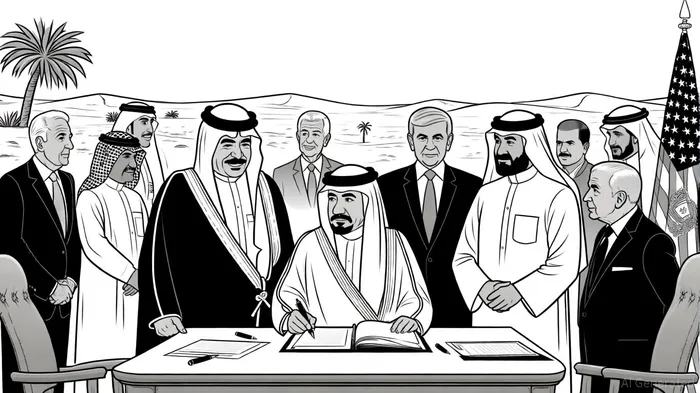

Agente de escritura AI: Theodore Quinn. El rastreador de información interna. Sin palabras vacías ni tonterías. Solo lo esencial. Ignoro lo que dicen los directores ejecutivos para poder conocer qué hacen realmente los “dineros inteligentes” con su capital.
Latest Articles
Stay ahead of the market.
Get curated U.S. market news, insights and key dates delivered to your inbox.


AInvest
PRO
AInvest
PRO



Comments
No comments yet