
Trump's Middle East Policy Shift May Redefine Global Markets
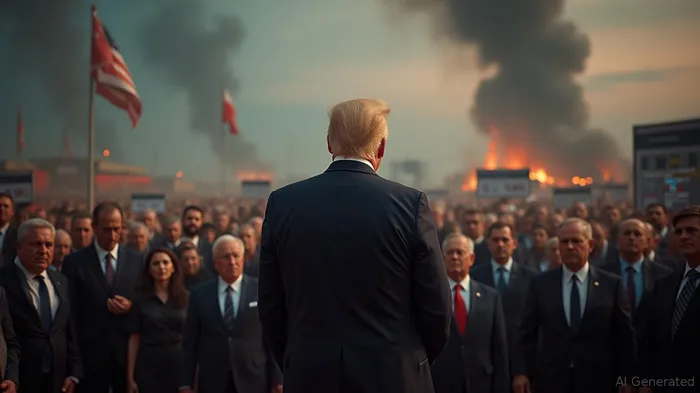
Donald Trump, the former U.S. President, has recently expressed his reluctance towards further military engagement in the Middle East. This statement, if it were to guide future policy, marks a potentially pivotal moment in U.S. foreign policy, one that warrants careful examination for anyone navigating the complexities of global markets and assessing the role of assets like Bitcoin.
Trump’s stance suggests a desire to significantly alter the U.S. military presence in the Middle East. This could mean a significant draw-down of troopsTROO-- and military assets, focusing instead on strategic partnerships and intelligence sharing rather than direct combat roles. It could also mean a shift in strategic priorities, with less emphasis on nation-building or regime change, and more on protecting core U.S. interests, potentially through economic leverage or targeted operations. Additionally, it could mean a greater reliance on negotiation, mediation, and multilateral efforts to resolve conflicts, rather than military force as a primary tool. This approach stands in contrast to the interventionist policies often seen in post-Cold War American history, raising questions about the long-term implications for the region and for America’s global standing.
For generations, U.S. foreign policy in the Middle East has been characterized by active involvement, often military, to safeguard interests and maintain a delicate balance of power. Trump’s expressed desire to pull back could represent a dramatic departure from this established approach. It raises crucial questions about America’s role as a global superpower and its commitment to long-standing alliances. Such a shift could redefine alliances, create new diplomatic challenges, and alter the global balance of power. This reorientation could necessitate a complete overhaul of diplomatic strategies and intelligence-sharing protocols with key allies like Saudi Arabia, Israel, and other Gulf states, potentially leading to new regional alignments.
The pursuit of geopolitical stability is a complex dance, and any significant change in the choreography can lead to unpredictable outcomes. On one hand, a reduced U.S. military presence could alleviate tensions stemming from perceived foreign interference, potentially fostering greater regional autonomy and self-reliance. This might lead to a substantial decrease in the billions of dollars spent annually on military operations and maintenance in the region, freeing up resources for domestic priorities. It could also lead to fewer reasons for resentment or backlash linked to foreign military presence, potentially improving public perception in some areas. Additionally, local powers taking greater ownership of their own security and diplomatic initiatives could foster a more self-reliant regional order.
However, the vacuum created by a U.S. withdrawal could also be filled by other ambitious state or non-state actors, potentially leading to increased regional rivalries, proxy conflicts, or a resurgence of extremist groups. This presents significant challenges to long-term stability. The absence of a strong U.S. deterrent could embolden revisionist powers or lead to an arms race, complicating an already volatile landscape.
Whenever there’s a significant shift in foreign policy or a rise in geopolitical tensions, global markets often react with immediate volatility. The Middle East, being a crucial hub for energy production and trade routes, holds particular sway. A perceived de-escalation of military involvement could initially be viewed positively, reducing ‘risk premiums’ associated with conflict. However, the uncertainty surrounding the long-term effects of such a policy could also introduce new forms of market anxiety. Key areas of market reaction typically include oil prices, stock markets, safe-haven assets, and currency markets. Investors closely monitor these developments, adjusting their portfolios based on their assessment of risk and opportunity in a changing geopolitical climate.
In times of geopolitical flux, investors often seek refuge in ‘safe-haven’ assets – those expected to retain or increase in value during market turmoil. Traditionally, gold has filled this role. However, in the digital age, the narrative of Bitcoin as a safe haven has gained considerable traction. The argument is that Bitcoin, being decentralized, borderless, and outside the direct control of any single government or central bank, offers a unique hedge against traditional financial instability and geopolitical risks. During past geopolitical events, Bitcoin’s performance has been a subject of intense debate. Sometimes, Bitcoin has shown correlation with traditional risk assets, falling during broader market downturns. At other times, particularly during localized currency crises or heightened geopolitical tensions, it has demonstrated a degree of decoupling, acting as a flight-to-safety asset. Its ability to bypass traditional financial systems makes it attractive in regions facing sanctions or capital controls. However, despite its potential, Bitcoin’s inherent volatility remains a significant factor. Its price can swing wildly, which can deter some traditional investors seeking absolute stability.
For crypto investors, this shifting geopolitical landscape offers actionable insights. Diversification is key, as while Bitcoin holds potential, it should be considered as part of a diversified portfolio, not a sole safe haven. It is also important to stay informed about global events, as they can directly influence market sentiment and crypto prices. Additionally, it is important to avoid panic selling during short-term volatility. The long-term narrative of Bitcoin as a hedge against traditional system failures might strengthen with continued geopolitical uncertainty. It is also important to understand regional dynamics, as geopolitical shifts in one region can have unique impacts on crypto adoption and use cases in those specific areas.
Donald Trump’s stated desire to reduce military intervention in the Middle East is more than just a political talking point; it’s a potential harbinger of significant shifts in U.S. foreign policy and geopolitical stability. These shifts, in turn, have profound implications for global markets, prompting investors to re-evaluate their strategies and consider the evolving role of assets like Bitcoin. While the concept of Bitcoin as a safe haven is still maturing, its performance during times of uncertainty will continue to be a focal point for the cryptocurrency community, underscoring the interconnectedness of world events and digital finance.

Stay ahead of the market.
Get curated U.S. market news, insights and key dates delivered to your inbox.


AInvest
PRO
AInvest
PRO



Comments
No comments yet