
Trump's Meme Coin Dinner Sparks Crypto Regulation Debate
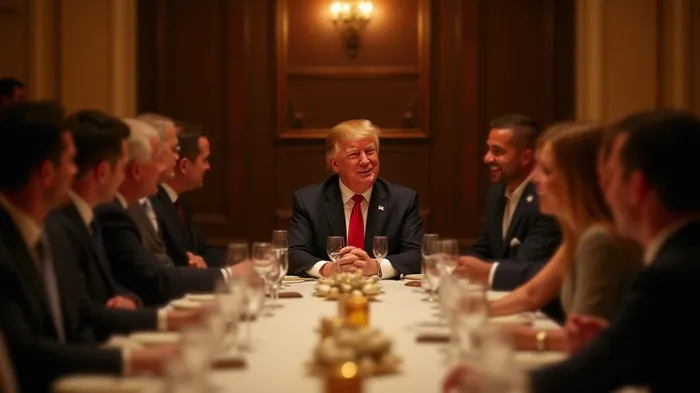
Donald Trump's high-profile dinner for holders of his meme coin has sparked a political firestorm, with advocacy groups and lawmakers expressing concerns that it may undermine public trust in crypto legislation. The event, scheduled for May 22 at the Trump National GolfGOLF-- Club, has become a focal point for debates over ethics, transparency, and access to power in the digital asset space.
While bipartisan efforts continue to advance blockchain-friendly regulation in Congress, Trump’s growing presence in the crypto sector has reignited debates over the ethical implications of his involvement. Democratic Representative Ritchie Torres of New York has co-sponsored the reintroduced Blockchain Regulatory Certainty Act, a bill originally put forward by Republican Representative Tom Emmer of Minnesota. This move signals a rare show of bipartisan unity amid growing political polarization over cryptocurrency legislation.
The Blockchain Regulatory Certainty Act seeks to clarify that blockchain developers and service providers who do not take custody of user funds are not classified as money transmitters under US law. This distinction is crucial for providing regulatory clarity for decentralized finance (DeFi) applications and non-custodial platforms. The bill has received endorsements from a broad coalition of industry advocacy organizations, which argue that the legislation is essential for fostering responsible innovation and protecting developers.
However, the bill's chances of passing remain uncertain due to the polarized political climate in Washington. The 2024 presidential campaign season is heating up, and digital assets have become a point of ideological contention. With Trump doubling down on crypto as a campaign strategy, Democrats may find it increasingly difficult to separate blockchain legislation from broader political narratives.
Democratic lawmakers have expressed skepticism about pro-crypto legislation, citing ethical concerns tied to Trump’s involvement in the digital asset space. Representative Maxine WatersWAT--, the ranking Democrat on the House Financial Services Committee, has made it clear that her support for blockchain-related legislation is contingent upon full transparency regarding Trump’s personal and familial financial interests in the industry.
Despite the broader Democratic skepticism, Representative Ritchie Torres has long been a consistent advocate for blockchain technology. His willingness to work across the aisle with Emmer on this issue has earned him credibility within the crypto industry but also places him at odds with many in his party. His involvement in this bill may represent an important litmus test for the future of bipartisan collaboration on emerging technologies.
The Trump meme coin dinner has sparked national protests and legislative backlash, with critics accusing Trump of "selling access to the presidency" through the monetization of his TRUMP meme coin. The event has become a flashpoint for broader debates over corruption, crypto regulation, and foreign influence in US politics. Critics argue that the event amounts to a blatant pay-for-access scheme, violating both the spiritFLYY-- and potentially the letter of US laws regarding gifts, foreign influence, and campaign finance.
In response to the event, Democratic lawmakers have withdrawn support from key crypto bills, including the GENIUS Act—a landmarkLARK-- piece of legislation to regulate stablecoins. Senator Mark Warner criticized the Trump family’s reported ties to World Liberty Financial, a blockchain firm that began issuing its own stablecoin in March and is believed to be connected to the TRUMP meme coin’s infrastructure. Senator Chris Murphy called for explicit legal prohibitions against any US president issuing stablecoins or launching blockchain tokens, claiming the Trump dinner was “setting a dangerous precedent.”
Public Citizen, a leading consumer advocacy group, has partnered with Our Revolution, a political advocacy organization, to stage a large rally near the Trump National Golf Club. The protest is expected to include appearances from Senator Jeff Merkley and leaders from Loudoun and Arlington County Democratic Committees. Other events will include press conferences with Senator Elizabeth Warren, Representative Maxine Waters, and advocacy groups calling for the passage of a new bill designed to block Trump’s meme coin and prevent similar schemes in the future.
Despite the backlash, several high-profile figures in the global crypto industry are expected to attend the dinner. These include Justin Sun, founder of Tron, Vincent Liu, CIO of Kronos Research, Oh Sangrok, co-CEO of Korean crypto investment firm Hyperithm, and Kain Warwick, founder of Synthetix, a leading decentralized finance platform. While organizers claim all participants must pass a background check and cannot be from “Know Your Customer [KYC] watchlist countries,” critics say that’s insufficient to prevent influence peddling, especially considering the international profile of several guests.
The Trump meme coin itself has been widely criticized as a potential vehicle for personal enrichment. The token launched amid the 's re-election campaign and quickly surged in value, driven in part by promises of exclusive access and political engagement. It is not clear whether any of the proceeds from token sales are funding campaign activities, personal income, or other undisclosed ventures—questions that may soon be addressed in Congressional hearings. The project’s website and marketing materials make several claims about Trump’s endorsement without clarifying whether he benefits financially. Meanwhile, Trump has neither denied nor confirmed his direct involvement in the token’s finances, though his family’s stake in World Liberty Financial has raised red flags among compliance and anti-corruption experts.

Stay ahead of the market.
Get curated U.S. market news, insights and key dates delivered to your inbox.


AInvest
PRO
AInvest
PRO



Comments
No comments yet