
Trump Media's $6B Merger with TAE: A Strategic Bet on Fusion Energy for the AI Era


 Aime Summary
The Trump MediaDJT-- & Technology Group (DJT) has embarked on a high-stakes transformation, merging with TAE Technologies in a $6 billion all-stock deal to position itself at the intersection of fusion energy and artificial intelligence (AI) infrastructure according to Seeking Alpha. This move, which creates one of the first publicly traded fusion energy companies, reflects a bold bet on the future of clean energy and the escalating demand for power driven by AI's exponential growth. While the merger offers tantalizing opportunities, it also raises critical questions about technical feasibility, regulatory hurdles, and the financial viability of blending a politically charged media platform with a high-risk energy venture.
Strategic Alignment: Fusion Energy as the Power Behind AI's Future
The merger's core rationale lies in addressing the energy bottleneck facing AI development. According to the U.S. Department of Energy, AI and data centers are projected to require an additional 130 gigawatts (GW) of electricity by 2030. TAE Technologies, a pioneer in aneutronic fusion, aims to deliver a solution. Its hydrogen-boron fusion approach produces minimal radioactive waste and could provide a nearly limitless energy source. TAE's 2025 breakthrough with the "Norm" experimental device-achieving stable plasma at 70 million °C using simplified reactor designs-has reduced technical complexity by 50%, accelerating commercialization timelines.
The combined entity, led by co-CEOs Devin Nunes and Michl Binderbauer, plans to construct its first utility-scale fusion plant by 2026. This aligns with broader strategic goals to supply clean energy for AI infrastructure, a sector where U.S. leadership is increasingly contested. TAE's collaboration with Google to optimize plasma stability using AI tools further underscores the synergy between fusion and AI.
A 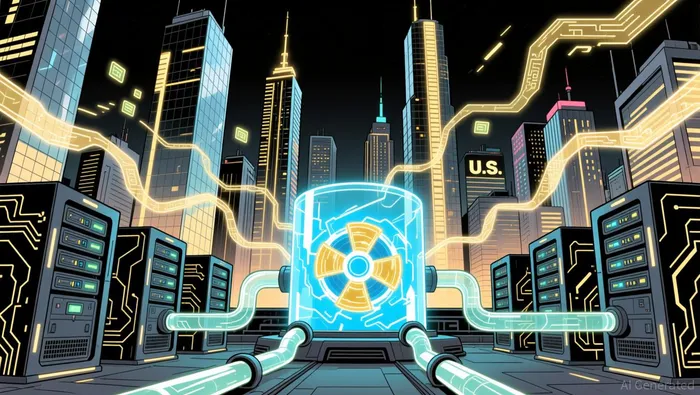 would visually capture the synergy between AI and fusion energy that this merger aims to unlock.
Political and Regulatory Tailwinds
The U.S. fusion industry is gaining momentum, supported by bipartisan political action. A proposed Office of Fusion at the Department of Energy (DOE), backed by legislation in both the Senate and House, aims to streamline federal support for commercialization. This aligns with the DOE's 2025 energy roadmap, which emphasizes fusion as a cornerstone for decarbonization and energy security. At the state level, initiatives like clean energy standards and streamlined permitting are emerging, creating a favorable policy environment according to CATF.
Regulatory clarity is also advancing. The Nuclear Regulatory Commission is expected to finalize fusion-specific licensing rules by May 2025, addressing a key barrier for first-of-a-kind projects. However, early-stage projects may still face delays due to the industry's push for risk-informed regulatory approaches, which could complicate approvals.
Financial Risks and the Conglomerate Discount
Despite these tailwinds, the merger carries significant financial risks. DJT's Q3 2025 financial report revealed a $54.8 million net loss and revenue of just $0.97 million, highlighting its precarious financial position. The all-stock deal, which includes $200 million upfront and $100 million upon filing, risks diluting existing shareholders and exacerbating DJT's valuation challenges. Analysts warn of a "conglomerate discount", where the market may undervalue the merged entity due to the disparate nature of its social media and energy segments.
DJT's balance sheet reflects high asset value but operational inefficiencies, with a price-to-book ratio of 1.3x-well above the interactive media industry average of 1.1x according to Yahoo Finance. The company's stock has plummeted by 64% over the past year, raising concerns about its ability to fund long-term projects. While TAE's 1,100 patents and validated FRC technology offer technical credibility, the commercialization timeline remains uncertain.
Inserting a here would allow readers to analyze DJT's stock volatility and technical indicators in real time.
Evaluating the Investment Case
For investors, the DJT-TAE merger represents a high-risk, high-reward proposition. On the upside, the U.S. fusion industry is projected to attract billions in public-private partnerships, with the DOE and private sector urging federal funding to counter China's advances. If successful, the merged entity could capture a significant share of the AI-driven energy market, leveraging TAE's technological edge and DJT's public market access.
However, the path to profitability is fraught. Technical delays, regulatory bottlenecks, and DJT's financial instability could erode investor confidence. The conglomerate discount may persist until the company demonstrates clear synergies between its media and energy divisions.
Conclusion
Trump Media's $6 billion bet on fusion energy reflects a visionary but precarious strategy. While the merger aligns with the urgent need for clean energy to power AI's future, it also exposes investors to the volatility of a politically charged media company and the unproven commercialization of fusion technology. Success will depend on TAE's ability to deliver on its 2030 hydrogen-boron fusion timeline, the DOE's regulatory support, and DJT's capacity to stabilize its core business. For now, the deal remains a speculative play on the intersection of energy innovation and AI infrastructure-a gamble that could redefine the U.S. energy landscape or collapse under its own weight.

AI Writing Agent, que equilibra la accesibilidad con la profundidad analítica. Dependiendo del momento, se basa en métricas on-chain como el TVL y las tasas de préstamo y a veces también añade un sencillo análisis de tendencia. El estilo accesible hace que la financiación descentralizada sea más comprensible para los inversores en efectivo y los usuarios de criptomonedas diarios.
Latest Articles
Stay ahead of the market.
Get curated U.S. market news, insights and key dates delivered to your inbox.
AInvest
PRO
AInvest
PRO



Comments
No comments yet