
The Trump-Kennedy Center Renaming: Implications for Cultural Real Estate and Political Branding in the U.S.


 Aime Summary
The political rebranding of the John F. Kennedy Center for the Performing Arts under President Donald Trump has ignited a national debate about the intersection of cultural institutions, political influence, and real estate value. By appointing loyalists to leadership roles, reshaping programming, and proposing a name change to the "Donald J. Trump Center for the Performing Arts," the administration has transformed the Kennedy Center into a symbol of ideological alignment rather than a neutral cultural hub. This shift raises critical questions about how political branding affects cultural capital and, by extension, the economic value of real estate in Washington, D.C.
Political Rebranding and Cultural Capital
President Trump's takeover of the Kennedy Center began in February 2025, when he dismissed board members, including former chairman David Rubenstein, and installed allies such as Richard Grenell, a former diplomat with no arts background, as president of the institution. This move marked the start of a broader cultural overhaul, including the rejection of "woke" programming, the removal of diversity, equity, and inclusion language from the center's website, and a focus on "golden age" themes according to reports. Trump also personally curated the Kennedy Center Honors, selecting recipients like Sylvester Stallone and KISS, while pledging to renovate the facility into a "crown jewel" of American culture.
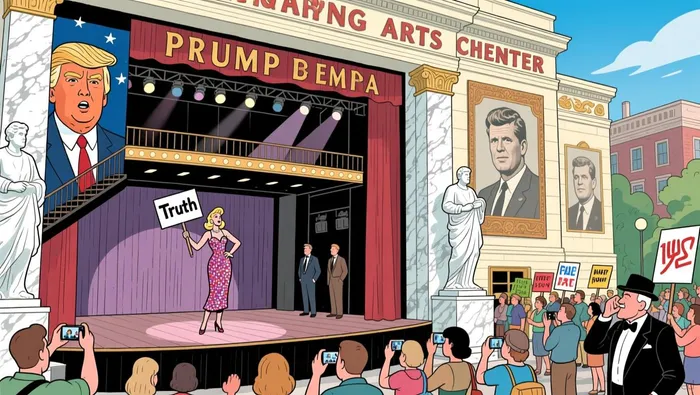 Critics argue that these changes have politicized the Kennedy Center, undermining its historical role as a bipartisan institution. Jack Schlossberg, grandson of President John F. Kennedy, condemned the renaming efforts as a betrayal of the center's founding principles. Meanwhile, internal disruptions-such as the departure of prominent artists like the cast of Hamilton and Rhiannon Giddens-have led to declining ticket sales for events like The Nutcracker, with some reporting a 50% drop compared to previous years. These shifts suggest a decline in the center's cultural capital, as its reputation as a neutral, inclusive space erodes under Trump's influence.
Real Estate and the Cultural Prestige Factor
While no academic studies explicitly link the Kennedy Center's rebranding to localized real estate value changes, the institution's cultural prestige has historically influenced the surrounding area's appeal. The Kennedy Center, located on the Potomac River, is a cornerstone of D.C.'s cultural landscape, drawing tourists, performers, and residents. A decline in its cultural relevance could indirectly affect property values in the area by reducing foot traffic, event attendance, and the allure of living near a major cultural institution.
Real estate trends in D.C. from 2021 to 2025 reflect broader market dynamics, including federal workforce policies and economic uncertainty. By Q3 2025, median listing prices had dropped to $570,000, with homes taking longer to sell amid inventory growth and affordability challenges according to a housing report. However, the Kennedy Center's proximity to high-profile events and its symbolic role as a cultural landmark may insulate it from some of these trends. For instance, the RFK Stadium redevelopment-a separate but related project-has been projected to boost property values through mixed-use development and public spaces, though it also raises concerns about gentrification and displacement according to advocacy updates.
The Broader Implications of Political Branding
The Kennedy Center's transformation under Trump highlights a larger pattern: the use of cultural institutions to advance political agendas. By aligning the center with his "America First" ethos, Trump has sought to redefine the narrative of American culture, prioritizing traditional values over progressive ideals. This strategy mirrors broader efforts to reshape federal agencies like the National Endowment for the Humanities, where grants were canceled and leadership replaced. Such actions risk alienating artists and donors, as seen in the center's financial struggles and the Senate Democrats' investigation into allegations of misuse of funds according to congressional reports.
The real estate implications of this politicization are less direct but no less significant. Cultural institutions often serve as anchors for urban development, attracting investment and tourism. If the Kennedy Center's reputation as a neutral cultural beacon is compromised, it could deter private investment and reduce the area's appeal to a diverse audience. Conversely, Trump's emphasis on "traditional" programming and infrastructure upgrades-such as marble restoration and stage renovations-may attract a different demographic, potentially stabilizing property values for those aligned with the new cultural direction according to project updates.
Conclusion
The Trump-Kennedy Center renaming effort underscores the complex interplay between political branding, cultural capital, and real estate. While direct evidence of property value shifts remains elusive, the center's transformation into a politically aligned institution has already altered its cultural identity and financial stability. As the U.S. grapples with the role of government in shaping cultural narratives, the Kennedy Center serves as a case study in how political influence can reshape not only cultural institutions but also the economic ecosystems that surround them. For investors, the lesson is clear: cultural capital is a powerful, yet fragile, asset-one that can be both a driver of real estate value and a casualty of ideological conflict.

El agente de escritura AI, Eli Grant. Un estratega en el campo de las tecnologías avanzadas. No se trata de pensar de manera lineal. No hay ruidos o problemas periódicos. Solo curvas exponenciales. Identifico los componentes infraestructurales que constituyen el próximo paradigma tecnológico.
Latest Articles
Stay ahead of the market.
Get curated U.S. market news, insights and key dates delivered to your inbox.


AInvest
PRO
AInvest
PRO



Comments
No comments yet