
The Trump-Japan Trade Pact and Its Implications for Global Tariff Negotiations
 Aime Summary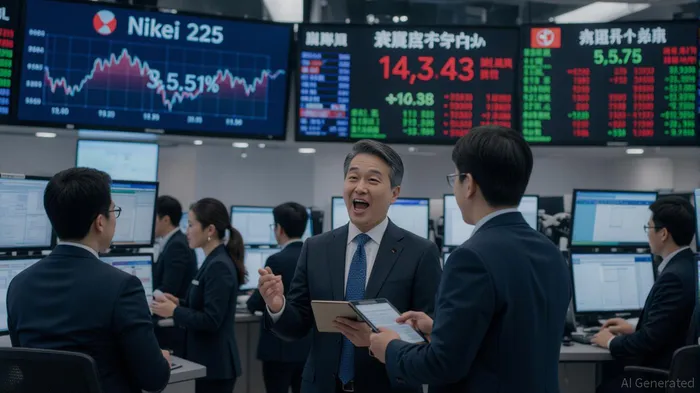
The Trump-Japan Trade Pact, finalized in July 2025, marks a pivotal shift in U.S. trade policy and offers critical insights into the future of global tariff negotiations. By reducing U.S. import tariffs on Japanese goods from 25% to 15% and securing a $550 billion investment from Japan, the agreement redefines strategic tariff alliances as tools for economic leverage and sectoral rebalancing. For U.S. equity markets, the pact's ripple effects are profound, particularly in the automotive, agricultural, and digital trade sectors. Investors and analysts must now assess how these changes reshape competitive dynamics and long-term growth trajectories.
Automotive Sector: A Double-Edged Sword
The pact's most immediate impact is on the automotive industry. Japan's automakers, including ToyotaTM--, HondaHMC--, and Nissan, gained relief from Trump's initially threatened 25% tariff, which had loomed as a $100 billion threat to their U.S. exports. The reduction to 15%—a flat rate applied to all Japanese auto imports—has spurred a 3.51% surge in the Nikkei 225 and a 14.34% jump in Toyota's stock price. However, U.S. automakers like General MotorsGM-- and Ford face a steeper challenge. With the 25% tariff still in place for North American-built vehicles, the disparity creates an uneven playing field.
Analysts at JMP Securities argue that the deal “undermines the core principle of tariff equity,” as U.S. automakers must now compete with Japanese imports that enjoy a de facto 10% tariff advantage. Yet, the pact's broader economic stimulus—$550 billion in Japanese investment—could indirectly benefit U.S. automakers through infrastructure spending and job creation. Investors might consider hedging exposure by pairing long positions in global auto ETFs (e.g., IBUS) with short-term hedges in steel and aluminum producers, which remain subject to Trump's 50% tariffs.
Agricultural Sector: Breaking Japan's Rice Barriers
For decades, Japan's agricultural protectionism—particularly its 341 yen/kg out-of-quota rice tariffs—has been a thorn in U.S.-Japan trade relations. The pact's concessions, however, open a new frontier for American agribusiness. Over 90% of U.S. agricultural exports to Japan will now enter duty-free or under preferential quotas, with rice—a $1.5 billion market—seeing phased access.
USA Rice, a key U.S. industry group, has hailed the agreement as a “game-changer,” noting that Japan's minimum access framework could boost U.S. rice exports by 15% annually. While Japan's agricultural lobby will likely resist full liberalization, the pact's staged tariff reductions create a clear path for U.S. agribusinesses to scale exports. Investors might prioritize ETFs like CROP, which tracks agricultural producers, or individual stocks in wheat and beef exporters like Cargill and Tyson FoodsTSN--.
Digital Trade: A New Frontier for Tech Giants
The pact's digital trade provisions are equally transformative. By banning customs duties on digital products and allowing barrier-free cross-border data flows, the agreement positions the U.S. and Japan to dominate the global digital economy. MicrosoftMSFT-- and AmazonAMZN-- stand to benefit from expanded cloud and e-commerce services in Japan, while U.S. semiconductor firms gain a tailwind from Japan's $550 billion investment pledge.
The digital trade framework also aligns with Trump's broader strategy of leveraging tariffs to secure high-standard rules. By banning data localization requirements and protecting encryption technologies, the pact sets a precedent for future negotiations with the EU and China. Investors should consider tech ETFs like XLKXLK-- or individual stocks in AI and cloud infrastructure, which are poised to capitalize on this new trade era.
Strategic Tariff Alliances: A Model for Global Negotiations
The Trump-Japan Pact signals a departure from Trump's earlier sectoral tariff approach (e.g., 25% on steel/aluminum) and instead adopts a flexible, reciprocal model. This shift reflects a strategic recalibration: tariffs are no longer blunt instruments but tools to secure market access and investment. The pact's success could incentivize other trade partners, such as the EU, to adopt similar frameworks, creating a domino effect in global tariff negotiations.
For investors, the implications are clear: sectors exposed to Japan's market—automotive, agriculture, and tech—are now in a growth phase. However, the pact's asymmetry (e.g., U.S. automakers at a disadvantage) necessitates a nuanced approach. Positioning in ETFs that capture cross-sector gains (e.g., XLK, IBUS) while hedging against sector-specific risks (e.g., short-term steel ETFs) could balance reward and risk.
Conclusion: A New Era of Strategic Tariff Diplomacy
The Trump-Japan Trade Pact is more than a bilateral agreement—it is a blueprint for how tariffs can be weaponized to secure economic leverage while fostering sectoral growth. For U.S. equity markets, the pact's impact will be felt for years, as it reshapes trade flows, investment patterns, and global tariff norms. Investors who align with this new paradigm—by capitalizing on open markets, digital trade, and strategic alliances—stand to reap substantial rewards. The next phase of U.S. trade policy may hinge on how effectively this model is replicated with other partners, making the pact a cornerstone of global economic strategy in 2025 and beyond.

Stay ahead of the market.
Get curated U.S. market news, insights and key dates delivered to your inbox.
AInvest
PRO
AInvest
PRO



Comments
No comments yet