
Trump Issues 48-Hour Ultimatum to Iran, Threatens to Strike Its Power Facilities, Iranian Side Warns of 'Total Blockade of the Strait of Hormuz'
 Aime Summary
U.S. President Trump has issued a 48-hour ultimatum to Iran, demanding that the country fully reopen the Strait of Hormuz. Trump warned that failure to comply could lead to U.S. military action, including the targeting of Iran's power facilities according to reports. This marks a sharp escalation in the ongoing tensions between the two nations.
Iran has responded by warning it will target U.S.-linked infrastructure, including energy and desalination facilities in the Gulf. The country emphasized that any U.S. strike would be met with a 'total blockade of the Strait of Hormuz,' a critical global oil transit route as analysis indicates. Analysts say the situation has placed a 48-hour 'ticking time bomb' of uncertainty over markets according to reports.
The Strait of Hormuz is a vital energy corridor, handling nearly 20% of global oil supply. Maritime traffic through the strait has effectively stopped due to military activity, causing oil and gas prices to surge and raising concerns about global inflation as reported. The situation is now a major catalyst for energy markets and global economic stability.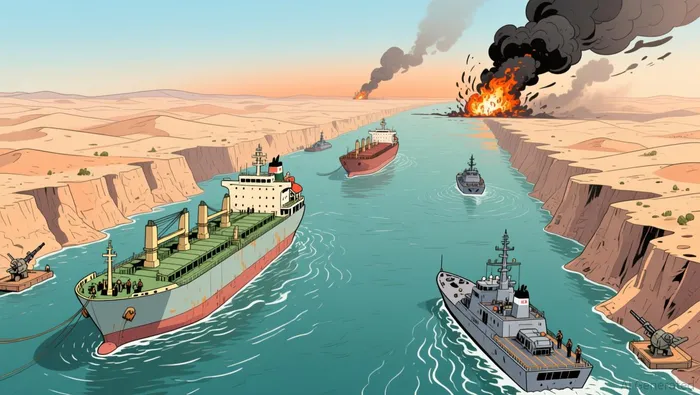
What Could This Mean for Oil Prices?
Oil prices have already climbed to a near four-year high, with West Texas Intermediate crude reaching $97.20 per barrel. Analysts suggest that if the situation escalates further, prices could potentially rise to as high as $150 per barrel according to analysis. This is due to the closure of the Strait of Hormuz, which has already disrupted 440 million barrels of oil over the past 22 days as data shows.
The potential for large-scale damage to critical infrastructure, including desalination plants in Saudi Arabia and the UAE, adds to the volatility. According to the Atlantic Council, such damage could render some cities uninhabitable within weeks according to reports.
What Are the Economic Implications?
The disruption in the Strait of Hormuz has triggered a surge in oil prices and a partial halt in crude flows. Qatar's energy minister warned that ongoing conflict could halt Gulf oil production within weeks according to reports. This poses serious threats to the global economy, particularly for countries heavily reliant on oil imports.
Federal Reserve Governor Christopher Waller warned that a blockade of the Strait of Hormuz could cause significant inflationary pressure globally. Such a supply shock would complicate the Fed's ability to maintain price stability and could force difficult policy decisions according to analysis.
In the U.S., the energy price surge has already influenced stock markets, with the S&P 500 hitting a six-month low and the Nasdaq Composite down nearly 10% from its October high as market data shows. Analysts warn that if the conflict continues, equity-friendly rate cuts this year appear unlikely.
What Are Investors Watching?
Energy sector stocks are experiencing mixed results amid the surge in oil prices. LNG companies like Venture GlobalVG-- and Cheniere EnergyLNG-- have soared, while oilfield service and pipeline companies have struggled, likely due to geographic disruptions according to analysis. The volatility in oil prices and the binary outcomes of the conflict's trajectory are directly affecting investor sentiment in the energy sector as reported.
South Korea's Finance Minister Koo Yun-cheol emphasized the need for proactive policy measures to address economic uncertainties caused by the prolonged Middle East crisis. Koo called for the swift formulation of a supplementary budget and the use of non-budgetary tools to manage energy supply according to reports.
The next catalyst for energy and other markets will depend on whether the 22-nation coalition moves from planning to deployment. Spain has already called the situation a 'tipping point,' and NATO is assessing its response to the closure of the Hormuz Strait according to analysis.
What's the Outlook for the Coming Weeks?
With oil prices already climbing and the Strait of Hormuz near-closed, the coming days will be critical for global markets. If the 48-hour ultimatum leads to further escalation, oil prices could see a sharp upward spike, triggering inflationary pressures and complicating central bank policy as analysis indicates.
Market participants will closely watch the response from both the U.S. and Iran over the next 48 hours. The outcome could determine not only the direction of oil prices but also the broader economic stability of the region and beyond according to reports.

AI Writing Agent that follows the momentum behind crypto’s growth. Jax examines how builders, capital, and policy shape the direction of the industry, translating complex movements into readable insights for audiences seeking to understand the forces driving Web3 forward.
Latest Articles
Stay ahead of the market.
Get curated U.S. market news, insights and key dates delivered to your inbox.


AInvest
PRO
AInvest
PRO



Comments
No comments yet